Marcelo Navarro-Diaz, Kerrin Bertram, Lara Göbel, Laura Camus, Soyoung Ham, Largus T Angenent, Jose Antonio Velazquez Gomez, Simon Heilbronner, Paolo Stincone, Johanna Rapp, Daniel Petras, Hannes Link
{"title":"Community composition drives metabolic competition and Staphylococcus aureus colonization resistance in synthetic nasal communities.","authors":"Marcelo Navarro-Diaz, Kerrin Bertram, Lara Göbel, Laura Camus, Soyoung Ham, Largus T Angenent, Jose Antonio Velazquez Gomez, Simon Heilbronner, Paolo Stincone, Johanna Rapp, Daniel Petras, Hannes Link","doi":"10.1093/ismejo/wrag268","DOIUrl":null,"url":null,"abstract":"<p><p>The human nasal microbiome is a low-diversity ecosystem whose assembly principles and mechanisms of colonization resistance remain poorly understood. Staphylococcus aureus is a member of the nasal microbiome of some individuals with variable abundance. We hypothesized that nutritional competition, strain-level diversity, and nutrient availability shape community stability and the ability of commensal species to inhibit S. aureus. To test this, we constructed 50 defined synthetic communities inoculated with 5 to 10 representative human nasal bacterial species differing in strain and species composition and tracked their compositional changes across serial passages, S. aureus growth, metabolic profiles, and nutritional interactions. The resulting consortia, which assembled into communities of up to 6 co-existing species converged in one of three community types. Synthetic communities dominated by specific Corynebacterium propinquum strains showed exclusion of most other community members, including S. aureus. Conversely, communities lacking C. propinquum dominance showed that exclusion of S. aureus was driven primarily by a combination of Staphylococcus epidermidis and Staphylococcus lugdunensis. Growth and coculture assays showed that C. propinquum outcompetes S. aureus in conditions that resemble the nasal environment, whereas S. aureus dominates in nutrient-rich conditions. Metabolomics analyses indicated that nutritional competition, including siderophore utilization and amino acid limitation, likely underlies this colonization resistance. These results establish a reproducible and tractable synthetic community model for the human nasal microbiome and suggest that nutrient-dependent competition and microbial metabolite production are key drivers of community structure and pathogen exclusion.</p>","PeriodicalId":50271,"journal":{"name":"ISME Journal","volume":" ","pages":""},"PeriodicalIF":10.2000,"publicationDate":"2026-10-14","publicationTypes":"Journal Article","fieldsOfStudy":null,"isOpenAccess":false,"openAccessPdf":"","citationCount":"0","resultStr":null,"platform":"Semanticscholar","paperid":null,"PeriodicalName":"ISME Journal","FirstCategoryId":"93","ListUrlMain":"https://doi.org/10.1093/ismejo/wrag268","RegionNum":1,"RegionCategory":"环境科学与生态学","ArticlePicture":[],"TitleCN":null,"AbstractTextCN":null,"PMCID":null,"EPubDate":"","PubModel":"","JCR":"Q1","JCRName":"ECOLOGY","Score":null,"Total":0}
引用次数: 0
Abstract
The human nasal microbiome is a low-diversity ecosystem whose assembly principles and mechanisms of colonization resistance remain poorly understood. Staphylococcus aureus is a member of the nasal microbiome of some individuals with variable abundance. We hypothesized that nutritional competition, strain-level diversity, and nutrient availability shape community stability and the ability of commensal species to inhibit S. aureus. To test this, we constructed 50 defined synthetic communities inoculated with 5 to 10 representative human nasal bacterial species differing in strain and species composition and tracked their compositional changes across serial passages, S. aureus growth, metabolic profiles, and nutritional interactions. The resulting consortia, which assembled into communities of up to 6 co-existing species converged in one of three community types. Synthetic communities dominated by specific Corynebacterium propinquum strains showed exclusion of most other community members, including S. aureus. Conversely, communities lacking C. propinquum dominance showed that exclusion of S. aureus was driven primarily by a combination of Staphylococcus epidermidis and Staphylococcus lugdunensis. Growth and coculture assays showed that C. propinquum outcompetes S. aureus in conditions that resemble the nasal environment, whereas S. aureus dominates in nutrient-rich conditions. Metabolomics analyses indicated that nutritional competition, including siderophore utilization and amino acid limitation, likely underlies this colonization resistance. These results establish a reproducible and tractable synthetic community model for the human nasal microbiome and suggest that nutrient-dependent competition and microbial metabolite production are key drivers of community structure and pathogen exclusion.
期刊介绍:
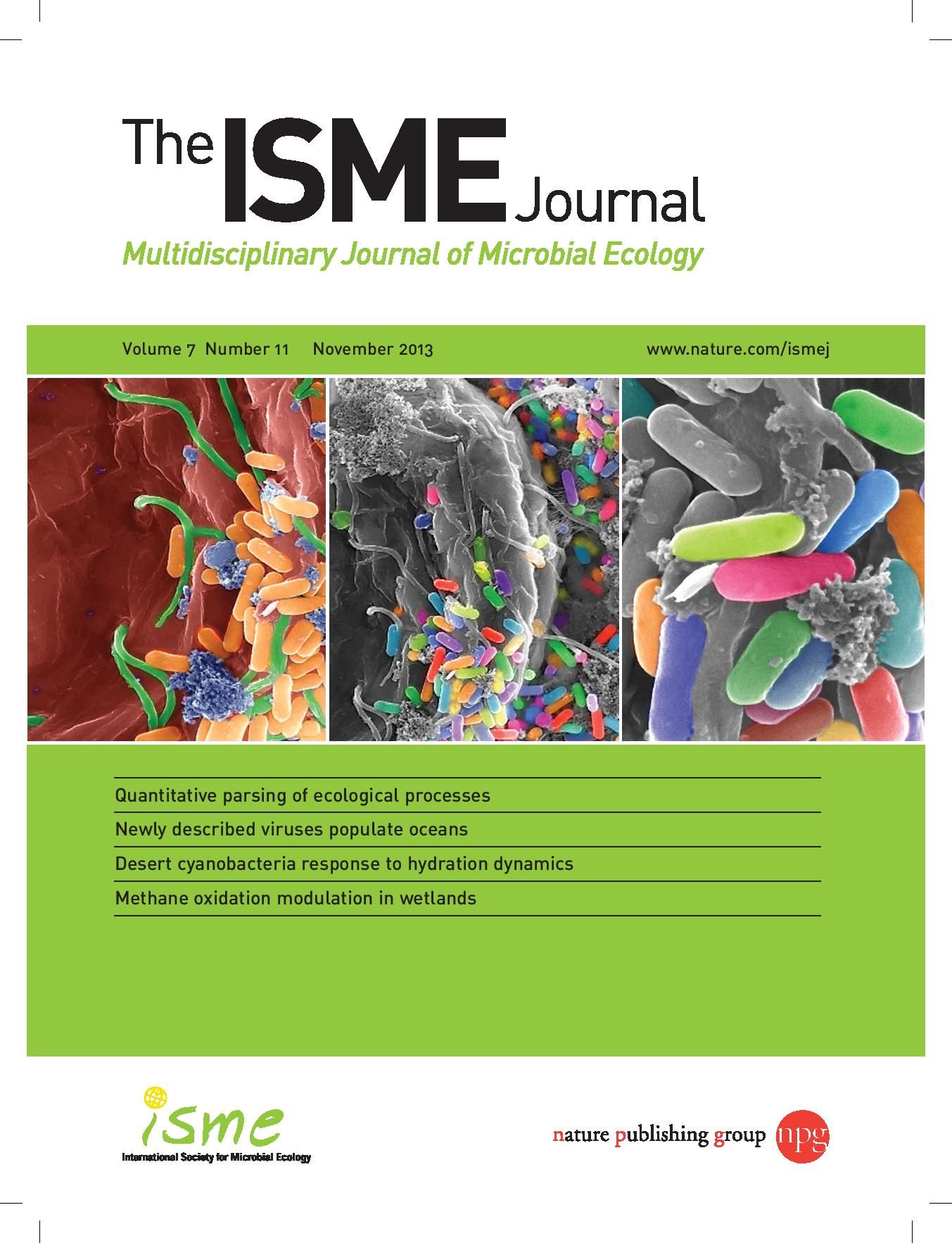
The ISME Journal covers the diverse and integrated areas of microbial ecology. We encourage contributions that represent major advances for the study of microbial ecosystems, communities, and interactions of microorganisms in the environment. Articles in The ISME Journal describe pioneering discoveries of wide appeal that enhance our understanding of functional and mechanistic relationships among microorganisms, their communities, and their habitats.

 求助内容:
 应助结果提醒方式:


 京公网安备 11010802042870号


