Allison N Martin, Alexandra C Istl, Tania K Arora, Courtney Collins, Justin Dimick, Lisa M McElroy, Olamide Alabi, Tracy S Wang, Oluwadamilola M Fayanju
{"title":"Anti-DEI Policies and Academic Surgery: Preserving the Mission in an Era of Legal Constraint.","authors":"Allison N Martin, Alexandra C Istl, Tania K Arora, Courtney Collins, Justin Dimick, Lisa M McElroy, Olamide Alabi, Tracy S Wang, Oluwadamilola M Fayanju","doi":"10.1097/SLA.0000000000007237","DOIUrl":null,"url":null,"abstract":"<p><strong>Importance: </strong>The January 2025 federal executive orders (EOs) restricting diversity, equity, and inclusion (DEI) programming in government-funded and private institutions represent a structural inflection point for academic surgery. The effects extend beyond institutional compliance and directly threaten workforce sustainability, research enterprises, and editorial freedom.</p><p><strong>Objective: </strong>To evaluate the immediate and projected effects of January 2025 federal EOs on research, editorial freedom, and workforce recruitment and retention in academic surgery, and to propose adaptive strategies for mission preservation.</p><p><strong>Design: </strong>A narrative synthesis of the literature and multi-institutional experience presented during a 2026 Academic Surgical Congress Committee panel session evaluated across multiple domains: workforce, scientific research/education, patient care, and editorial ecosystems.</p><p><strong>Results: </strong>Anti-DEI EOs produced measurable disruptions across the domains examined. Regarding the workforce, survey data indicate that 50% of faculty in affected states are seeking positions elsewhere, and underrepresented-in-medicine trainees are redistributing away from institutions with policy climates perceived as hostile. In research, federal grant withdrawals and self-censorship constrain equity-focused scientific inquiry and threaten surgeon-scientist career trajectories. In publishing, editorial leaders report early signals of declining submissions addressing disparities, reflecting investigators' concerns for possible retaliation rather than actual changes in editorial policy. Across domains, a false binary of \"doubling down\" versus \"pivot\" obscures a potentially more viable path: adaptive reframing that modifies language and programmatic infrastructure, while sustaining core missions.</p><p><strong>Conclusions: </strong>Academic surgery should preserve its mission to train a diverse surgical workforce, advance rigorous science, and deliver equitable patient care. Adaptive reframing, by embedding equity-oriented work within quality improvement, workforce sustainability, and patient safety frameworks, offers a principled strategy for navigating evolving legal constraints, without abandoning institutional missions or scientific integrity.</p>","PeriodicalId":8017,"journal":{"name":"Annals of surgery","volume":" ","pages":""},"PeriodicalIF":7.4000,"publicationDate":"2026-10-15","publicationTypes":"Journal Article","fieldsOfStudy":null,"isOpenAccess":false,"openAccessPdf":"","citationCount":"0","resultStr":null,"platform":"Semanticscholar","paperid":null,"PeriodicalName":"Annals of surgery","FirstCategoryId":"3","ListUrlMain":"https://doi.org/10.1097/SLA.0000000000007237","RegionNum":1,"RegionCategory":"医学","ArticlePicture":[],"TitleCN":null,"AbstractTextCN":null,"PMCID":null,"EPubDate":"","PubModel":"","JCR":"Q1","JCRName":"SURGERY","Score":null,"Total":0}
引用次数: 0
Abstract
Importance: The January 2025 federal executive orders (EOs) restricting diversity, equity, and inclusion (DEI) programming in government-funded and private institutions represent a structural inflection point for academic surgery. The effects extend beyond institutional compliance and directly threaten workforce sustainability, research enterprises, and editorial freedom.
Objective: To evaluate the immediate and projected effects of January 2025 federal EOs on research, editorial freedom, and workforce recruitment and retention in academic surgery, and to propose adaptive strategies for mission preservation.
Design: A narrative synthesis of the literature and multi-institutional experience presented during a 2026 Academic Surgical Congress Committee panel session evaluated across multiple domains: workforce, scientific research/education, patient care, and editorial ecosystems.
Results: Anti-DEI EOs produced measurable disruptions across the domains examined. Regarding the workforce, survey data indicate that 50% of faculty in affected states are seeking positions elsewhere, and underrepresented-in-medicine trainees are redistributing away from institutions with policy climates perceived as hostile. In research, federal grant withdrawals and self-censorship constrain equity-focused scientific inquiry and threaten surgeon-scientist career trajectories. In publishing, editorial leaders report early signals of declining submissions addressing disparities, reflecting investigators' concerns for possible retaliation rather than actual changes in editorial policy. Across domains, a false binary of "doubling down" versus "pivot" obscures a potentially more viable path: adaptive reframing that modifies language and programmatic infrastructure, while sustaining core missions.
Conclusions: Academic surgery should preserve its mission to train a diverse surgical workforce, advance rigorous science, and deliver equitable patient care. Adaptive reframing, by embedding equity-oriented work within quality improvement, workforce sustainability, and patient safety frameworks, offers a principled strategy for navigating evolving legal constraints, without abandoning institutional missions or scientific integrity.
期刊介绍:
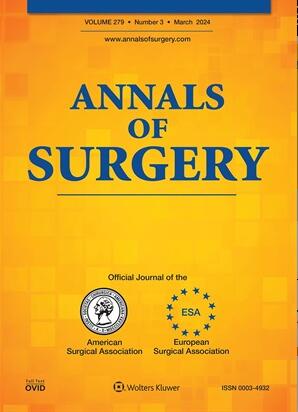
The Annals of Surgery is a renowned surgery journal, recognized globally for its extensive scholarly references. It serves as a valuable resource for the international medical community by disseminating knowledge regarding important developments in surgical science and practice. Surgeons regularly turn to the Annals of Surgery to stay updated on innovative practices and techniques. The journal also offers special editorial features such as "Advances in Surgical Technique," offering timely coverage of ongoing clinical issues. Additionally, the journal publishes monthly review articles that address the latest concerns in surgical practice.

 求助内容:
 应助结果提醒方式:


 京公网安备 11010802042870号


