LIF and let die: Generation, mechanistical and structural characterization of bispecific antibodies triggering leukemia inhibitory factor (LIF) receptor activation independent of the cytokine LIF.
Julia Harwardt, Silke Pudewell, Kristina Keil, Britta Lipinski, Laura Unmuth, Thi Hong Hue Tran, Enrico Guarnera, Desislava Elter, Lukas Pekar, Doreen M Floss, Jürgen Scheller, Andrew B Ward, Monica L Fernández-Quintero, Andreas Evers, Stefan Zielonka
{"title":"LIF and let die: Generation, mechanistical and structural characterization of bispecific antibodies triggering leukemia inhibitory factor (LIF) receptor activation independent of the cytokine LIF.","authors":"Julia Harwardt, Silke Pudewell, Kristina Keil, Britta Lipinski, Laura Unmuth, Thi Hong Hue Tran, Enrico Guarnera, Desislava Elter, Lukas Pekar, Doreen M Floss, Jürgen Scheller, Andrew B Ward, Monica L Fernández-Quintero, Andreas Evers, Stefan Zielonka","doi":"10.1016/j.jbc.2026.113634","DOIUrl":null,"url":null,"abstract":"<p><p>Here, we report on the generation and characterization of single-domain antibody (sdAb)-derived bispecifics that mimic the function of LIF by triggering agonism on its heterodimeric receptor composed of the subunits LIF receptor (LIFR) and glycoprotein 130 (gp130). For this, LIFR-targeting sdAbs were identified by yeast surface display (YSD) after camelid immunization. Resulting 14 LIFR-specific paratopes were expressed in a bispecific antibody (bsAb) format all harboring the identical gp130-adressing sdAb. Profiling of bsAbs on Ba/F3 cells expressing human LIFR as well as gp130 revealed LIF-like functionality of one bsAb as characterized by the induction of cell proliferation. Cryo-EM structural analysis revealed that the bsAb targets a distinct LIFR epitope, indicating the formation of a receptor architecture that differs from previously reported LIF signaling complex structures. In addition, the identified sdAb-based bispecific LIF mimetic elicited STAT3 phosphorylation in HeLa as well as TF-1 cells naturally expressing the LIF receptor subunits. Moreover, agonism capabilities were further improved by antibody engineering. Taken together, we demonstrate that cytokine members of the IL-6 family can be mimicked by harnessing sdAbs as building blocks.</p>","PeriodicalId":15140,"journal":{"name":"Journal of Biological Chemistry","volume":" ","pages":"113634"},"PeriodicalIF":4.0000,"publicationDate":"2026-10-09","publicationTypes":"Journal Article","fieldsOfStudy":null,"isOpenAccess":false,"openAccessPdf":"","citationCount":"0","resultStr":null,"platform":"Semanticscholar","paperid":null,"PeriodicalName":"Journal of Biological Chemistry","FirstCategoryId":"99","ListUrlMain":"https://doi.org/10.1016/j.jbc.2026.113634","RegionNum":2,"RegionCategory":"生物学","ArticlePicture":[],"TitleCN":null,"AbstractTextCN":null,"PMCID":null,"EPubDate":"","PubModel":"","JCR":"Q2","JCRName":"BIOCHEMISTRY & MOLECULAR BIOLOGY","Score":null,"Total":0}
引用次数: 0
Abstract
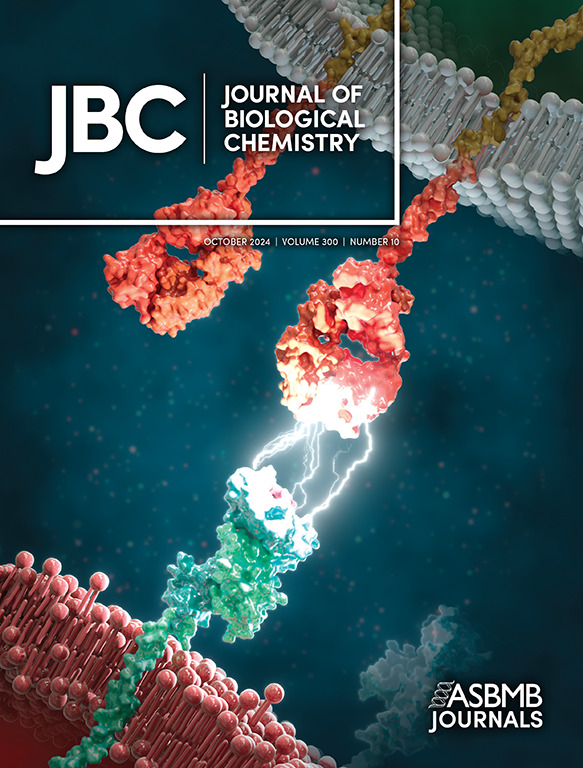
Here, we report on the generation and characterization of single-domain antibody (sdAb)-derived bispecifics that mimic the function of LIF by triggering agonism on its heterodimeric receptor composed of the subunits LIF receptor (LIFR) and glycoprotein 130 (gp130). For this, LIFR-targeting sdAbs were identified by yeast surface display (YSD) after camelid immunization. Resulting 14 LIFR-specific paratopes were expressed in a bispecific antibody (bsAb) format all harboring the identical gp130-adressing sdAb. Profiling of bsAbs on Ba/F3 cells expressing human LIFR as well as gp130 revealed LIF-like functionality of one bsAb as characterized by the induction of cell proliferation. Cryo-EM structural analysis revealed that the bsAb targets a distinct LIFR epitope, indicating the formation of a receptor architecture that differs from previously reported LIF signaling complex structures. In addition, the identified sdAb-based bispecific LIF mimetic elicited STAT3 phosphorylation in HeLa as well as TF-1 cells naturally expressing the LIF receptor subunits. Moreover, agonism capabilities were further improved by antibody engineering. Taken together, we demonstrate that cytokine members of the IL-6 family can be mimicked by harnessing sdAbs as building blocks.
期刊介绍:
The Journal of Biological Chemistry welcomes high-quality science that seeks to elucidate the molecular and cellular basis of biological processes. Papers published in JBC can therefore fall under the umbrellas of not only biological chemistry, chemical biology, or biochemistry, but also allied disciplines such as biophysics, systems biology, RNA biology, immunology, microbiology, neurobiology, epigenetics, computational biology, ’omics, and many more. The outcome of our focus on papers that contribute novel and important mechanistic insights, rather than on a particular topic area, is that JBC is truly a melting pot for scientists across disciplines. In addition, JBC welcomes papers that describe methods that will help scientists push their biochemical inquiries forward and resources that will be of use to the research community.

 求助内容:
 应助结果提醒方式:


 京公网安备 11010802042870号


