{"title":"Kleptoparasitic multiparasitism allows parasitoids to expand their host range to otherwise unsuitable invasive hosts.","authors":"Kazumu Kuramitsu, Narisara Piyasaengthong","doi":"10.1016/j.cois.2026.101632","DOIUrl":null,"url":null,"abstract":"<p><p>Biological invasions frequently disrupt co-evolved host-parasitoid interactions and create evolutionary traps in which native parasitoids attack unsuitable invasive hosts. While escape from such traps has traditionally been viewed as a consequence of adaptive evolution, recent studies suggest that ecological interactions among parasitoids may also enable exploitation of otherwise unsuitable hosts. In particular, increasing evidence supports the occurrence of \"pirate parasitism\", a specialized form of kleptoparasitism in which one parasitoid species enables another to successfully develop in an otherwise unsuitable host, often through host immune suppression. Here, we review historical and recent studies on pirate parasitism, clarify its conceptual framework, and discuss its ecological and evolutionary implications. Reported cases include both native sympatric systems and invasion-associated systems, suggesting that pirate parasitism may transiently expand realized host ranges, alleviate demographic costs of maladaptive oviposition, and potentially promote rewiring of host-parasitoid interaction networks. We further discuss the possibility that pirate parasitism functions as an ecological bridge between initial maladaptive host use and subsequent evolutionary host range expansion. Finally, we highlight major knowledge deficiencies, including limited evidence from natural ecosystems and unresolved behavioral and physiological mechanisms underlying pirate parasitism. Understanding kleptoparasitic interactions among parasitoids may provide new insights into eco-evolutionary dynamics in rapidly changing environments.</p>","PeriodicalId":11038,"journal":{"name":"Current opinion in insect science","volume":" ","pages":"101632"},"PeriodicalIF":5.5000,"publicationDate":"2026-10-09","publicationTypes":"Journal Article","fieldsOfStudy":null,"isOpenAccess":false,"openAccessPdf":"","citationCount":"0","resultStr":null,"platform":"Semanticscholar","paperid":null,"PeriodicalName":"Current opinion in insect science","FirstCategoryId":"97","ListUrlMain":"https://doi.org/10.1016/j.cois.2026.101632","RegionNum":1,"RegionCategory":"农林科学","ArticlePicture":[],"TitleCN":null,"AbstractTextCN":null,"PMCID":null,"EPubDate":"","PubModel":"","JCR":"Q1","JCRName":"BIOLOGY","Score":null,"Total":0}
引用次数: 0
Abstract
Biological invasions frequently disrupt co-evolved host-parasitoid interactions and create evolutionary traps in which native parasitoids attack unsuitable invasive hosts. While escape from such traps has traditionally been viewed as a consequence of adaptive evolution, recent studies suggest that ecological interactions among parasitoids may also enable exploitation of otherwise unsuitable hosts. In particular, increasing evidence supports the occurrence of "pirate parasitism", a specialized form of kleptoparasitism in which one parasitoid species enables another to successfully develop in an otherwise unsuitable host, often through host immune suppression. Here, we review historical and recent studies on pirate parasitism, clarify its conceptual framework, and discuss its ecological and evolutionary implications. Reported cases include both native sympatric systems and invasion-associated systems, suggesting that pirate parasitism may transiently expand realized host ranges, alleviate demographic costs of maladaptive oviposition, and potentially promote rewiring of host-parasitoid interaction networks. We further discuss the possibility that pirate parasitism functions as an ecological bridge between initial maladaptive host use and subsequent evolutionary host range expansion. Finally, we highlight major knowledge deficiencies, including limited evidence from natural ecosystems and unresolved behavioral and physiological mechanisms underlying pirate parasitism. Understanding kleptoparasitic interactions among parasitoids may provide new insights into eco-evolutionary dynamics in rapidly changing environments.
期刊介绍:
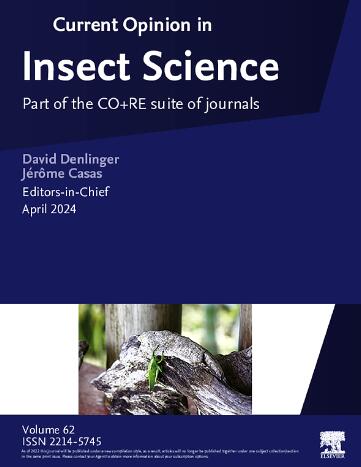
Current Opinion in Insect Science is a new systematic review journal that aims to provide specialists with a unique and educational platform to keep up–to–date with the expanding volume of information published in the field of Insect Science. As this is such a broad discipline, we have determined themed sections each of which is reviewed once a year.
The following 11 areas are covered by Current Opinion in Insect Science.
-Ecology
-Insect genomics
-Global Change Biology
-Molecular Physiology (Including Immunity)
-Pests and Resistance
-Parasites, Parasitoids and Biological Control
-Behavioural Ecology
-Development and Regulation
-Social Insects
-Neuroscience
-Vectors and Medical and Veterinary Entomology
There is also a section that changes every year to reflect hot topics in the field.
Section Editors, who are major authorities in their area, are appointed by the Editors of the journal. They divide their section into a number of topics, ensuring that the field is comprehensively covered and that all issues of current importance are emphasized. Section Editors commission articles from leading scientists on each topic that they have selected and the commissioned authors write short review articles in which they present recent developments in their subject, emphasizing the aspects that, in their opinion, are most important. In addition, they provide short annotations to the papers that they consider to be most interesting from all those published in their topic over the previous year.

 求助内容:
 应助结果提醒方式:


 京公网安备 11010802042870号


