Jacinda Pujols, Kyutae D Lee, Nick J Kapolka, Sam Taylor, Bruno Colon, Daniel G Isom
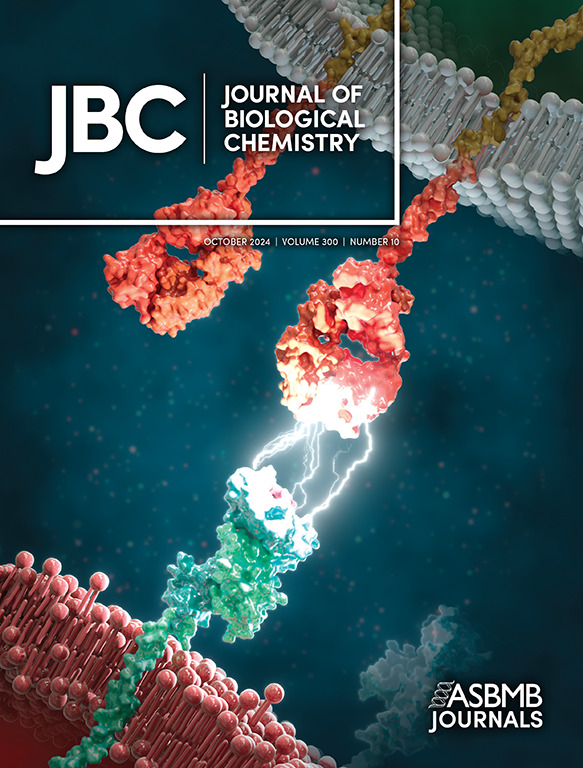
{"title":"Systematic mapping of chimera-permissive sites by CRISPR-guided PAM scanning.","authors":"Jacinda Pujols, Kyutae D Lee, Nick J Kapolka, Sam Taylor, Bruno Colon, Daniel G Isom","doi":"10.1016/j.jbc.2026.113627","DOIUrl":null,"url":null,"abstract":"<p><p>Protein chimeras enable new biological functions by combining otherwise independent protein elements, but identifying insertion sites that preserve host protein function remains largely empirical. Here, we introduce CRISPR-guided protospacer adjacent motif (PAM) scanning, a scalable strategy for mapping chimera-permissive sites directly in living cells. PAM scanning uses CRISPR-addressable positions across coding sequences to systematically install functional payloads and measure insertion tolerance. In yeast, PAM accessibility provided near-comprehensive coverage across proteins of diverse size and function. We first applied this approach across an entire G protein-coupled receptor (GPCR) signaling pathway, generating 91 chimeras containing inserted protease recognition sequences to map insertion tolerance and site-specific biophysical protection from a protease probe by surrounding protein structure and binding partners. Cognate protease cleavage revealed how this protection varied with protease inhibition and size. We then used PAM scanning to identify bi-functional GPCR chimeras that retained receptor signaling while supporting fluorescent or luminescent reporters. Screening human adenosine A2A and melatonin MTNR1A receptors in yeast identified functional mNeonGreen and NanoLuc insertion sites that retained ligand-dependent signaling following translation to human cells. Together, these studies establish PAM scanning as a general framework for mapping insertional tolerance and biophysical protection in living cells, accelerating functional chimera engineering, and experimentally validating generative chimera design.</p>","PeriodicalId":15140,"journal":{"name":"Journal of Biological Chemistry","volume":" ","pages":"113627"},"PeriodicalIF":4.0000,"publicationDate":"2026-10-08","publicationTypes":"Journal Article","fieldsOfStudy":null,"isOpenAccess":false,"openAccessPdf":"","citationCount":"0","resultStr":null,"platform":"Semanticscholar","paperid":null,"PeriodicalName":"Journal of Biological Chemistry","FirstCategoryId":"99","ListUrlMain":"https://doi.org/10.1016/j.jbc.2026.113627","RegionNum":2,"RegionCategory":"生物学","ArticlePicture":[],"TitleCN":null,"AbstractTextCN":null,"PMCID":null,"EPubDate":"","PubModel":"","JCR":"Q2","JCRName":"BIOCHEMISTRY & MOLECULAR BIOLOGY","Score":null,"Total":0}
引用次数: 0
Abstract
Protein chimeras enable new biological functions by combining otherwise independent protein elements, but identifying insertion sites that preserve host protein function remains largely empirical. Here, we introduce CRISPR-guided protospacer adjacent motif (PAM) scanning, a scalable strategy for mapping chimera-permissive sites directly in living cells. PAM scanning uses CRISPR-addressable positions across coding sequences to systematically install functional payloads and measure insertion tolerance. In yeast, PAM accessibility provided near-comprehensive coverage across proteins of diverse size and function. We first applied this approach across an entire G protein-coupled receptor (GPCR) signaling pathway, generating 91 chimeras containing inserted protease recognition sequences to map insertion tolerance and site-specific biophysical protection from a protease probe by surrounding protein structure and binding partners. Cognate protease cleavage revealed how this protection varied with protease inhibition and size. We then used PAM scanning to identify bi-functional GPCR chimeras that retained receptor signaling while supporting fluorescent or luminescent reporters. Screening human adenosine A2A and melatonin MTNR1A receptors in yeast identified functional mNeonGreen and NanoLuc insertion sites that retained ligand-dependent signaling following translation to human cells. Together, these studies establish PAM scanning as a general framework for mapping insertional tolerance and biophysical protection in living cells, accelerating functional chimera engineering, and experimentally validating generative chimera design.
期刊介绍:
The Journal of Biological Chemistry welcomes high-quality science that seeks to elucidate the molecular and cellular basis of biological processes. Papers published in JBC can therefore fall under the umbrellas of not only biological chemistry, chemical biology, or biochemistry, but also allied disciplines such as biophysics, systems biology, RNA biology, immunology, microbiology, neurobiology, epigenetics, computational biology, ’omics, and many more. The outcome of our focus on papers that contribute novel and important mechanistic insights, rather than on a particular topic area, is that JBC is truly a melting pot for scientists across disciplines. In addition, JBC welcomes papers that describe methods that will help scientists push their biochemical inquiries forward and resources that will be of use to the research community.

 求助内容:
 应助结果提醒方式:


 京公网安备 11010802042870号


