Julia Caton, Bo Sun, Natasha Steele, Christine Santiago, Farzana Antara, Jason Hom, Rebecca Dougherty
{"title":"Hospital-Based Clinicians' Knowledge and Practices Regarding Stigmatizing Language in Clinical Documentation: A Multicenter Survey.","authors":"Julia Caton, Bo Sun, Natasha Steele, Christine Santiago, Farzana Antara, Jason Hom, Rebecca Dougherty","doi":"10.1007/s11606-026-10803-x","DOIUrl":null,"url":null,"abstract":"<p><strong>Background: </strong>Stigmatizing language is common in the medical record and can perpetuate bias, which has downstream effects on clinical decision-making and patient care. Internal medicine faculty, residents, and advanced practice providers (APPs) are front-line clinicians for composing documentation, and faculty and APPs are also tasked with providing trainees with feedback and training on best documentation practices. However, resident, APP, and faculty preparedness to address stigmatizing language in documentation is unknown. Furthermore, little is known about clinicians' knowledge, attitudes, and behaviors regarding such language.</p><p><strong>Objective: </strong>We sought to understand resident, APP, and faculty experiences, values, and beliefs around stigmatizing language in clinical documentation.</p><p><strong>Design: </strong>We conducted a cross-sectional online survey and knowledge test.</p><p><strong>Participants: </strong>Internal medicine residents, faculty, and APPs within two large academic internal medicine departments.</p><p><strong>Main measures: </strong>The knowledge test measured participants' ability to identify stigmatizing language in snippets of documentation and the survey measured attitudes and perceived skills via a series of Likert-style questions.</p><p><strong>Key results: </strong>In total, 82 faculty/APPs (72 faculty and 10 APPs; 52% response rate) and 63 residents (21% response rate) responded. Nearly all respondents reported considering how their word choices impact patients (91% of faculty/APPs [n = 74] and 92% of residents [n = 58]) and other clinicians (90% of faculty/APPs [n = 73] and 84% of residents [n = 53]). However, only 10% (n = 8) of faculty/APPs and 24% (n = 15) of residents were confident that their clinical documentation avoided stigmatizing language. Only 4% (n = 3) of faculty/APPs and 3% (n = 2) of residents correctly identified all 11 stigmatizing terms assessed on the knowledge test.</p><p><strong>Conclusions: </strong>Faculty/APPs and residents at our institutions value the importance of patient-centered language, yet they lack knowledge and skills around this topic, highlighting key opportunities for future targeted educational and systems-level interventions.</p>","PeriodicalId":15860,"journal":{"name":"Journal of General Internal Medicine","volume":" ","pages":""},"PeriodicalIF":4.1000,"publicationDate":"2026-10-07","publicationTypes":"Journal Article","fieldsOfStudy":null,"isOpenAccess":false,"openAccessPdf":"","citationCount":"0","resultStr":null,"platform":"Semanticscholar","paperid":null,"PeriodicalName":"Journal of General Internal Medicine","FirstCategoryId":"3","ListUrlMain":"https://doi.org/10.1007/s11606-026-10803-x","RegionNum":2,"RegionCategory":"医学","ArticlePicture":[],"TitleCN":null,"AbstractTextCN":null,"PMCID":null,"EPubDate":"","PubModel":"","JCR":"Q1","JCRName":"HEALTH CARE SCIENCES & SERVICES","Score":null,"Total":0}
引用次数: 0
Abstract
Background: Stigmatizing language is common in the medical record and can perpetuate bias, which has downstream effects on clinical decision-making and patient care. Internal medicine faculty, residents, and advanced practice providers (APPs) are front-line clinicians for composing documentation, and faculty and APPs are also tasked with providing trainees with feedback and training on best documentation practices. However, resident, APP, and faculty preparedness to address stigmatizing language in documentation is unknown. Furthermore, little is known about clinicians' knowledge, attitudes, and behaviors regarding such language.
Objective: We sought to understand resident, APP, and faculty experiences, values, and beliefs around stigmatizing language in clinical documentation.
Design: We conducted a cross-sectional online survey and knowledge test.
Participants: Internal medicine residents, faculty, and APPs within two large academic internal medicine departments.
Main measures: The knowledge test measured participants' ability to identify stigmatizing language in snippets of documentation and the survey measured attitudes and perceived skills via a series of Likert-style questions.
Key results: In total, 82 faculty/APPs (72 faculty and 10 APPs; 52% response rate) and 63 residents (21% response rate) responded. Nearly all respondents reported considering how their word choices impact patients (91% of faculty/APPs [n = 74] and 92% of residents [n = 58]) and other clinicians (90% of faculty/APPs [n = 73] and 84% of residents [n = 53]). However, only 10% (n = 8) of faculty/APPs and 24% (n = 15) of residents were confident that their clinical documentation avoided stigmatizing language. Only 4% (n = 3) of faculty/APPs and 3% (n = 2) of residents correctly identified all 11 stigmatizing terms assessed on the knowledge test.
Conclusions: Faculty/APPs and residents at our institutions value the importance of patient-centered language, yet they lack knowledge and skills around this topic, highlighting key opportunities for future targeted educational and systems-level interventions.
期刊介绍:
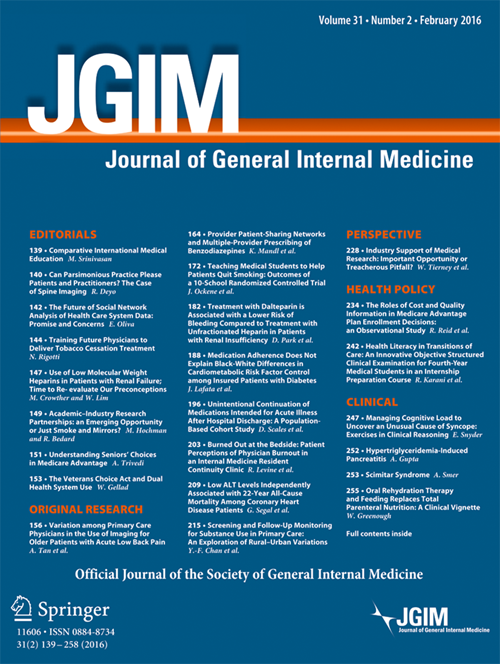
The Journal of General Internal Medicine is the official journal of the Society of General Internal Medicine. It promotes improved patient care, research, and education in primary care, general internal medicine, and hospital medicine. Its articles focus on topics such as clinical medicine, epidemiology, prevention, health care delivery, curriculum development, and numerous other non-traditional themes, in addition to classic clinical research on problems in internal medicine.

 求助内容:
 应助结果提醒方式:


 京公网安备 11010802042870号


