{"title":"Towards next generation enzyme mimics through local electric field control in organic cage catalysts.","authors":"Marco Vitek, Igor Rončević, Keith G Andrews","doi":"10.1039/d6sc04940k","DOIUrl":null,"url":null,"abstract":"<p><p>Electric fields (EFs) can, in principle, accelerate chemical reactions by preferentially stabilising charge distribution in transition states. In practice, strategies for aligning tuneable EFs across reaction sites in artificial molecular systems remain scarce. Here, using modelling, we establish the potential of dipolar supramolecular cavities as an approach to quantify and optimise solution-phase EF catalysis. By positioning pairs of charged substituents on a cage catalyst exterior, we align tuneable, oriented, local fields with reaction dipoles without introducing through-bond effects. We introduce a finite capacitor model to evaluate EFs in dipolar cavities and show cavities of 1 nm can generate EF strengths comparable to enzymes (∼0.2 V Å<sup>-1</sup>). We validate this model computationally by quantifying EF-dependent catalysis in synthetically accessible analogues of an existing acyl-transfer cage catalyst, obtaining a large 13 kcal mol<sup>-1</sup> per V Å<sup>-1</sup> dependency. Roughly half of the generated field interaction energy is translated into catalysis, yielding a projected rate acceleration of two orders of magnitude. Optimal EF catalysis required constraining and aligning both the reactant complex and transition state in the EF, suggesting that enzymes may employ strong binding to maximise EF catalysis by preserving electrostatically strained substrate configurations in local fields.</p>","PeriodicalId":9909,"journal":{"name":"Chemical Science","volume":" ","pages":""},"PeriodicalIF":8.1000,"publicationDate":"2026-10-02","publicationTypes":"Journal Article","fieldsOfStudy":null,"isOpenAccess":false,"openAccessPdf":"https://www.ncbi.nlm.nih.gov/pmc/articles/PMC13631960/pdf/","citationCount":"0","resultStr":null,"platform":"Semanticscholar","paperid":null,"PeriodicalName":"Chemical Science","FirstCategoryId":"92","ListUrlMain":"https://doi.org/10.1039/d6sc04940k","RegionNum":1,"RegionCategory":"化学","ArticlePicture":[],"TitleCN":null,"AbstractTextCN":null,"PMCID":null,"EPubDate":"","PubModel":"","JCR":"Q1","JCRName":"CHEMISTRY, MULTIDISCIPLINARY","Score":null,"Total":0}
引用次数: 0
Abstract
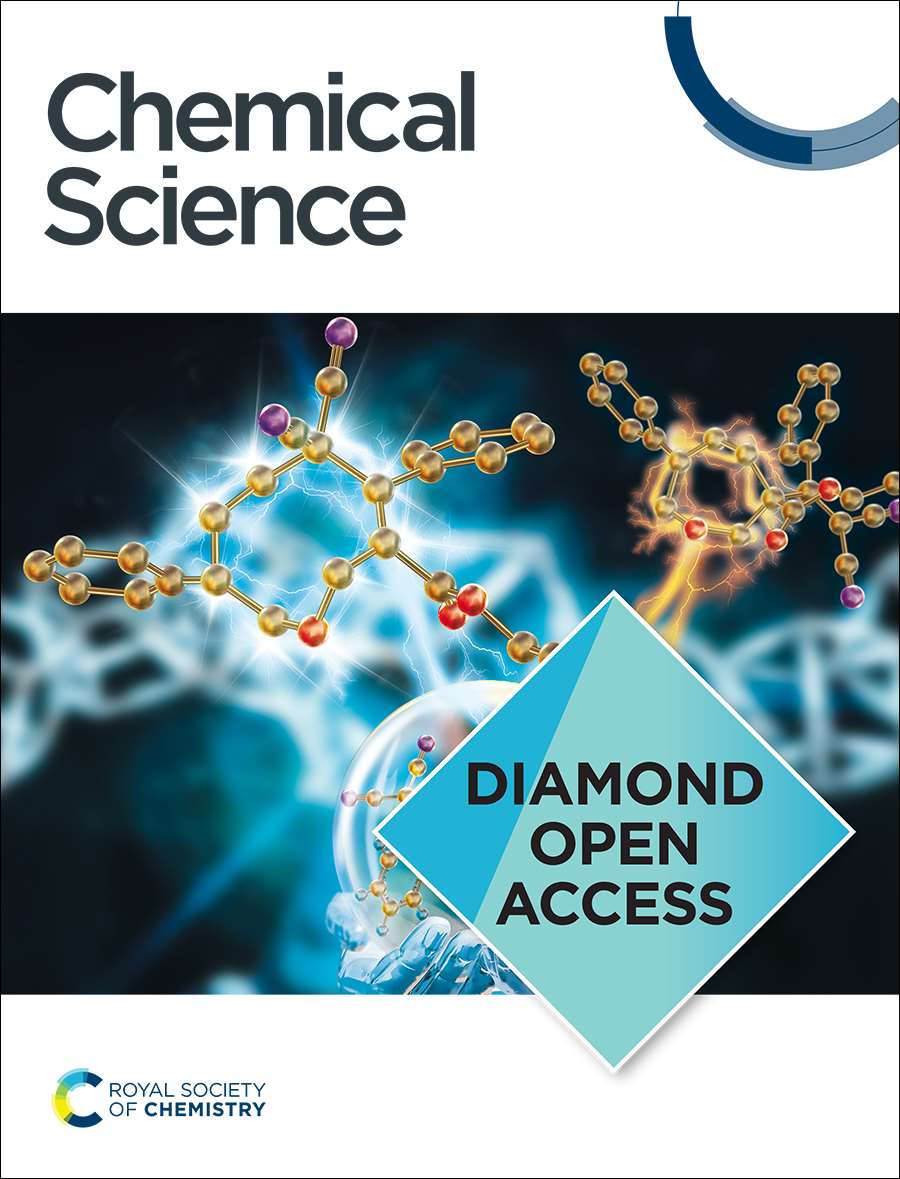
Electric fields (EFs) can, in principle, accelerate chemical reactions by preferentially stabilising charge distribution in transition states. In practice, strategies for aligning tuneable EFs across reaction sites in artificial molecular systems remain scarce. Here, using modelling, we establish the potential of dipolar supramolecular cavities as an approach to quantify and optimise solution-phase EF catalysis. By positioning pairs of charged substituents on a cage catalyst exterior, we align tuneable, oriented, local fields with reaction dipoles without introducing through-bond effects. We introduce a finite capacitor model to evaluate EFs in dipolar cavities and show cavities of 1 nm can generate EF strengths comparable to enzymes (∼0.2 V Å-1). We validate this model computationally by quantifying EF-dependent catalysis in synthetically accessible analogues of an existing acyl-transfer cage catalyst, obtaining a large 13 kcal mol-1 per V Å-1 dependency. Roughly half of the generated field interaction energy is translated into catalysis, yielding a projected rate acceleration of two orders of magnitude. Optimal EF catalysis required constraining and aligning both the reactant complex and transition state in the EF, suggesting that enzymes may employ strong binding to maximise EF catalysis by preserving electrostatically strained substrate configurations in local fields.
电场(EFs)原则上可以通过优先稳定过渡态中的电荷分布来加速化学反应。在实践中,在人工分子系统的反应位点上排列可调谐电场的策略仍然很少。在这里,通过建模,我们建立了偶极超分子空腔的潜力,作为一种量化和优化溶液相EF催化的方法。通过在笼状催化剂表面定位一对带电取代基,我们将可调谐、定向的局部场与反应偶极子对齐,而不引入通键效应。我们引入了一个有限电容模型来评估偶极腔中的电场,并表明1nm的腔可以产生与酶相当的电场强度(~ 0.2 V Å-1)。我们通过量化现有酰基转移笼催化剂的合成类似物中ef依赖性催化的计算验证了该模型,获得了13 kcal mol-1 / V Å-1依赖性。大约一半产生的场相互作用能转化为催化作用,产生两个数量级的预计速率加速度。最佳的EF催化需要约束和调整EF中的反应物复合物和过渡态,这表明酶可能通过在局部场中保持静电应变底物构型来利用强结合来最大化EF催化。
期刊介绍:
Chemical Science is a journal that encompasses various disciplines within the chemical sciences. Its scope includes publishing ground-breaking research with significant implications for its respective field, as well as appealing to a wider audience in related areas. To be considered for publication, articles must showcase innovative and original advances in their field of study and be presented in a manner that is understandable to scientists from diverse backgrounds. However, the journal generally does not publish highly specialized research.

 求助内容:
 应助结果提醒方式:


 京公网安备 11010802042870号


