Mason McAnally, Koushik Mondal, Yuheng Luo, Nils W Melbourne, Pooja Chahal, Xilin Bai, Jinghui Lu, Baoyu Song, Xinxuan Wang, Andrew M Turner, Alexandre Bergantini, Souvick Biswas, Rui Sun, Tao Yang, Ralf I Kaiser
{"title":"Radical chemistry in atmospheric ice analogs forms persistent trifluoroacetic acid.","authors":"Mason McAnally, Koushik Mondal, Yuheng Luo, Nils W Melbourne, Pooja Chahal, Xilin Bai, Jinghui Lu, Baoyu Song, Xinxuan Wang, Andrew M Turner, Alexandre Bergantini, Souvick Biswas, Rui Sun, Tao Yang, Ralf I Kaiser","doi":"10.1039/d6sc05084k","DOIUrl":null,"url":null,"abstract":"<p><p>Trifluoroacetic acid (TFA, CF<sub>3</sub>COOH), the most prevalent per- and polyfluoroalkyl substance (PFAS), is accumulating globally in precipitation, soils, and drinking water, yet its formation remains unresolved. Atmospheric models emphasize gas-phase oxidation of hydrofluorocarbons and hydrofluoroolefins, but measured abundances often exceed predictions, implying missing chemistry. Here, we identify a condensed-phase radical pathway to TFA in cryogenic trifluoromethane/carbon dioxide ice analogs. Energetic processing generates trifluoromethyl (CF<sub>3</sub>) and hydroxycarbonyl (HOCO) radicals that undergo barrierless recombination to form TFA. Fourier transform infrared spectroscopy tracks reactive intermediates and carboxylic acid functional groups, while synchrotron vacuum-ultraviolet photoionization reflectron time-of-flight mass spectrometry provides isomer-selective detection of TFA and diagnostic dimer fragments. These results support CF<sub>3</sub>-HOCO recombination as a potential condensed-phase route linking fluorocarbon degradation to persistent PFAS formation, highlighting the potential role of ice crystals and cloud particles as chemical reactors in atmospheric fluorine chemistry.</p>","PeriodicalId":9909,"journal":{"name":"Chemical Science","volume":" ","pages":""},"PeriodicalIF":8.1000,"publicationDate":"2026-10-06","publicationTypes":"Journal Article","fieldsOfStudy":null,"isOpenAccess":false,"openAccessPdf":"https://www.ncbi.nlm.nih.gov/pmc/articles/PMC13641192/pdf/","citationCount":"0","resultStr":null,"platform":"Semanticscholar","paperid":null,"PeriodicalName":"Chemical Science","FirstCategoryId":"92","ListUrlMain":"https://doi.org/10.1039/d6sc05084k","RegionNum":1,"RegionCategory":"化学","ArticlePicture":[],"TitleCN":null,"AbstractTextCN":null,"PMCID":null,"EPubDate":"","PubModel":"","JCR":"Q1","JCRName":"CHEMISTRY, MULTIDISCIPLINARY","Score":null,"Total":0}
引用次数: 0
Abstract
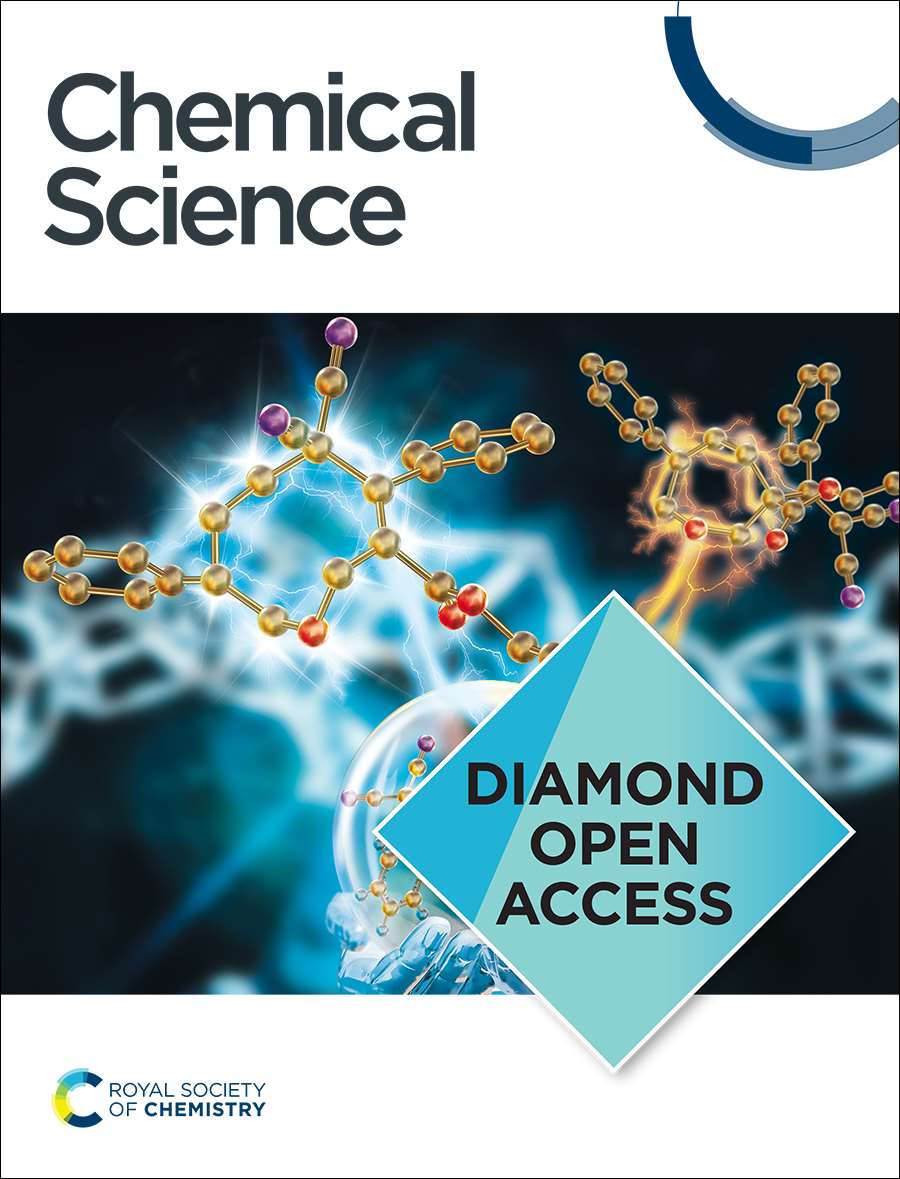
Trifluoroacetic acid (TFA, CF3COOH), the most prevalent per- and polyfluoroalkyl substance (PFAS), is accumulating globally in precipitation, soils, and drinking water, yet its formation remains unresolved. Atmospheric models emphasize gas-phase oxidation of hydrofluorocarbons and hydrofluoroolefins, but measured abundances often exceed predictions, implying missing chemistry. Here, we identify a condensed-phase radical pathway to TFA in cryogenic trifluoromethane/carbon dioxide ice analogs. Energetic processing generates trifluoromethyl (CF3) and hydroxycarbonyl (HOCO) radicals that undergo barrierless recombination to form TFA. Fourier transform infrared spectroscopy tracks reactive intermediates and carboxylic acid functional groups, while synchrotron vacuum-ultraviolet photoionization reflectron time-of-flight mass spectrometry provides isomer-selective detection of TFA and diagnostic dimer fragments. These results support CF3-HOCO recombination as a potential condensed-phase route linking fluorocarbon degradation to persistent PFAS formation, highlighting the potential role of ice crystals and cloud particles as chemical reactors in atmospheric fluorine chemistry.
期刊介绍:
Chemical Science is a journal that encompasses various disciplines within the chemical sciences. Its scope includes publishing ground-breaking research with significant implications for its respective field, as well as appealing to a wider audience in related areas. To be considered for publication, articles must showcase innovative and original advances in their field of study and be presented in a manner that is understandable to scientists from diverse backgrounds. However, the journal generally does not publish highly specialized research.

 求助内容:
 应助结果提醒方式:


 京公网安备 11010802042870号


