Binhang Zhao, Pan Yang, Donald R Inns, Angela Gondolini, Alessandra Sanson, Haifei Zhang
{"title":"Emulsion-templated hierarchical silica monoliths functionalized with sulfonic acid for esterification and acetalization reactions.","authors":"Binhang Zhao, Pan Yang, Donald R Inns, Angela Gondolini, Alessandra Sanson, Haifei Zhang","doi":"10.1039/d6cy00824k","DOIUrl":null,"url":null,"abstract":"<p><p>Efficient heterogeneous catalysts have been developed owing to their advantages in reusability and sustainability. However, conventional catalysts composed of fine or nanosized particles suffered from a high pressure drop and catalyst loss in fixed-bed or batch reactors, limiting their practical applications. In this work, macro-mesoporous hierarchical silica monoliths were fabricated <i>via</i> an emulsion-templating method with easily available silica colloids as building blocks. Post-grafting of -SH groups and subsequent oxidation with H<sub>2</sub>O<sub>2</sub> generated hierarchically porous silica monoliths with sulfonic acid sites. The resulting H-(0.9) SO<sub>3</sub>-75%-silica exhibited an interconnected macroporous morphology with a pore volume of 2.67 cm<sup>3</sup> g<sup>-1</sup> and a surface area of 232.7 m<sup>2</sup> g<sup>-1</sup>. NH<sub>3</sub> temperature programmed desorption analysis confirmed the presence of acidic sites, while the sulfonic acid site density was estimated from the sulphur content determined by elemental analysis. The H-(0.9) SO<sub>3</sub>-75%-silica catalyst demonstrated high performance in both oleic acid-rich fatty acid feedstock esterification and glycerol acetalization. The free fatty acid conversion reached 95% at 90 °C in 6 h with a turnover frequency (TOF) of 32.1 h<sup>-1</sup>, while glycerol acetalization achieved 98.6% conversion and 98% solketal selectivity at 20 °C within 30 min (TOF = 1155 h<sup>-1</sup>). Moreover, the catalyst maintained high activity over five consecutive cycles, and its monolithic form allowed easy separation from the reaction system, indicating its potential suitability for practical continuous or fixed-bed applications.</p>","PeriodicalId":66,"journal":{"name":"Catalysis Science & Technology","volume":" ","pages":""},"PeriodicalIF":4.0000,"publicationDate":"2026-09-21","publicationTypes":"Journal Article","fieldsOfStudy":null,"isOpenAccess":false,"openAccessPdf":"https://www.ncbi.nlm.nih.gov/pmc/articles/PMC13636408/pdf/","citationCount":"0","resultStr":null,"platform":"Semanticscholar","paperid":null,"PeriodicalName":"Catalysis Science & Technology","FirstCategoryId":"92","ListUrlMain":"https://doi.org/10.1039/d6cy00824k","RegionNum":3,"RegionCategory":"化学","ArticlePicture":[],"TitleCN":null,"AbstractTextCN":null,"PMCID":null,"EPubDate":"","PubModel":"","JCR":"Q2","JCRName":"CHEMISTRY, PHYSICAL","Score":null,"Total":0}
引用次数: 0
Abstract
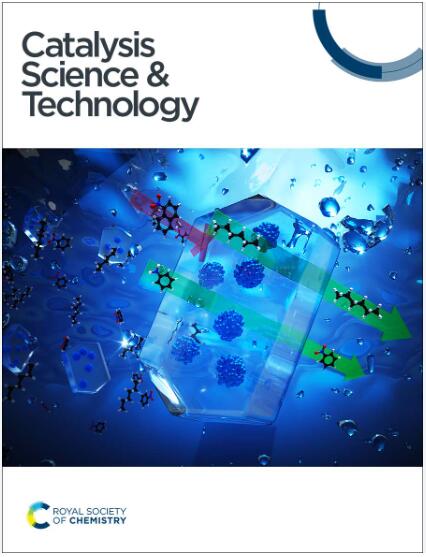
Efficient heterogeneous catalysts have been developed owing to their advantages in reusability and sustainability. However, conventional catalysts composed of fine or nanosized particles suffered from a high pressure drop and catalyst loss in fixed-bed or batch reactors, limiting their practical applications. In this work, macro-mesoporous hierarchical silica monoliths were fabricated via an emulsion-templating method with easily available silica colloids as building blocks. Post-grafting of -SH groups and subsequent oxidation with H2O2 generated hierarchically porous silica monoliths with sulfonic acid sites. The resulting H-(0.9) SO3-75%-silica exhibited an interconnected macroporous morphology with a pore volume of 2.67 cm3 g-1 and a surface area of 232.7 m2 g-1. NH3 temperature programmed desorption analysis confirmed the presence of acidic sites, while the sulfonic acid site density was estimated from the sulphur content determined by elemental analysis. The H-(0.9) SO3-75%-silica catalyst demonstrated high performance in both oleic acid-rich fatty acid feedstock esterification and glycerol acetalization. The free fatty acid conversion reached 95% at 90 °C in 6 h with a turnover frequency (TOF) of 32.1 h-1, while glycerol acetalization achieved 98.6% conversion and 98% solketal selectivity at 20 °C within 30 min (TOF = 1155 h-1). Moreover, the catalyst maintained high activity over five consecutive cycles, and its monolithic form allowed easy separation from the reaction system, indicating its potential suitability for practical continuous or fixed-bed applications.
期刊介绍:
A multidisciplinary journal focusing on cutting edge research across all fundamental science and technological aspects of catalysis.
Editor-in-chief: Bert Weckhuysen
Impact factor: 5.0
Time to first decision (peer reviewed only): 31 days

 求助内容:
 应助结果提醒方式:


 京公网安备 11010802042870号


