
Ethernet POWERLINK for Reconfigurable Robotics: Teaching an Old Fieldbus New Tricks
IF 9.8
1区 计算机科学
Q1 AUTOMATION & CONTROL SYSTEMS
IEEE Transactions on Industrial Informatics
Pub Date : 2026-10-01
Epub Date: 2026-06-11
DOI:10.1109/TII.2026.3697941
引用次数: 0
Abstract
The concept of reconfigurable robots proposes the interconnection of dozens or even hundreds of modules, which poses a significant challenge to the communication system, which must be real-time, fast, small, inexpensive to implement, energy-efficient, and flexible in terms of allowed topologies. This article shows that legacy fieldbus solutions can be extended for applications that require additional flexibility, such as reconfigurable robotics. The example proposed in this article is based on Ethernet POWERLINK and extends the design with minimal additional hardware and communication effort. This article proposes a new field-programmable gate array (FPGA)-based smart hub that brings a new set of capabilities: seamless support for multiple loops in the topology, massive redundancy, automatic node numbering for any topology, and automatic topology recovery. The presented design has a compact footprint of 917 logical element (LE) for a 16-port hub, making it suitable for implementation with low-cost, low-power FPGAs, such as the Intel MAX10 series. Moreover, due to its low logical complexity, the power consumption of the intellectual property core implemented with MAX10 will be only 61.65 mW. The experimental studies, performed both using cycle-accurate simulation and real prototypes, confirmed that the Ethernet POWERLINK network created with smart hubs operates in topologies with multiple redundant lines and loops. The controlled nodes remained in operation mode even during rewiring “on the fly.” It was also clearly demonstrated that the PollRequest–PollResponse interval jitter of FPGA-based controlled nodes is only用于可重构机器人的以太网POWERLINK:教授旧现场总线的新技巧
可重构机器人的概念提出了数十个甚至数百个模块的互连,这对通信系统提出了重大挑战,通信系统必须实时,快速,小型,成本低廉,节能,并且在允许的拓扑方面具有灵活性。本文展示了遗留的现场总线解决方案可以扩展到需要额外灵活性的应用程序,例如可重构机器人。本文中提出的示例基于以太网POWERLINK,并以最小的额外硬件和通信工作量扩展了设计。本文提出了一种新的基于现场可编程门阵列(FPGA)的智能集线器,它带来了一组新的功能:对拓扑中的多环路的无缝支持、大规模冗余、任何拓扑的自动节点编号以及自动拓扑恢复。所提出的设计对于16端口集线器具有917个逻辑元件(LE)的紧凑占用,使其适合与低成本,低功耗fpga(如英特尔MAX10系列)实现。此外,由于其逻辑复杂度较低,使用MAX10实现的知识产权核心的功耗仅为61.65 mW。实验研究使用周期精确模拟和真实原型进行,证实了由智能集线器创建的以太网POWERLINK网络在具有多个冗余线路和环路的拓扑结构中运行。受控制的节点即使在“动态”重新布线期间也保持运行模式。结果表明,基于fpga的受控节点的PollRequest-PollResponse间隔抖动值仅为$\pm 40$ ns,这使得利用本文提出的方法确定相邻节点并自动恢复网络拓扑成为可能。
本文章由计算机程序翻译,如有差异,请以英文原文为准。
求助全文
约1分钟内获得全文
求助全文
来源期刊
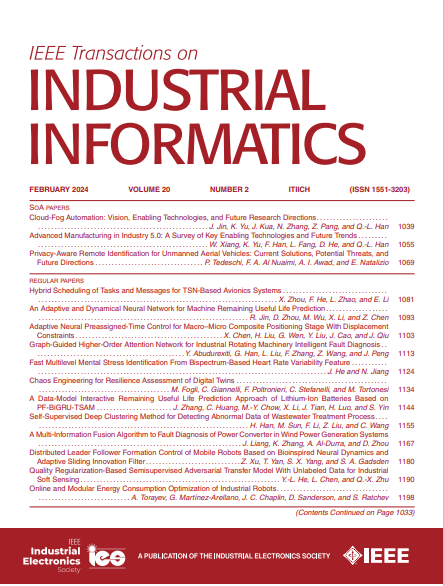
IEEE Transactions on Industrial Informatics
工程技术-工程:工业
CiteScore
24.10
自引率
8.90%
发文量
1202
审稿时长
5.1 months
期刊介绍:
The IEEE Transactions on Industrial Informatics is a multidisciplinary journal dedicated to publishing technical papers that connect theory with practical applications of informatics in industrial settings. It focuses on the utilization of information in intelligent, distributed, and agile industrial automation and control systems. The scope includes topics such as knowledge-based and AI-enhanced automation, intelligent computer control systems, flexible and collaborative manufacturing, industrial informatics in software-defined vehicles and robotics, computer vision, industrial cyber-physical and industrial IoT systems, real-time and networked embedded systems, security in industrial processes, industrial communications, systems interoperability, and human-machine interaction.
 求助内容:
 应助结果提醒方式:


 京公网安备 11010802042870号


