
A Wearable Sensor-Driven Monitoring Framework for Hypoxic Respiratory Key Parameters Using Sensitivity-Based Estimation

IF 9.8 1区 计算机科学 Q1 AUTOMATION & CONTROL SYSTEMS
Meitong Li;Jing Chen;Dawei Shi;Shiyue Jia;Lingling Zhu
{"title":"A Wearable Sensor-Driven Monitoring Framework for Hypoxic Respiratory Key Parameters Using Sensitivity-Based Estimation","authors":"Meitong Li;Jing Chen;Dawei Shi;Shiyue Jia;Lingling Zhu","doi":"10.1109/TII.2026.3695486","DOIUrl":null,"url":null,"abstract":"Wearable sensors provide continuous physiological measurements, such as <inline-formula><tex-math>$\\text{SpO}_{2}$</tex-math></inline-formula> and heart rate. However, in hypoxic respiratory applications, such sensors primarily monitor superficial symptoms, while the key underlying parameters remain nonmeasurable. To address this issue, this work proposes a process monitoring framework driven by a novel sensitivity-based parameter estimation approach. The framework utilizes a physics-informed model with 18 key parameters as the monitoring target, where the change in two critical parameters is used to assess the hypoxic adaptation index (HAI). The estimation method incorporates a sensitivity-based groupwise optimization and an identifiability-based collective variational inference, which assigns greater trust weights to high-quality signals to mitigate the impact of low-quality data. Monitoring effectiveness is validated via an <italic>in silico</i> experiment, which demonstrates normalized mean absolute error reductions of 3.28% (individual) and 4.30% (population) over the baseline. The robustness of the framework and the effectiveness of the HAI are subsequently confirmed in a real-world intermittent hypoxic training experiment that involved noisy sensor data from 19 human subjects. This work provides a robust and generalizable framework for monitoring nonmeasurable key parameters in other complex dynamic systems.","PeriodicalId":13301,"journal":{"name":"IEEE Transactions on Industrial Informatics","volume":"22 10","pages":"8801-8812"},"PeriodicalIF":9.8000,"publicationDate":"2026-10-01","publicationTypes":"Journal Article","fieldsOfStudy":null,"isOpenAccess":false,"openAccessPdf":"","citationCount":"0","resultStr":null,"platform":"Semanticscholar","paperid":null,"PeriodicalName":"IEEE Transactions on Industrial Informatics","FirstCategoryId":"94","ListUrlMain":"https://ieeexplore.ieee.org/document/11560966/","RegionNum":1,"RegionCategory":"计算机科学","ArticlePicture":[],"TitleCN":null,"AbstractTextCN":null,"PMCID":null,"EPubDate":"2026/6/12 0:00:00","PubModel":"Epub","JCR":"Q1","JCRName":"AUTOMATION & CONTROL SYSTEMS","Score":null,"Total":0}
引用次数: 0

Abstract

Wearable sensors provide continuous physiological measurements, such as $\text{SpO}_{2}$ and heart rate. However, in hypoxic respiratory applications, such sensors primarily monitor superficial symptoms, while the key underlying parameters remain nonmeasurable. To address this issue, this work proposes a process monitoring framework driven by a novel sensitivity-based parameter estimation approach. The framework utilizes a physics-informed model with 18 key parameters as the monitoring target, where the change in two critical parameters is used to assess the hypoxic adaptation index (HAI). The estimation method incorporates a sensitivity-based groupwise optimization and an identifiability-based collective variational inference, which assigns greater trust weights to high-quality signals to mitigate the impact of low-quality data. Monitoring effectiveness is validated via an in silico experiment, which demonstrates normalized mean absolute error reductions of 3.28% (individual) and 4.30% (population) over the baseline. The robustness of the framework and the effectiveness of the HAI are subsequently confirmed in a real-world intermittent hypoxic training experiment that involved noisy sensor data from 19 human subjects. This work provides a robust and generalizable framework for monitoring nonmeasurable key parameters in other complex dynamic systems.
基于灵敏度估计的可穿戴传感器驱动的缺氧呼吸关键参数监测框架
可穿戴传感器提供连续的生理测量,如$\text{SpO}_{2}$和心率。然而,在低氧呼吸应用中,这种传感器主要监测表面症状,而关键的潜在参数仍然无法测量。为了解决这个问题,这项工作提出了一个新的基于灵敏度的参数估计方法驱动的过程监控框架。该框架利用一个具有18个关键参数的物理信息模型作为监测目标,其中两个关键参数的变化用于评估低氧适应指数(HAI)。该估计方法结合了基于灵敏度的群体优化和基于可识别性的集体变分推理,为高质量信号分配了更大的信任权重,以减轻低质量数据的影响。通过计算机实验验证了监测的有效性,该实验表明,与基线相比,归一化平均绝对误差减少了3.28%(个人)和4.30%(群体)。该框架的稳健性和HAI的有效性随后在现实世界的间歇性缺氧训练实验中得到证实,该实验涉及来自19名人类受试者的噪声传感器数据。这项工作为监测其他复杂动态系统中不可测量的关键参数提供了一个鲁棒和可推广的框架。
本文章由计算机程序翻译,如有差异,请以英文原文为准。
求助全文
约1分钟内获得全文 求助全文
来源期刊
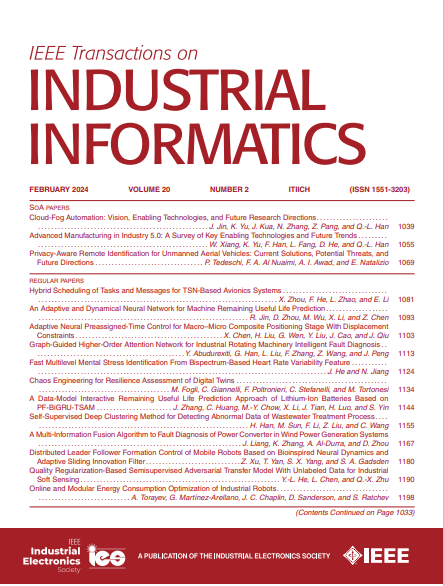
IEEE Transactions on Industrial Informatics
IEEE Transactions on Industrial Informatics 工程技术-工程:工业
CiteScore
24.10
自引率
8.90%
发文量
1202
审稿时长
5.1 months
期刊介绍: The IEEE Transactions on Industrial Informatics is a multidisciplinary journal dedicated to publishing technical papers that connect theory with practical applications of informatics in industrial settings. It focuses on the utilization of information in intelligent, distributed, and agile industrial automation and control systems. The scope includes topics such as knowledge-based and AI-enhanced automation, intelligent computer control systems, flexible and collaborative manufacturing, industrial informatics in software-defined vehicles and robotics, computer vision, industrial cyber-physical and industrial IoT systems, real-time and networked embedded systems, security in industrial processes, industrial communications, systems interoperability, and human-machine interaction.

×
引用
GB/T 7714-2015
复制
MLA
复制
APA
复制
导出至
BibTeX EndNote RefMan NoteFirst NoteExpress
×
提示
您的信息不完整,为了账户安全,请先补充。
现在去补充
×
提示
您因"违规操作"
具体请查看互助需知
我知道了
×
提示
确定
请完成安全验证×
copy
已复制链接
快去分享给好友吧!
我知道了
右上角分享
点击右上角分享
0
联系我们:info@booksci.cn Book学术提供免费学术资源搜索服务,方便国内外学者检索中英文文献。致力于提供最便捷和优质的服务体验。 Copyright © 2023 布克学术 All rights reserved.
京ICP备2023020795号-1
ghs 京公网安备 11010802042870号
Book学术文献互助
Book学术文献互助群
群 号:604180095
Book学术官方微信
小红书


