
DEFT-DPT: A Lightweight Multimodal Framework for Egocentric Video Action Recognition
IF 10.8
1区 工程技术
Q1 ENGINEERING, ELECTRICAL & ELECTRONIC
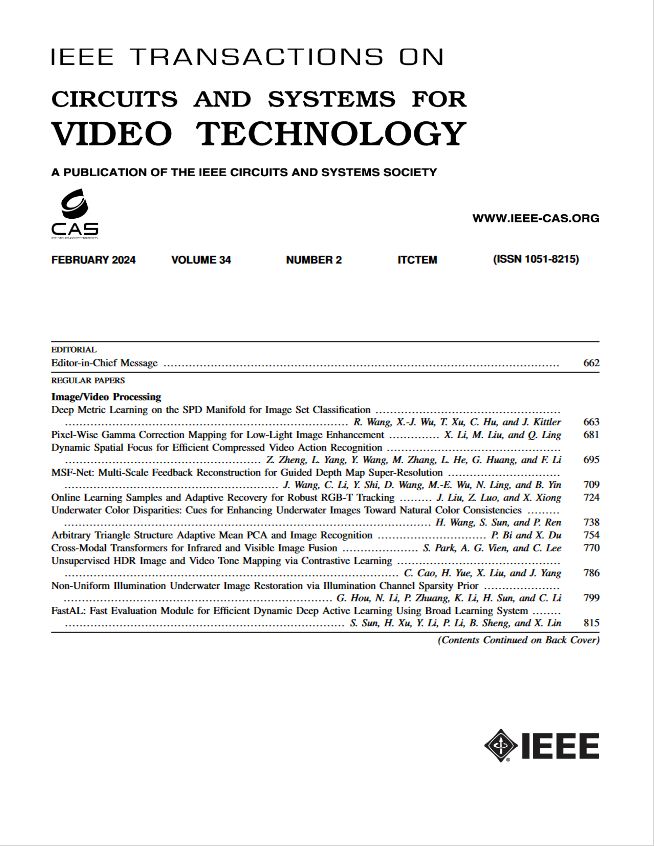
IEEE Transactions on Circuits and Systems for Video Technology
Pub Date : 2026-10-01
Epub Date: 2026-06-25
DOI:10.1109/TCSVT.2026.3707206
引用次数: 0
Abstract
Egocentric video analysis has emerged as an active and rapidly growing area of research in computer vision and multimedia due to its ability to capture human actions from a first-person perspective rich in visual and motion cues. This paper presents a lightweight multimodal framework for action localization and recognition in egocentric videos. Existing approaches often fail to effectively leverage complementary information from RGB, motion, and depth modalities, and even when multiple cues are fused, they typically lack adaptive integration, accurate localization, and scalability for large datasets. To overcome these challenges, we introduce the Dynamic Egocentric Feature Transformation (DEFT) module, which adaptively encodes features while preserving the distinctive motion and viewpoint characteristics of egocentric videos. DEFT emphasizes on central and action-relevant regions through spatial alignment and Gaussian-based weighting, enabling precise action localization and robust recognition. Furthermore, a lightweight Co-Attention module adaptively fuses complementary modality features through a cross-modal agreement. Next, we construct a Sparse Video Similarity Graph (SVSG) in the deep feature space using ResNet-50, where the central frame regions serve as graph nodes. To maintain computational efficiency, Dynamic Percentile Thresholding (DPT) retains only the most informative graph edges, yielding a sparse, yet meaningful graph representation. The resulting graph is then processed by a Graph Attention Network (GAT) for context-aware learning and action classification. Our lightweight framework, containing only 34.22M parameters, achieves 46.25% lower computation time compared to large-scale pretrained foundation models, while maintaining competitive accuracy. Extensive experiments on four benchmark egocentric video datasets—EPIC-Kitchens (RGB + Optical Flow), MECCANO (RGB + Depth), GTEA (RGB), and ADL (RGB)—demonstrate the superiority of the proposed method, showing consistent improvements in different modalities and settings. Our implementation and code are publicly available atDEFT-DPT:用于自我中心视频动作识别的轻量级多模态框架
自我中心视频分析已经成为计算机视觉和多媒体研究的一个活跃和快速发展的领域,因为它能够从丰富的视觉和运动线索的第一人称视角捕捉人类行为。本文提出了一个轻量级的多模态框架,用于自我中心视频中的动作定位和识别。现有的方法往往不能有效地利用来自RGB、运动和深度模式的互补信息,即使融合了多个线索,它们通常也缺乏自适应集成、准确定位和大型数据集的可扩展性。为了克服这些挑战,我们引入了动态自中心特征变换(DEFT)模块,该模块自适应编码特征,同时保留了自中心视频的独特运动和视点特征。DEFT通过空间对齐和基于高斯的加权强调中心和行动相关区域,实现精确的行动定位和鲁棒识别。此外,轻量级的协同关注模块通过跨模态协议自适应地融合互补模态特征。接下来,我们使用ResNet-50在深度特征空间构建稀疏视频相似图(SVSG),其中中心帧区域作为图节点。为了保持计算效率,动态百分位阈值(DPT)只保留最有信息的图边,产生稀疏但有意义的图表示。然后由图注意网络(GAT)处理生成的图,用于上下文感知学习和动作分类。我们的轻量级框架仅包含34.22M个参数,与大规模预训练的基础模型相比,计算时间减少了46.25%,同时保持了相当的准确性。在四个基准自中心视频数据集(epic - kitchens (RGB +光流)、MECCANO (RGB +深度)、GTEA (RGB)和ADL (RGB))上进行的大量实验证明了所提出方法的优越性,在不同模式和设置下显示出一致的改进。我们的实现和代码可以在https://github.com/pawanesh-mnnit/deft_dpt上公开获得
本文章由计算机程序翻译,如有差异,请以英文原文为准。
求助全文
约1分钟内获得全文
求助全文
来源期刊
CiteScore
13.80
自引率
27.40%
发文量
660
审稿时长
5 months
期刊介绍:
The IEEE Transactions on Circuits and Systems for Video Technology (TCSVT) is dedicated to covering all aspects of video technologies from a circuits and systems perspective. We encourage submissions of general, theoretical, and application-oriented papers related to image and video acquisition, representation, presentation, and display. Additionally, we welcome contributions in areas such as processing, filtering, and transforms; analysis and synthesis; learning and understanding; compression, transmission, communication, and networking; as well as storage, retrieval, indexing, and search. Furthermore, papers focusing on hardware and software design and implementation are highly valued. Join us in advancing the field of video technology through innovative research and insights.
 求助内容:
 应助结果提醒方式:


 京公网安备 11010802042870号


