
Robust Dataset Pruning via Joint Noise-Aware Discrimination and Re-Labeling
IF 10.8
1区 工程技术
Q1 ENGINEERING, ELECTRICAL & ELECTRONIC
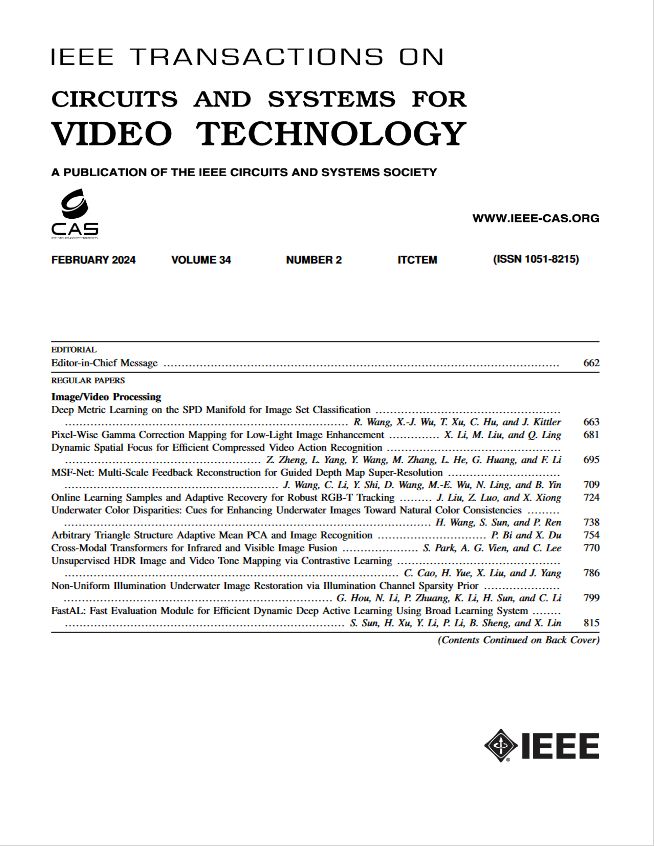
IEEE Transactions on Circuits and Systems for Video Technology
Pub Date : 2026-10-01
Epub Date: 2026-06-29
DOI:10.1109/TCSVT.2026.3708310
引用次数: 0
Abstract
Deep neural networks have achieved success, but require enormous computational costs and storage space on large-scale datasets. Dataset pruning is an effective method to construct compact subsets from large-scale datasets to reduce computational costs while preserving model performance. Existing dataset pruning methods predominantly focus on clean benchmark datasets, overlooking the critical challenges of real-world scenarios with prevalent noisy label samples. In this paper, we find that previous methods have the limitation of being unable to distinguish noisy label samples from hard samples, resulting in overfitting to noisy label samples. To address this, we propose Robust Pruning (RoP), a two-stage dataset pruning framework that consists of noisy label discrimination and re-labeling. Specifically, RoP employs the divergence in label distributions between given labeled samples and their neighboring predictions as an importance metric to identify noisy samples. Compared to other neighborhood-based methods, RoP corrects uncertain neighboring samples through feature and label propagation. Subsequently, RoP applies re-labeling techniques to the selected subset to prevent overfitting of noisy labels. Finally, RoP evaluates easy and hard samples through empirical analysis of re-labeling accuracy, guaranteeing the coverage of hard and easy samples in the selected subset. Extensive experiments demonstrate the effectiveness of the proposed method, not only on real-world benchmarks but also on synthetic datasets, highlighting its suitability for noisy label scenarios. The code is available at基于联合噪声感知识别和重标记的鲁棒数据集修剪
深度神经网络已经取得了成功,但在大规模数据集上需要巨大的计算成本和存储空间。数据集修剪是一种有效的从大规模数据集中构造紧凑子集的方法,可以在保持模型性能的同时降低计算成本。现有的数据集修剪方法主要集中在干净的基准数据集上,忽略了具有普遍噪声标签样本的现实场景的关键挑战。在本文中,我们发现以前的方法存在无法区分有噪声标签样本和硬样本的局限性,导致对有噪声标签样本的过拟合。为了解决这个问题,我们提出了鲁棒修剪(RoP),这是一个由噪声标签识别和重新标记组成的两阶段数据集修剪框架。具体来说,RoP使用给定标记样本与其相邻预测之间的标签分布的散度作为识别噪声样本的重要度量。与其他基于邻域的方法相比,RoP通过特征和标签传播来纠正不确定的相邻样本。随后,RoP将重新标记技术应用于选定的子集,以防止噪声标签的过拟合。最后,RoP通过对重标精度的实证分析对易、难样本进行评价,保证在所选子集中易、难样本的覆盖范围。大量的实验证明了所提出方法的有效性,不仅在现实世界的基准测试中,而且在合成数据集上,突出了其对噪声标签场景的适用性。代码可在https://github.com/successhaha/RoP上获得
本文章由计算机程序翻译,如有差异,请以英文原文为准。
求助全文
约1分钟内获得全文
求助全文
来源期刊
CiteScore
13.80
自引率
27.40%
发文量
660
审稿时长
5 months
期刊介绍:
The IEEE Transactions on Circuits and Systems for Video Technology (TCSVT) is dedicated to covering all aspects of video technologies from a circuits and systems perspective. We encourage submissions of general, theoretical, and application-oriented papers related to image and video acquisition, representation, presentation, and display. Additionally, we welcome contributions in areas such as processing, filtering, and transforms; analysis and synthesis; learning and understanding; compression, transmission, communication, and networking; as well as storage, retrieval, indexing, and search. Furthermore, papers focusing on hardware and software design and implementation are highly valued. Join us in advancing the field of video technology through innovative research and insights.
 求助内容:
 应助结果提醒方式:


 京公网安备 11010802042870号


