
Learning Shallow-Robust Vision Transformers With Selective Distillation for Real-Time UAV Tracking
IF 10.8
1区 工程技术
Q1 ENGINEERING, ELECTRICAL & ELECTRONIC
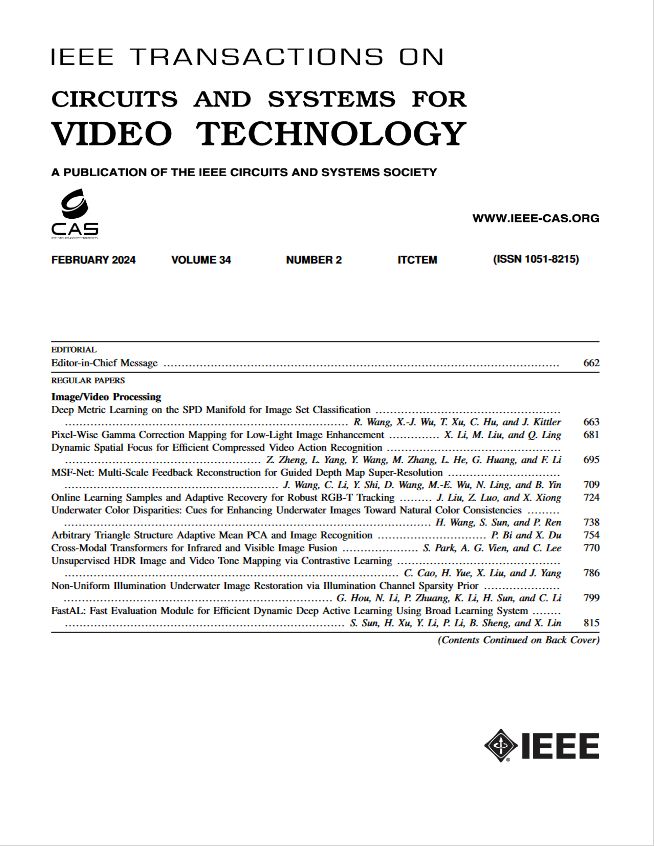
IEEE Transactions on Circuits and Systems for Video Technology
Pub Date : 2026-10-01
Epub Date: 2026-06-24
DOI:10.1109/TCSVT.2026.3706810
引用次数: 0
Abstract
To deploy high-performance vision transformer on resource-constrained uncrewed aerial vehicles, existing methods often adopt dynamic layer activation or layer selection mechanisms to reduce the depth of ViT and accelerate model inference. However, these mechanisms disrupt the inherent sequential feature modeling path, which can limit the modeling capacity of ViT. To alleviate this issue, we propose SRTrack, a simple yet robust tracker built upon a novel teacher-student framework. For the teacher model, we introduce a random exit training strategy that randomly terminates forward process at different ViT layers, encouraging shallow layers to undertake more modeling tasks and enhancing their discriminative capacity while preserving the sequential modeling path. For the student model, we design a selective distillation strategy to achieve effective compression. Instead of blindly relying on the conventional last-layer features, this strategy adaptively selects the most discriminative features from the enhanced teacher model as the distillation target, enabling more robust feature modeling. By combining these two strategies, SRTrack exhibits strong modeling capability even with only a few ViT layers. Extensive experiments on multiple UAV benchmarks demonstrate that SRTrack achieves a superior trade-off between tracking precision and efficiency. Our code is available at基于选择性蒸馏学习的浅鲁棒视觉变压器用于无人机实时跟踪
为了在资源受限的无人飞行器上部署高性能视觉转换器,现有方法通常采用动态层激活或层选择机制,以减小ViT深度,加速模型推理。然而,这些机制破坏了固有的序列特征建模路径,限制了ViT的建模能力。为了缓解这个问题,我们提出了SRTrack,一个简单而强大的跟踪器,建立在一个新的师生框架上。对于教师模型,我们引入了随机退出训练策略,在不同的ViT层随机终止正向过程,鼓励浅层承担更多的建模任务,在保持顺序建模路径的同时增强浅层的区分能力。对于学生模型,我们设计了一种选择性蒸馏策略来实现有效的压缩。该策略不再盲目依赖传统的最后一层特征,而是自适应地从增强的教师模型中选择最具判别性的特征作为蒸馏目标,使特征建模更加鲁棒。通过结合这两种策略,即使只有几个ViT层,SRTrack也显示出强大的建模能力。在多个无人机基准上的广泛实验表明,SRTrack在跟踪精度和效率之间实现了卓越的权衡。我们的代码可在https://github.com/GXNU-ZhongLab/SRTrack上获得
本文章由计算机程序翻译,如有差异,请以英文原文为准。
求助全文
约1分钟内获得全文
求助全文
来源期刊
CiteScore
13.80
自引率
27.40%
发文量
660
审稿时长
5 months
期刊介绍:
The IEEE Transactions on Circuits and Systems for Video Technology (TCSVT) is dedicated to covering all aspects of video technologies from a circuits and systems perspective. We encourage submissions of general, theoretical, and application-oriented papers related to image and video acquisition, representation, presentation, and display. Additionally, we welcome contributions in areas such as processing, filtering, and transforms; analysis and synthesis; learning and understanding; compression, transmission, communication, and networking; as well as storage, retrieval, indexing, and search. Furthermore, papers focusing on hardware and software design and implementation are highly valued. Join us in advancing the field of video technology through innovative research and insights.
 求助内容:
 应助结果提醒方式:


 京公网安备 11010802042870号


