
Enhancing Cross-View Geo-Localization via Global–Local Feature Matching and Keypoint Guidance
IF 10.8
1区 工程技术
Q1 ENGINEERING, ELECTRICAL & ELECTRONIC
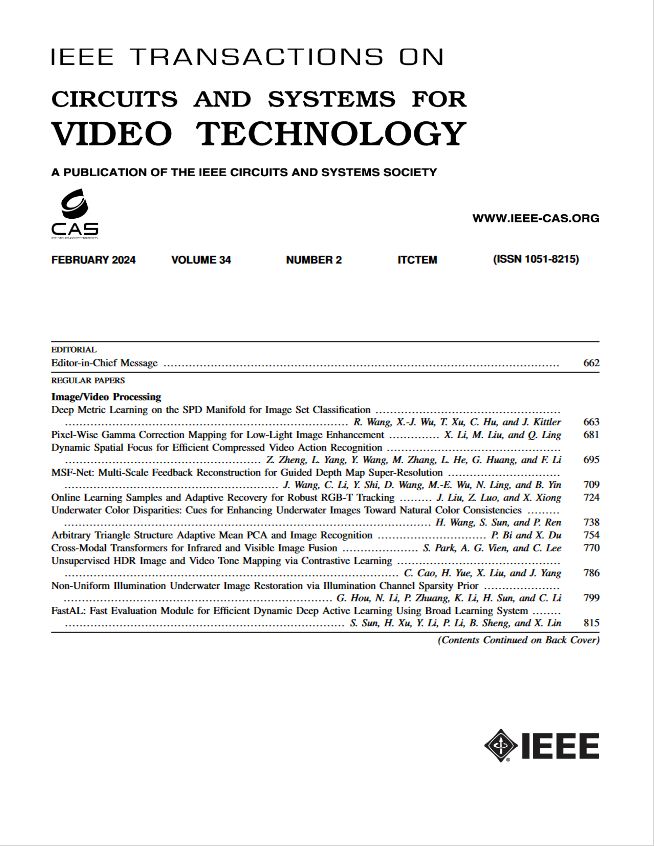
IEEE Transactions on Circuits and Systems for Video Technology
Pub Date : 2026-10-01
Epub Date: 2026-06-17
DOI:10.1109/TCSVT.2026.3704558
引用次数: 0
Abstract
Cross-view geo-localization (CVGL), which aims to match ground- or drone-view imagery with satellite maps, has emerged as a fundamental task in remote sensing, with broad applications in urban monitoring and uncrewed aerial vehicle (UAV) localization. Despite remarkable progress, existing approaches rely heavily on metric-based comparisons of global image features, which often leads to mismatches in regions with highly similar global appearances but distinct local structures. To address this limitation, this work introduces a novel CVGL framework, termed LKGL, which integrates two complementary methods. First, the global–local feature matching (GLFM) method computes similarity at both holistic and localized levels and integrates a reliability-based filtering mechanism to remove ambiguous or low-confidence local correspondences, thereby enhancing robustness against confusing global patterns. Second, the keypoint-guided feature pyramid network (KGFPN) integrates multiscale features with spatial priors derived from keypoint maps through attention-based interactions between shallow and deep layers. This design further enhances local feature expressiveness and structural sensitivity. Together, the GLFM and KGFPN enable LKGL to balance global contextual information with fine-grained local cues, achieving state-of-the-art performance on University-1652 and SUES-200. The source code is released on基于全局-局部特征匹配和关键点引导的跨视地理定位方法
交叉视角地理定位(CVGL)是遥感领域的一项基本任务,旨在将地面或无人机视角图像与卫星地图相匹配,在城市监测和无人机定位中有着广泛的应用。尽管取得了显著进展,但现有的方法严重依赖于基于度量的全局图像特征比较,这经常导致全局外观高度相似但局部结构不同的区域不匹配。为了解决这一限制,本工作引入了一种新的CVGL框架,称为LKGL,它集成了两种互补的方法。首先,全局-局部特征匹配(GLFM)方法在整体和局部两个层面计算相似度,并集成基于可靠性的过滤机制来去除模糊或低置信度的局部对应,从而增强对混乱的全局模式的鲁棒性。其次,关键点引导的特征金字塔网络(KGFPN)通过浅层和深层之间基于注意力的相互作用,将多尺度特征与关键点地图的空间先验相结合。这种设计进一步增强了局部特征的表现力和结构的敏感性。GLFM和KGFPN共同使LKGL能够平衡全局上下文信息和细粒度本地线索,在University-1652和sus -200上实现最先进的性能。源代码在https://github.com/OrigamiSL/LKGL上发布
本文章由计算机程序翻译,如有差异,请以英文原文为准。
求助全文
约1分钟内获得全文
求助全文
来源期刊
CiteScore
13.80
自引率
27.40%
发文量
660
审稿时长
5 months
期刊介绍:
The IEEE Transactions on Circuits and Systems for Video Technology (TCSVT) is dedicated to covering all aspects of video technologies from a circuits and systems perspective. We encourage submissions of general, theoretical, and application-oriented papers related to image and video acquisition, representation, presentation, and display. Additionally, we welcome contributions in areas such as processing, filtering, and transforms; analysis and synthesis; learning and understanding; compression, transmission, communication, and networking; as well as storage, retrieval, indexing, and search. Furthermore, papers focusing on hardware and software design and implementation are highly valued. Join us in advancing the field of video technology through innovative research and insights.
 求助内容:
 应助结果提醒方式:


 京公网安备 11010802042870号


