
SMRFHash: Semantic-Guided Multi-Representation Fusion Hashing for Fine-Grained Image Retrieval
IF 10.8
1区 工程技术
Q1 ENGINEERING, ELECTRICAL & ELECTRONIC
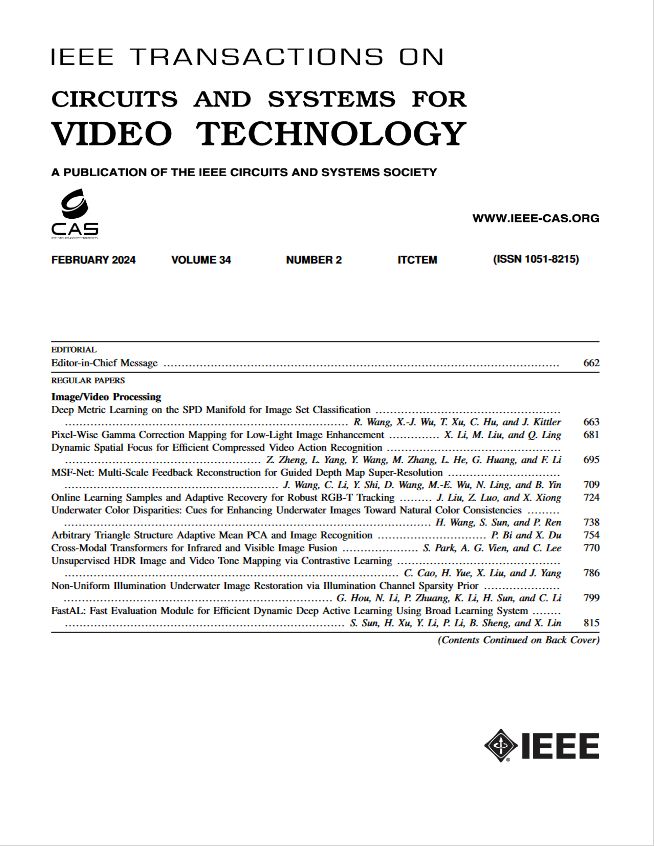
IEEE Transactions on Circuits and Systems for Video Technology
Pub Date : 2026-10-01
Epub Date: 2026-07-02
DOI:10.1109/TCSVT.2026.3709470
引用次数: 0
Abstract
Fine-Grained Image Retrieval (FGIR) is an important visual task. Most existing hash-based FGIR methods have difficulty in sufficiently leveraging low-level attributes and effectively associating high-level semantic information with these low-level attributes, thereby limiting their ability to accurately discriminate fine-grained images. To address this issue, we propose a Semantic-Guided Multi-Representation Fusion Hashing (hereafter SMRFHash), which uses semantic features as an anchor to guide and align color and frequency features, thereby enhancing fine-grained retrieval. Specifically, a multi-branch feature extraction module is proposed to separately capture frequency, color, and semantic features of images by attention mechanisms. Then, we further develop a semantic-guided attention fusion module that guides the model to focus on frequency and color regions relevant to the target object. In addition, we propose a confidence-weighted hash loss, which jointly exploits the triplet loss and cross-entropy loss to constrain network training. The proposed loss dynamically re-weights training samples according to the model’s prediction confidence. It improves early-stage training stability and enhances discriminative learning from hard samples. Experimental results show that the SMRFHash outperforms several state-of-the-art methods in retrieval performance.SMRFHash:用于细粒度图像检索的语义引导多表示融合哈希
细粒度图像检索是一项重要的视觉任务。大多数现有的基于哈希的FGIR方法难以充分利用低级属性并有效地将高级语义信息与这些低级属性关联起来,从而限制了它们准确区分细粒度图像的能力。为了解决这个问题,我们提出了一种语义引导的多表示融合哈希(以下简称SMRFHash),它使用语义特征作为锚点来引导和对齐颜色和频率特征,从而增强了细粒度检索。具体而言,提出了一个多分支特征提取模块,通过注意机制分别捕获图像的频率、颜色和语义特征。然后,我们进一步开发了一个语义引导的注意力融合模块,引导模型关注与目标物体相关的频率和颜色区域。此外,我们提出了一种置信度加权哈希损失,它联合利用三元组损失和交叉熵损失来约束网络训练。该方法根据模型的预测置信度对训练样本进行动态加权。它提高了早期训练的稳定性,增强了对硬样本的判别学习。实验结果表明,SMRFHash在检索性能上优于几种最先进的方法。
本文章由计算机程序翻译,如有差异,请以英文原文为准。
求助全文
约1分钟内获得全文
求助全文
来源期刊
CiteScore
13.80
自引率
27.40%
发文量
660
审稿时长
5 months
期刊介绍:
The IEEE Transactions on Circuits and Systems for Video Technology (TCSVT) is dedicated to covering all aspects of video technologies from a circuits and systems perspective. We encourage submissions of general, theoretical, and application-oriented papers related to image and video acquisition, representation, presentation, and display. Additionally, we welcome contributions in areas such as processing, filtering, and transforms; analysis and synthesis; learning and understanding; compression, transmission, communication, and networking; as well as storage, retrieval, indexing, and search. Furthermore, papers focusing on hardware and software design and implementation are highly valued. Join us in advancing the field of video technology through innovative research and insights.
 求助内容:
 应助结果提醒方式:


 京公网安备 11010802042870号


