
Quantitative Observability of PMSM Inductance Estimation: A Unified Multiscale Framework
IF 5.7
2区 工程技术
Q1 ENGINEERING, ELECTRICAL & ELECTRONIC
IEEE Journal of Emerging and Selected Topics in Power Electronics
Pub Date : 2026-10-01
Epub Date: 2026-03-20
DOI:10.1109/JESTPE.2026.3695100
引用次数: 0
Abstract
The convergence stability and accuracy of permanent magnet synchronous motor (PMSM) parameter estimation are fundamentally governed by model observability. While fundamental-frequency approaches are established, the theoretical observability of emerging models relying on high-frequency current-derivative information remains largely unexplored. This article proposes a real-time quantitative framework for evaluating the observability of PMSM parameter-estimation basis models within a unified multiscale perspective. The proposed method introduces a condition-number-based metric derived from the information matrix, enabling real-time assessment of model excitation and conditioning. Most existing parameter-estimation methods are summarized into three basis models: the fundamental-frequency time-scale model (FFTM), the switching-time-scale full model (STFM), and the virtual-voltage-vector model (VVVM). These models are comparatively analyzed within this framework. Analytical results reveal the excitation-dependent conditioning characteristics of each model and identify their weakly observable conditions. An adaptive observer guided by the proposed metric is utilized specifically to demonstrate the effectiveness of the observability assessment. Both numerical and experimental results confirm that the proposed criterion provides a reliable and real-time index for model observability evaluation and parameter-identification stability.永磁同步电机电感估计的定量可观测性:一个统一的多尺度框架
永磁同步电机参数估计的收敛性、稳定性和精度从根本上取决于模型的可观测性。虽然建立了基频方法,但依赖高频电流导数信息的新兴模型的理论可观测性仍未得到很大程度的探索。本文提出了一种统一多尺度下评价永磁同步电机参数估计基础模型可观测性的实时定量框架。该方法从信息矩阵中引入了一个基于条件数的度量,可以实时评估模型的激励和条件。现有的参数估计方法主要归纳为三种基本模型:基频时标模型(FFTM)、开关时标全量模型(STFM)和虚电压矢量模型(VVVM)。在此框架下对这些模型进行了比较分析。分析结果揭示了每个模型的激励依赖条件反射特性,并确定了它们的弱可观测条件。在此基础上,利用自适应观测器验证了可观测性评估的有效性。数值和实验结果表明,该准则为模型可观测性评价和参数识别稳定性提供了可靠的实时指标。
本文章由计算机程序翻译,如有差异,请以英文原文为准。
求助全文
约1分钟内获得全文
求助全文
来源期刊
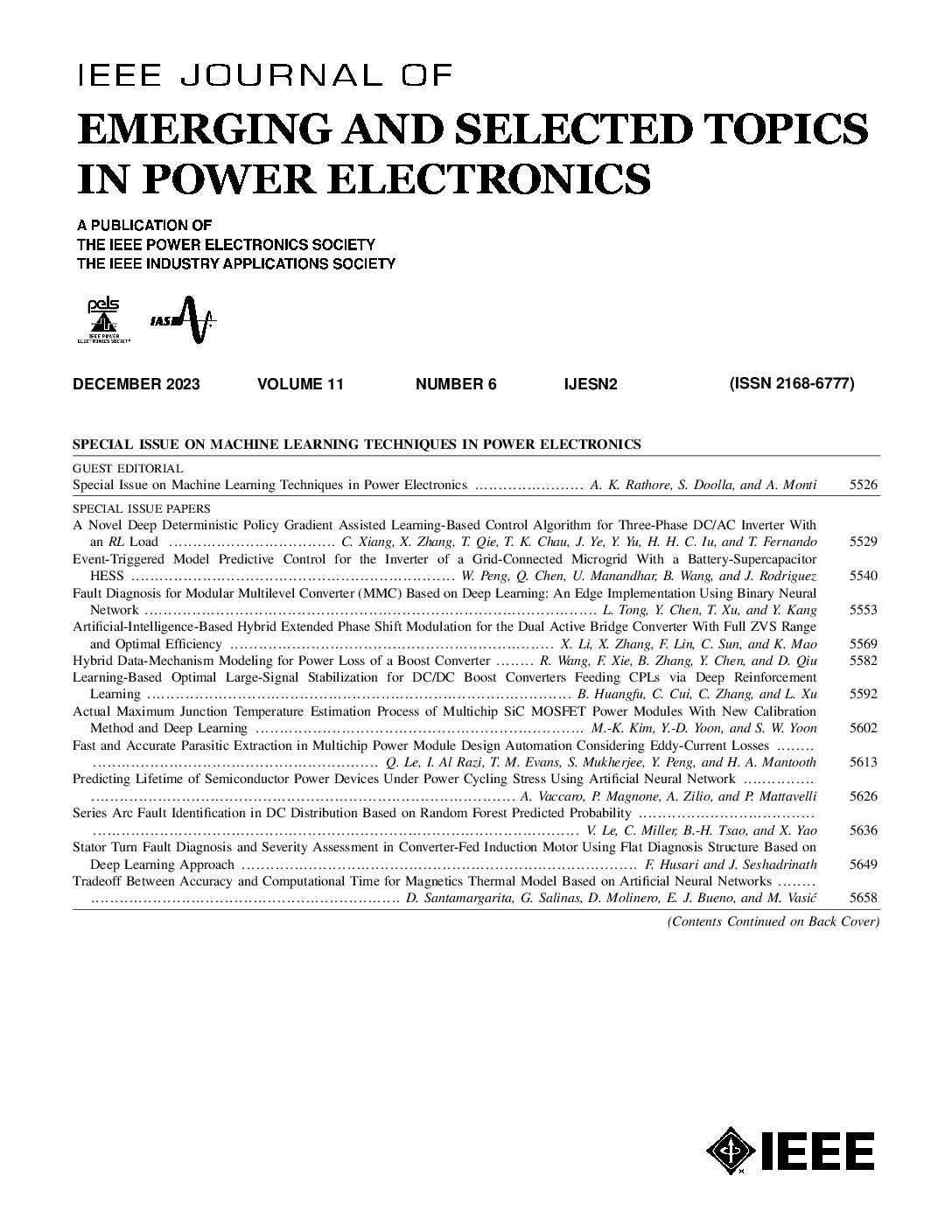
IEEE Journal of Emerging and Selected Topics in Power Electronics
ENGINEERING, ELECTRICAL & ELECTRONIC-
CiteScore
12.50
自引率
9.10%
发文量
547
审稿时长
3 months
期刊介绍:
The aim of the journal is to enable the power electronics community to address the emerging and selected topics in power electronics in an agile fashion. It is a forum where multidisciplinary and discriminating technologies and applications are discussed by and for both practitioners and researchers on timely topics in power electronics from components to systems.
 求助内容:
 应助结果提醒方式:


 京公网安备 11010802042870号


