
OccM3D-SS: Bridging Sparse Supervision With Dense 3D Perception via Semi-Supervised Occupancy Learning

IF 10.8 1区 工程技术 Q1 ENGINEERING, ELECTRICAL & ELECTRONIC
Ke Liu;Xinzhu Ma;Ruxuan Hu;Boqian Liu;Zhiyong Wang;Zhihui Wang
{"title":"OccM3D-SS: Bridging Sparse Supervision With Dense 3D Perception via Semi-Supervised Occupancy Learning","authors":"Ke Liu;Xinzhu Ma;Ruxuan Hu;Boqian Liu;Zhiyong Wang;Zhihui Wang","doi":"10.1109/TCSVT.2026.3724359","DOIUrl":null,"url":null,"abstract":"Monocular 3D object detection faces inherent challenges in reconstructing accurate 3D spatial structures from 2D images due to the lack of depth cues. Existing paradigms either struggle with limited 3D representation capability, <italic>e.g.</i> depth estimation pipeline, or rely heavily on fine-grained supervision annotations, <italic>e.g.</i> occupancy-guided pipeline. Moreover, occupancy labels derived from sparse LiDAR signals are often unreliable, introducing noise into geometric supervision. In this work, we propose <bold>OccM3D-SS</b>, a semi-supervised occupancy-guided framework that integrates occupancy learning with unlabeled sequential data to enhance geometric reasoning. Our framework employs a dual-branch architecture: the supervised branch enforces semantic and geometric perception using annotated data, while the unsupervised branch leverages occupancy constraint to enhance geometric representation capability. Furthermore, to address the label noise issue, we introduce a temporal point-cloud densification strategy by tracking and aggregating foreground points from multi-frames, thereby improving the quality of occupancy annotations significantly. The experimental results on the KITTI-3D and Waymo Open datasets demonstrate that our framework outperforms the baseline by a large margin, achieving state-of-the-art performance while reducing annotation dependency.","PeriodicalId":13082,"journal":{"name":"IEEE Transactions on Circuits and Systems for Video Technology","volume":"36 10","pages":"14826-14837"},"PeriodicalIF":10.8000,"publicationDate":"2026-10-01","publicationTypes":"Journal Article","fieldsOfStudy":null,"isOpenAccess":false,"openAccessPdf":"","citationCount":"0","resultStr":null,"platform":"Semanticscholar","paperid":null,"PeriodicalName":"IEEE Transactions on Circuits and Systems for Video Technology","FirstCategoryId":"5","ListUrlMain":"https://ieeexplore.ieee.org/document/11657456/","RegionNum":1,"RegionCategory":"工程技术","ArticlePicture":[],"TitleCN":null,"AbstractTextCN":null,"PMCID":null,"EPubDate":"2026/8/17 0:00:00","PubModel":"Epub","JCR":"Q1","JCRName":"ENGINEERING, ELECTRICAL & ELECTRONIC","Score":null,"Total":0}
引用次数: 0

Abstract

Monocular 3D object detection faces inherent challenges in reconstructing accurate 3D spatial structures from 2D images due to the lack of depth cues. Existing paradigms either struggle with limited 3D representation capability, e.g. depth estimation pipeline, or rely heavily on fine-grained supervision annotations, e.g. occupancy-guided pipeline. Moreover, occupancy labels derived from sparse LiDAR signals are often unreliable, introducing noise into geometric supervision. In this work, we propose OccM3D-SS, a semi-supervised occupancy-guided framework that integrates occupancy learning with unlabeled sequential data to enhance geometric reasoning. Our framework employs a dual-branch architecture: the supervised branch enforces semantic and geometric perception using annotated data, while the unsupervised branch leverages occupancy constraint to enhance geometric representation capability. Furthermore, to address the label noise issue, we introduce a temporal point-cloud densification strategy by tracking and aggregating foreground points from multi-frames, thereby improving the quality of occupancy annotations significantly. The experimental results on the KITTI-3D and Waymo Open datasets demonstrate that our framework outperforms the baseline by a large margin, achieving state-of-the-art performance while reducing annotation dependency.
OccM3D-SS:通过半监督占用学习架起稀疏监督与密集3D感知的桥梁
由于缺乏深度线索,单目三维物体检测在从二维图像重建精确的三维空间结构方面面临着固有的挑战。现有的范例要么与有限的3D表示能力作斗争,例如深度估计管道,要么严重依赖于细粒度的监督注释,例如占用引导管道。此外,稀疏激光雷达信号产生的占用标签往往不可靠,在几何监督中引入了噪声。在这项工作中,我们提出了OccM3D-SS,这是一种半监督占用引导框架,它将占用学习与未标记的序列数据相结合,以增强几何推理。我们的框架采用双分支架构:监督分支使用带注释的数据强制执行语义和几何感知,而无监督分支利用占用约束来增强几何表示能力。此外,为了解决标签噪声问题,我们引入了一种时间点云密度策略,通过跟踪和聚合来自多帧的前景点,从而显著提高占用注释的质量。在KITTI-3D和Waymo Open数据集上的实验结果表明,我们的框架在很大程度上优于基线,在减少注释依赖的同时实现了最先进的性能。
本文章由计算机程序翻译,如有差异,请以英文原文为准。
求助全文
约1分钟内获得全文 求助全文
来源期刊
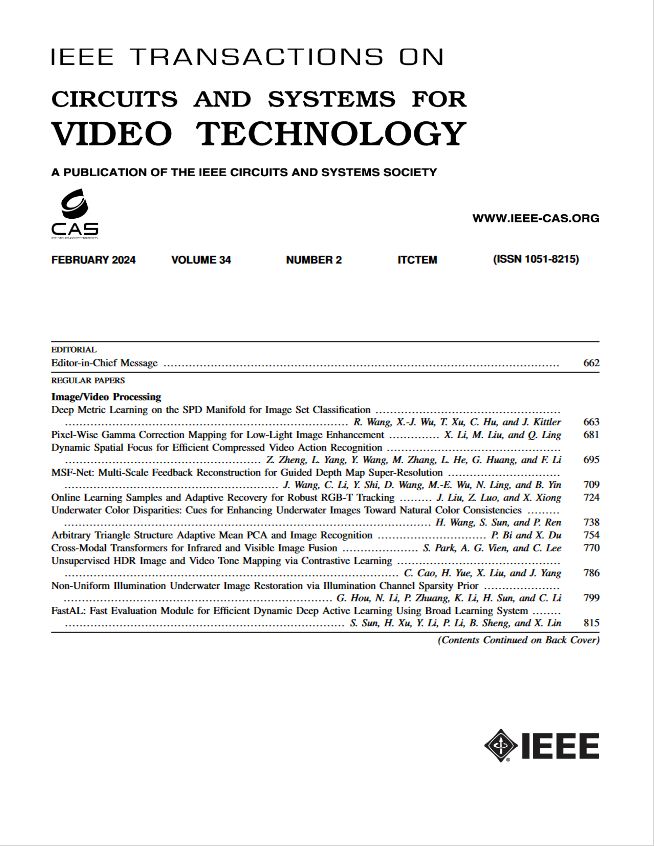
CiteScore
13.80
自引率
27.40%
发文量
660
审稿时长
5 months
期刊介绍: The IEEE Transactions on Circuits and Systems for Video Technology (TCSVT) is dedicated to covering all aspects of video technologies from a circuits and systems perspective. We encourage submissions of general, theoretical, and application-oriented papers related to image and video acquisition, representation, presentation, and display. Additionally, we welcome contributions in areas such as processing, filtering, and transforms; analysis and synthesis; learning and understanding; compression, transmission, communication, and networking; as well as storage, retrieval, indexing, and search. Furthermore, papers focusing on hardware and software design and implementation are highly valued. Join us in advancing the field of video technology through innovative research and insights.

×
引用
GB/T 7714-2015
复制
MLA
复制
APA
复制
导出至
BibTeX EndNote RefMan NoteFirst NoteExpress
×
提示
您的信息不完整,为了账户安全,请先补充。
现在去补充
×
提示
您因"违规操作"
具体请查看互助需知
我知道了
×
提示
确定
请完成安全验证×
copy
已复制链接
快去分享给好友吧!
我知道了
右上角分享
点击右上角分享
0
联系我们:info@booksci.cn Book学术提供免费学术资源搜索服务,方便国内外学者检索中英文文献。致力于提供最便捷和优质的服务体验。 Copyright © 2023 布克学术 All rights reserved.
京ICP备2023020795号-1
ghs 京公网安备 11010802042870号
Book学术文献互助
Book学术文献互助群
群 号:604180095
Book学术官方微信
小红书


