
AdaGuard: Location-Aware Adaptive Defense Against Adversarial Patch Attacks in Vision Transformers

IF 10.8 1区 工程技术 Q1 ENGINEERING, ELECTRICAL & ELECTRONIC
Jinyin Hu;Jiawei Zhou;Zhonghao Yang;Huadi Zheng;Daojing He;Yu Li
{"title":"AdaGuard: Location-Aware Adaptive Defense Against Adversarial Patch Attacks in Vision Transformers","authors":"Jinyin Hu;Jiawei Zhou;Zhonghao Yang;Huadi Zheng;Daojing He;Yu Li","doi":"10.1109/TCSVT.2026.3710546","DOIUrl":null,"url":null,"abstract":"Vision Transformers (ViTs) have achieved state-of-the-art performance across a wide range of vision tasks, yet they remain highly vulnerable to adversarial patch attacks—deliberate image modifications confined to small, localized regions (patches) that can completely mislead the model. Existing defenses often treat all adversarial inputs uniformly, which either removes essential features or fails to eliminate malicious influence, thereby limiting robustness. We present AdaGuard, an adaptive defense framework that combines adversarial patch detection with location-aware treatment. AdaGuard first employs a lightweight, model-agnostic detector based on patch–neighbor discontinuity to accurately localize adversarial regions of unknown size and position. It then distinguishes between <italic>non-catastrophic</i> attacks (patches in less informative regions) and <italic>catastrophic</i> attacks (patches overlapping with essential features). For non-catastrophic cases, AdaGuard reconstructs the region with neighboring content to fully remove adversarial information, while for catastrophic cases it applies fine-grained attention suppression to neutralize adversarial influence without discarding critical features. Experiments on 12 ViT models and multiple attack methods on ImageNet demonstrate that AdaGuard achieves state-of-the-art robust accuracy while preserving clean accuracy, offering a practical defense for ViTs in real-world applications.","PeriodicalId":13082,"journal":{"name":"IEEE Transactions on Circuits and Systems for Video Technology","volume":"36 10","pages":"15305-15316"},"PeriodicalIF":10.8000,"publicationDate":"2026-10-01","publicationTypes":"Journal Article","fieldsOfStudy":null,"isOpenAccess":false,"openAccessPdf":"","citationCount":"0","resultStr":null,"platform":"Semanticscholar","paperid":null,"PeriodicalName":"IEEE Transactions on Circuits and Systems for Video Technology","FirstCategoryId":"5","ListUrlMain":"https://ieeexplore.ieee.org/document/11595869/","RegionNum":1,"RegionCategory":"工程技术","ArticlePicture":[],"TitleCN":null,"AbstractTextCN":null,"PMCID":null,"EPubDate":"2026/7/6 0:00:00","PubModel":"Epub","JCR":"Q1","JCRName":"ENGINEERING, ELECTRICAL & ELECTRONIC","Score":null,"Total":0}
引用次数: 0

Abstract

Vision Transformers (ViTs) have achieved state-of-the-art performance across a wide range of vision tasks, yet they remain highly vulnerable to adversarial patch attacks—deliberate image modifications confined to small, localized regions (patches) that can completely mislead the model. Existing defenses often treat all adversarial inputs uniformly, which either removes essential features or fails to eliminate malicious influence, thereby limiting robustness. We present AdaGuard, an adaptive defense framework that combines adversarial patch detection with location-aware treatment. AdaGuard first employs a lightweight, model-agnostic detector based on patch–neighbor discontinuity to accurately localize adversarial regions of unknown size and position. It then distinguishes between non-catastrophic attacks (patches in less informative regions) and catastrophic attacks (patches overlapping with essential features). For non-catastrophic cases, AdaGuard reconstructs the region with neighboring content to fully remove adversarial information, while for catastrophic cases it applies fine-grained attention suppression to neutralize adversarial influence without discarding critical features. Experiments on 12 ViT models and multiple attack methods on ImageNet demonstrate that AdaGuard achieves state-of-the-art robust accuracy while preserving clean accuracy, offering a practical defense for ViTs in real-world applications.
AdaGuard:针对视觉变形器中对抗性补丁攻击的位置感知自适应防御
视觉变形器(vit)已经在广泛的视觉任务中实现了最先进的性能,但它们仍然非常容易受到对抗性补丁攻击的攻击——故意将图像修改局限于小的局部区域(补丁),这可能会完全误导模型。现有的防御通常统一对待所有对抗性输入,这要么消除了基本特征,要么无法消除恶意影响,从而限制了鲁棒性。我们提出了AdaGuard,一种将对抗性补丁检测与位置感知治疗相结合的自适应防御框架。AdaGuard首先采用了一种轻量级的、基于patch-neighbor不连续的模型不可知检测器来精确定位未知大小和位置的对抗区域。然后,它区分非灾难性攻击(信息较少区域的补丁)和灾难性攻击(与基本特征重叠的补丁)。对于非灾难性的情况,AdaGuard用邻近的内容重建区域,以完全去除对抗信息,而对于灾难性的情况,它应用细粒度的注意力抑制来抵消对抗影响,而不丢弃关键特征。在ImageNet上对12个ViT模型和多种攻击方法进行的实验表明,AdaGuard在保持干净精度的同时实现了最先进的鲁棒精度,为实际应用中的ViT提供了实用的防御。
本文章由计算机程序翻译,如有差异,请以英文原文为准。
求助全文
约1分钟内获得全文 求助全文
来源期刊
CiteScore
13.80
自引率
27.40%
发文量
660
审稿时长
5 months
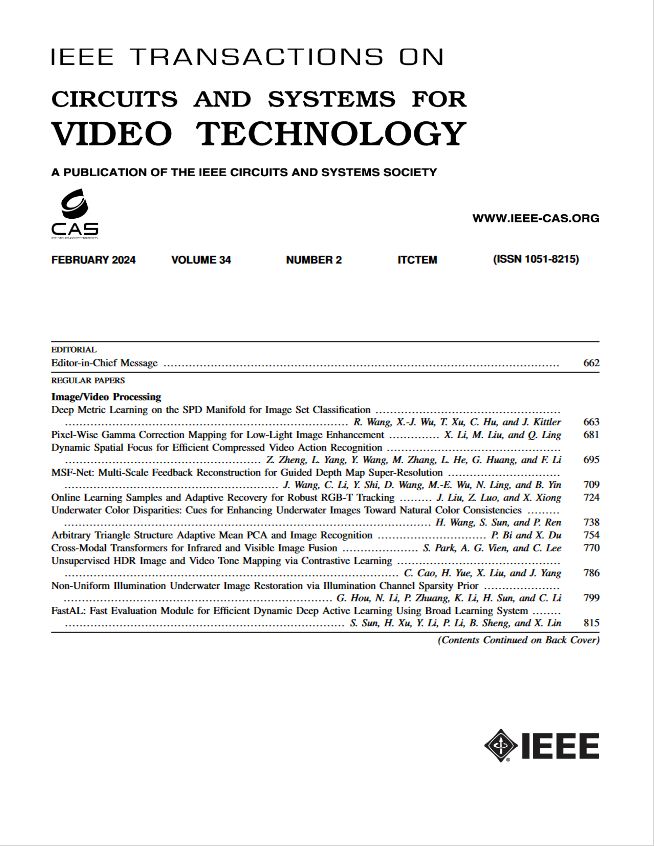
期刊介绍: The IEEE Transactions on Circuits and Systems for Video Technology (TCSVT) is dedicated to covering all aspects of video technologies from a circuits and systems perspective. We encourage submissions of general, theoretical, and application-oriented papers related to image and video acquisition, representation, presentation, and display. Additionally, we welcome contributions in areas such as processing, filtering, and transforms; analysis and synthesis; learning and understanding; compression, transmission, communication, and networking; as well as storage, retrieval, indexing, and search. Furthermore, papers focusing on hardware and software design and implementation are highly valued. Join us in advancing the field of video technology through innovative research and insights.

×
引用
GB/T 7714-2015
复制
MLA
复制
APA
复制
导出至
BibTeX EndNote RefMan NoteFirst NoteExpress
×
提示
您的信息不完整,为了账户安全,请先补充。
现在去补充
×
提示
您因"违规操作"
具体请查看互助需知
我知道了
×
提示
确定
请完成安全验证×
copy
已复制链接
快去分享给好友吧!
我知道了
右上角分享
点击右上角分享
0
联系我们:info@booksci.cn Book学术提供免费学术资源搜索服务,方便国内外学者检索中英文文献。致力于提供最便捷和优质的服务体验。 Copyright © 2023 布克学术 All rights reserved.
京ICP备2023020795号-1
ghs 京公网安备 11010802042870号
Book学术文献互助
Book学术文献互助群
群 号:604180095
Book学术官方微信
小红书


