
A Survey on Reinforcement Learning Methods for Seamless Connectivity in 6G Non-Terrestrial Networks: Algorithms and Key Findings
IF 50.6
1区 计算机科学
Q1 COMPUTER SCIENCE, INFORMATION SYSTEMS
IEEE Communications Surveys and Tutorials
Pub Date : 2026-01-01
Epub Date: 2026-10-06
DOI:10.1109/COMST.2026.3740875
引用次数: 0
Abstract
The vision of sixth-generation (6G) communications aims to achieve global hyperconnectivity by integrating terrestrial, aerial, and maritime domains. Non-terrestrial networks (NTNs) are key enablers of this vision but face inherent challenges such as high mobility, long propagation delays, and limited onboard computation. To address these challenges, reinforcement learning (RL) has emerged as a promising solution. This paper presents a comprehensive tutorial on RL-based methods for seamless 6G NTN connectivity. It adopts a dual perspective: (i) how RL addresses core NTN problems such as handover, beamforming, and resource allocation and (ii) how NTN constraints inspire the development of advanced RL techniques, including quantum RL, graph-based RL, and federated RL. Based on Third Generation Partnership Project (3GPP) Technical Report (TR) 38.811, the paper identifies 14 optimization challenges across four categories of NTN characteristics—platform dynamics, altitude-dependent propagation, system design constraints, and network architecture—surveys state-of-the-art RL approaches, and analyzes their suitability under real-world NTN conditions. It further discusses performance evaluation results and future research directions, identifying open problems and emerging paradigms that will shape the next phase of intelligent NTN systems. By bridging the gap between theory and practical deployment, this work positions RL as a foundational technology for intelligent, adaptive, and resilient 6G NTN systems.6G非地面网络无缝连接的强化学习方法研究:算法和关键发现
第六代(6G)通信的愿景旨在通过整合陆地,空中和海洋领域实现全球超连接。非地面网络(ntn)是实现这一愿景的关键因素,但也面临着诸如高移动性、长传播延迟和有限的机载计算等固有挑战。为了应对这些挑战,强化学习(RL)已经成为一种有前途的解决方案。本文介绍了基于rl的无缝6G NTN连接方法的综合教程。它采用了双重视角:(i) RL如何解决核心NTN问题,如切换、波束形成和资源分配;(ii) NTN约束如何激发先进RL技术的发展,包括量子RL、基于图的RL和联合RL。基于第三代合作伙伴计划(3GPP)技术报告(TR) 38.811,本文确定了四类NTN特征(平台动态、高度相关传播、系统设计约束和网络架构)中的14个优化挑战,调查了最先进的强化学习方法,并分析了它们在实际NTN条件下的适用性。它进一步讨论了性能评估结果和未来的研究方向,确定了将塑造下一阶段智能NTN系统的开放问题和新兴范例。通过缩小理论与实际部署之间的差距,这项工作将RL定位为智能、自适应和弹性6G NTN系统的基础技术。
本文章由计算机程序翻译,如有差异,请以英文原文为准。
求助全文
约1分钟内获得全文
求助全文
来源期刊
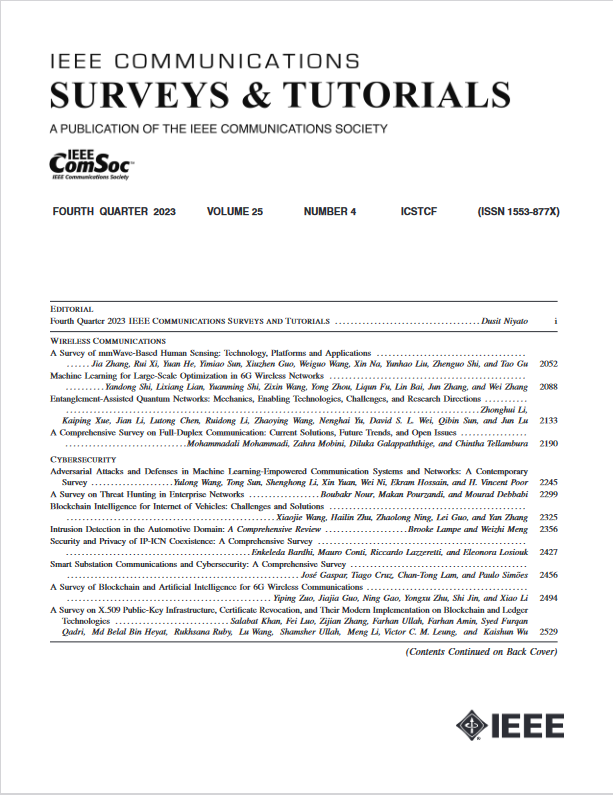
IEEE Communications Surveys and Tutorials
COMPUTER SCIENCE, INFORMATION SYSTEMS-TELECOMMUNICATIONS
CiteScore
80.20
自引率
2.50%
发文量
84
审稿时长
6 months
期刊介绍:
IEEE Communications Surveys & Tutorials is an online journal published by the IEEE Communications Society for tutorials and surveys covering all aspects of the communications field. Telecommunications technology is progressing at a rapid pace, and the IEEE Communications Society is committed to providing researchers and other professionals the information and tools to stay abreast. IEEE Communications Surveys and Tutorials focuses on integrating and adding understanding to the existing literature on communications, putting results in context. Whether searching for in-depth information about a familiar area or an introduction into a new area, IEEE Communications Surveys & Tutorials aims to be the premier source of peer-reviewed, comprehensive tutorials and surveys, and pointers to further sources. IEEE Communications Surveys & Tutorials publishes only articles exclusively written for IEEE Communications Surveys & Tutorials and go through a rigorous review process before their publication in the quarterly issues.
A tutorial article in the IEEE Communications Surveys & Tutorials should be designed to help the reader to become familiar with and learn something specific about a chosen topic. In contrast, the term survey, as applied here, is defined to mean a survey of the literature. A survey article in IEEE Communications Surveys & Tutorials should provide a comprehensive review of developments in a selected area, covering its development from its inception to its current state and beyond, and illustrating its development through liberal citations from the literature. Both tutorials and surveys should be tutorial in nature and should be written in a style comprehensible to readers outside the specialty of the article.
 求助内容:
 应助结果提醒方式:


 京公网安备 11010802042870号


