Kyunghyeon Lee, Ki Hyun Kim, Joshua Mysona, Daniel F. Sunday, Jong Dae Jang, Sang Ho Lee, Ji Sung Park, In Beom Heo, Gordon S. W. Craig, Hyeong Min Jin, Paul F. Nealey
{"title":"Coil- to Worm-like Transition for Short Side chain Polymers: Impact on the Design of High-χ, Low-N Block Copolymers for High-Resolution Patterning","authors":"Kyunghyeon Lee, Ki Hyun Kim, Joshua Mysona, Daniel F. Sunday, Jong Dae Jang, Sang Ho Lee, Ji Sung Park, In Beom Heo, Gordon S. W. Craig, Hyeong Min Jin, Paul F. Nealey","doi":"10.1021/acs.macromol.6c00983","DOIUrl":null,"url":null,"abstract":"<p>As block copolymers (BCPs) are designed to self-assemble with smaller feature sizes, the requirement for a lower degree of polymerization (<em>N</em>) inevitably brings the contour length (<em>L</em><sub>c</sub>) closer to the persistence length (<em>L</em><sub>p</sub>). As <em>L</em><sub>c</sub> approaches <em>L</em><sub>p</sub>, even relatively short side groups on chain segments can drive the system away from flexible chain behavior toward worm-like and rod-like conformations. Here, we demonstrate that side groups consisting of only 8–12 carbon units induce worm-like chain (WLC) behavior at length scales relevant to 16–28 nm BCP domain spacings (<em>L</em><sub>0</sub>). We investigate thiol-modified poly(glycidyl methacrylate) (PGMA), a versatile platform for post-polymerization functionalization that has played a key role in the development of BCPs with A-<em>b</em>-(B-<em>r</em>-C) architectures for applications in directed self-assembly. Small-angle neutron scattering from PGMA-modified 4-methoxythiophenol (4MTP), trifluoroethanethiol (TFET), or mixtures of the thiols reveals rod-like scaling in the high-<em>q</em> regime and a relatively large <em>L</em><sub>p</sub> (2–3 nm), consistent with WLC behavior over block lengths relevant to these systems. All-atom simulation further corroborates reduced conformational flexibility with slower relaxation dynamics for the thiol-modified PGMA. These results provide fundamental insights into the onset of deviations in behavior compared to coil-coil BCPs as a function of <em>N</em> and side group lengths, including changes in scaling, with <em>v</em> > 2/3 for <em>L</em><sub>0</sub> ∼ <em>N</em><sup><em>v</em></sup>, and narrower interfacial widths, and reveal chain stiffness as an additional design parameter for high-χ, low-<em>N</em> block copolymers in high-resolution patterning applications.</p>","PeriodicalId":51,"journal":{"name":"Macromolecules","volume":"59 19","pages":"10781–10793"},"PeriodicalIF":5.7000,"publicationDate":"2026-10-13","publicationTypes":"Journal Article","fieldsOfStudy":null,"isOpenAccess":false,"openAccessPdf":"","citationCount":"0","resultStr":null,"platform":"Semanticscholar","paperid":null,"PeriodicalName":"Macromolecules","FirstCategoryId":"92","ListUrlMain":"https://pubs.acs.org/doi/10.1021/acs.macromol.6c00983","RegionNum":1,"RegionCategory":"化学","ArticlePicture":[],"TitleCN":null,"AbstractTextCN":null,"PMCID":null,"EPubDate":"2026/10/1 0:00:00","PubModel":"Epub","JCR":"Q1","JCRName":"POLYMER SCIENCE","Score":null,"Total":0}
引用次数: 0
Abstract
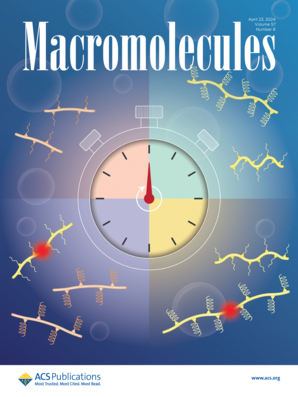
As block copolymers (BCPs) are designed to self-assemble with smaller feature sizes, the requirement for a lower degree of polymerization (N) inevitably brings the contour length (Lc) closer to the persistence length (Lp). As Lc approaches Lp, even relatively short side groups on chain segments can drive the system away from flexible chain behavior toward worm-like and rod-like conformations. Here, we demonstrate that side groups consisting of only 8–12 carbon units induce worm-like chain (WLC) behavior at length scales relevant to 16–28 nm BCP domain spacings (L0). We investigate thiol-modified poly(glycidyl methacrylate) (PGMA), a versatile platform for post-polymerization functionalization that has played a key role in the development of BCPs with A-b-(B-r-C) architectures for applications in directed self-assembly. Small-angle neutron scattering from PGMA-modified 4-methoxythiophenol (4MTP), trifluoroethanethiol (TFET), or mixtures of the thiols reveals rod-like scaling in the high-q regime and a relatively large Lp (2–3 nm), consistent with WLC behavior over block lengths relevant to these systems. All-atom simulation further corroborates reduced conformational flexibility with slower relaxation dynamics for the thiol-modified PGMA. These results provide fundamental insights into the onset of deviations in behavior compared to coil-coil BCPs as a function of N and side group lengths, including changes in scaling, with v > 2/3 for L0 ∼ Nv, and narrower interfacial widths, and reveal chain stiffness as an additional design parameter for high-χ, low-N block copolymers in high-resolution patterning applications.
期刊介绍:
Macromolecules publishes original, fundamental, and impactful research on all aspects of polymer science. Topics of interest include synthesis (e.g., controlled polymerizations, polymerization catalysis, post polymerization modification, new monomer structures and polymer architectures, and polymerization mechanisms/kinetics analysis); phase behavior, thermodynamics, dynamic, and ordering/disordering phenomena (e.g., self-assembly, gelation, crystallization, solution/melt/solid-state characteristics); structure and properties (e.g., mechanical and rheological properties, surface/interfacial characteristics, electronic and transport properties); new state of the art characterization (e.g., spectroscopy, scattering, microscopy, rheology), simulation (e.g., Monte Carlo, molecular dynamics, multi-scale/coarse-grained modeling), and theoretical methods. Renewable/sustainable polymers, polymer networks, responsive polymers, electro-, magneto- and opto-active macromolecules, inorganic polymers, charge-transporting polymers (ion-containing, semiconducting, and conducting), nanostructured polymers, and polymer composites are also of interest. Typical papers published in Macromolecules showcase important and innovative concepts, experimental methods/observations, and theoretical/computational approaches that demonstrate a fundamental advance in the understanding of polymers.

 求助内容:
 应助结果提醒方式:


 京公网安备 11010802042870号


