
Virtual Synchronous Generator Stability Enhancement and Power Oscillation Suppression With Adaptive Virtual Impedance Control
IF 5.7
2区 工程技术
Q1 ENGINEERING, ELECTRICAL & ELECTRONIC
IEEE Journal of Emerging and Selected Topics in Power Electronics
Pub Date : 2026-10-01
Epub Date: 2026-03-01
DOI:10.1109/JESTPE.2026.3689505
引用次数: 0
Abstract
With the rapid growth of renewable power generation (RPG), grid inertia gradually decreases. Therefore, the virtual synchronous generator (VSG) is proposed to enhance the inertia and damping of the power system. High-penetration RPG, characterized by intermittency, stochasticity, and output volatility, could cause grid impedance variations, thereby leading to short-circuit ratio (SCR) fluctuations that are detrimental to system stability. When the grid reactance is much larger than its resistance, VSG is stable under weak grids while less stable under strong grids, so it is challenging for VSG to meet the stability criteria under a wide range of SCRs. Furthermore, power oscillation may occur during SCR fluctuations. Therefore, this article proposes an adaptive virtual impedance (AVI) control strategy which fully retains the characteristics of the grid-forming (GFM) mode, mitigates power oscillation during SCR fluctuations, and improves the stability of VSG under strong grids. First, a state-space model of the VSG is developed to analyze the control parameters. Then, an open-loop small-signal transfer function of the active power loop (APL) is derived to analyze the proposed strategy. Finally, an appropriate feedback coefficient is determined based on the developed model. Experimental results verify the effectiveness of the proposed strategy.自适应虚拟阻抗控制增强虚拟同步发电机稳定性及抑制功率振荡
随着可再生能源发电的快速增长,电网惯性逐渐减小。因此,提出了虚拟同步发电机(VSG)来增强电力系统的惯性和阻尼。高穿深RPG具有间歇性、随机性和输出波动性的特点,可能导致电网阻抗变化,从而导致短路比(SCR)波动,不利于系统稳定性。当电网电抗远大于其电阻时,弱电网条件下VSG稳定,而强电网条件下VSG稳定性较差,因此满足大范围scr条件下VSG的稳定性要求是一项挑战。此外,在可控硅波动期间可能发生功率振荡。因此,本文提出了一种自适应虚拟阻抗(AVI)控制策略,该策略充分保留了电网形成(GFM)模式的特性,减轻了可控硅波动时的功率振荡,提高了强电网下VSG的稳定性。首先,建立了VSG的状态空间模型,对其控制参数进行了分析。然后,推导了有功回路的开环小信号传递函数来分析所提出的策略。最后,根据所建立的模型确定合适的反馈系数。实验结果验证了该策略的有效性。
本文章由计算机程序翻译,如有差异,请以英文原文为准。
求助全文
约1分钟内获得全文
求助全文
来源期刊
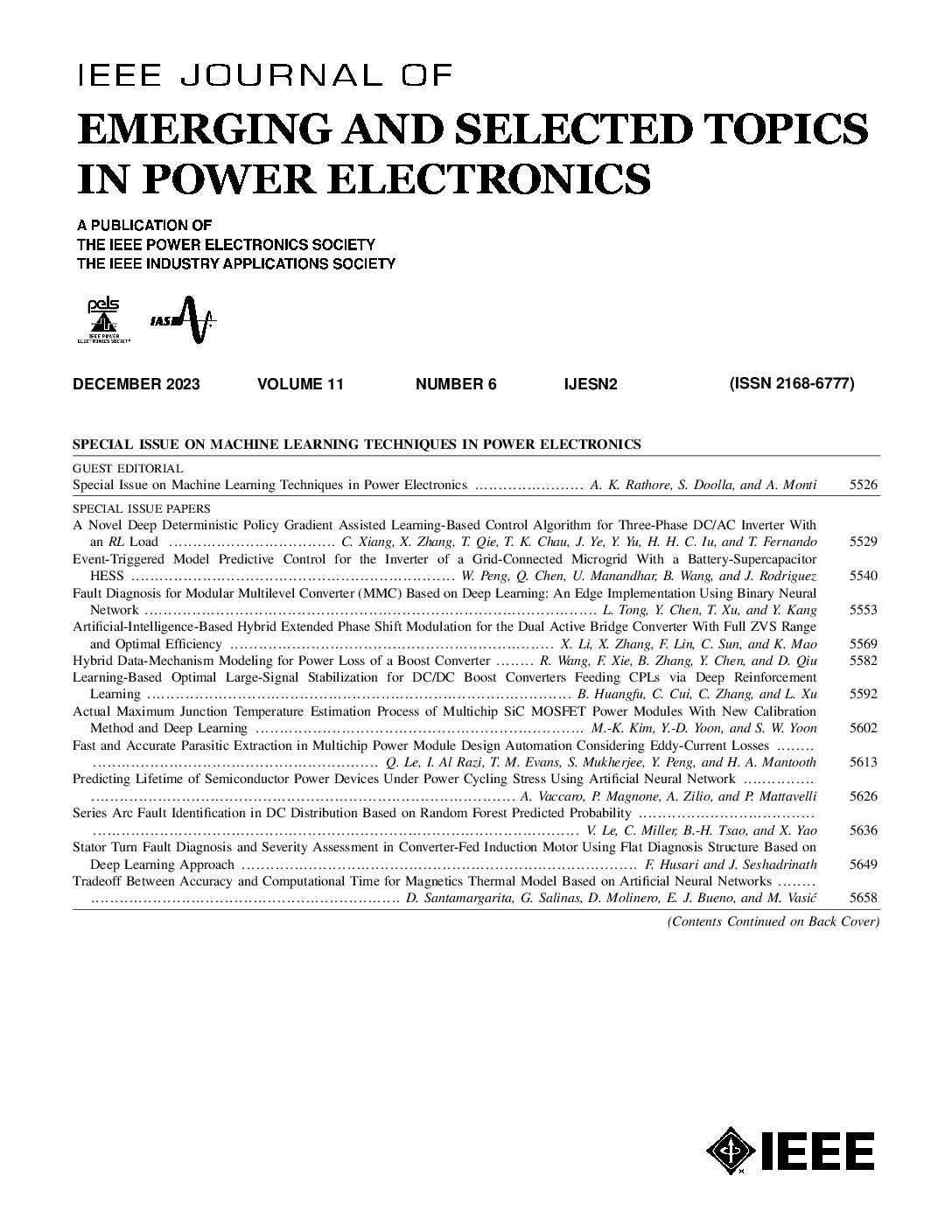
IEEE Journal of Emerging and Selected Topics in Power Electronics
ENGINEERING, ELECTRICAL & ELECTRONIC-
CiteScore
12.50
自引率
9.10%
发文量
547
审稿时长
3 months
期刊介绍:
The aim of the journal is to enable the power electronics community to address the emerging and selected topics in power electronics in an agile fashion. It is a forum where multidisciplinary and discriminating technologies and applications are discussed by and for both practitioners and researchers on timely topics in power electronics from components to systems.
 求助内容:
 应助结果提醒方式:


 京公网安备 11010802042870号


