
Model Vectorization and Low-Fluctuation Method for Dynamic Wireless Power Transfer
IF 5.7
2区 工程技术
Q1 ENGINEERING, ELECTRICAL & ELECTRONIC
IEEE Journal of Emerging and Selected Topics in Power Electronics
Pub Date : 2026-10-01
Epub Date: 2026-03-04
DOI:10.1109/JESTPE.2026.3689746
引用次数: 0
Abstract
Dynamic wireless power transfer (DWPT) is a pivotal technology for future mobile electrical energy interaction. However, its widespread adoption is challenged by significant transfer fluctuations induced by spatial and temporal factors. This article proposes a vectorization method of variables to reconstruct the controlled scalar variables into space vector variables for analyzing fluctuations in both spatial and temporal factors. A vector-based model is further established for the multiple-transmitter (Tx)–single-receiver (Rx) DWPT system. To improve the performance, the model is constrained and ultimately simplified into a single-Tx–single-Rx model. Based on this model, a stable output of the Rx is achieved just by maintaining the amplitude of the input voltage vector, which can track the Rx position synchronously. This article further investigates the impact of the coil design parameters on the electrical parameters, cross-coupling, fundamental content, and offset of coupling coefficient curves, which can impact the model and system performance through the analysis. Compared with two existing advanced methods, the proposed approach demonstrates superior performance in experiments: power fluctuations remain around ±1.2% across all tested positions, and average efficiency exceeds 90%, peaking at 92.3%.动态无线电力传输的模型矢量化和低波动方法
动态无线能量传输(DWPT)是未来移动电能交互的关键技术。然而,它的广泛采用受到空间和时间因素引起的重大转移波动的挑战。本文提出了一种变量矢量化方法,将被控制的标量变量重构为空间矢量变量,用于分析时空因素的波动。进一步建立了多发射机-单接收机DWPT系统的矢量模型。为了提高性能,对模型进行约束,最终简化为单tx -单rx模型。基于该模型,只需保持输入电压矢量的幅值,即可实现Rx的稳定输出,并且可以同步跟踪Rx的位置。本文通过分析,进一步研究了线圈设计参数对耦合系数曲线的电气参数、交叉耦合、基本内容和偏移量的影响,从而影响模型和系统性能。与现有的两种先进方法相比,本文方法在实验中表现出了优越的性能,在所有测试位置的功率波动保持在±1.2%左右,平均效率超过90%,峰值为92.3%。
本文章由计算机程序翻译,如有差异,请以英文原文为准。
求助全文
约1分钟内获得全文
求助全文
来源期刊
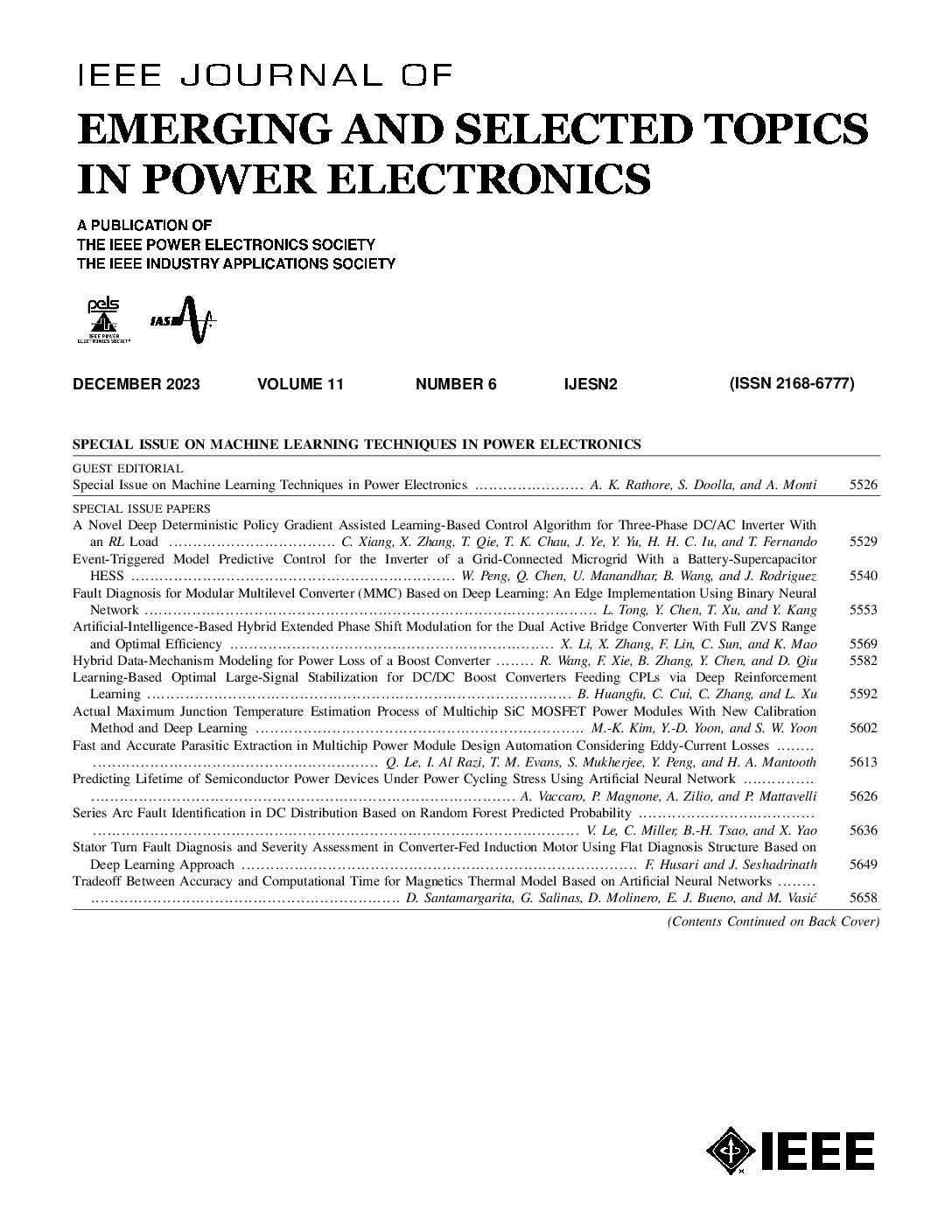
IEEE Journal of Emerging and Selected Topics in Power Electronics
ENGINEERING, ELECTRICAL & ELECTRONIC-
CiteScore
12.50
自引率
9.10%
发文量
547
审稿时长
3 months
期刊介绍:
The aim of the journal is to enable the power electronics community to address the emerging and selected topics in power electronics in an agile fashion. It is a forum where multidisciplinary and discriminating technologies and applications are discussed by and for both practitioners and researchers on timely topics in power electronics from components to systems.
 求助内容:
 应助结果提醒方式:


 京公网安备 11010802042870号


