Maham Azhar, Lasse Hunger, Loai Al-Sheakh, Andreas Appelhagen, Lennart Kruse, Ralf Ludwig
{"title":"Structural and Spectroscopic Evidence of Hydrogen Bonded Anionic Wires in Protic Ionic Liquids","authors":"Maham Azhar, Lasse Hunger, Loai Al-Sheakh, Andreas Appelhagen, Lennart Kruse, Ralf Ludwig","doi":"10.1002/cphc.70581","DOIUrl":null,"url":null,"abstract":"<p>Hydrogen Bonding (H-bonds) between ions of like charge challenges the fundamental principle of electrostatics that opposite charges attract and like charges repel. This study provides direct structural and spectroscopic evidence of H-bonded anionic wires in protic ionic liquids (PILs), which consist of triethylammonium cations and hydrogen dicarboxylate anions. The anionic wires were identified by X-ray crystallography in the solid state, wherein the anions are linked by <sup>−</sup>OH···O<sup>−</sup> type H-bonds. The H-bonds within the anionic wire are significantly stronger than those between cation and anion despite repulsive Coulomb interaction in the first and attractive ones in the latter case. Analysis by nuclear magnetic resonance (NMR) and infrared (IR) spectroscopy suggests that the binding motifs of the solid structure are mainly preserved in the liquid state of the supercooled PILs. This conclusion is drawn from density functional theory (DFT) calculations of the same structural motifs as observed in the solid state. The calculated <sup>1</sup>H NMR chemical shifts and IR C═O frequencies for these H-bond structures correspond well with the measured spectroscopic signatures. The anionic chains remain intact even when gradually removing the counterions. Our findings highlight the fundamental role of hydrogen bonding for the unusual attractive interaction between ions of like charge.</p>","PeriodicalId":9819,"journal":{"name":"Chemphyschem","volume":"27 19","pages":""},"PeriodicalIF":2.4000,"publicationDate":"2026-09-29","publicationTypes":"Journal Article","fieldsOfStudy":null,"isOpenAccess":false,"openAccessPdf":"https://www.ncbi.nlm.nih.gov/pmc/articles/PMC13624368/pdf/","citationCount":"0","resultStr":null,"platform":"Semanticscholar","paperid":null,"PeriodicalName":"Chemphyschem","FirstCategoryId":"92","ListUrlMain":"https://onlinelibrary.wiley.com/doi/10.1002/cphc.70581","RegionNum":3,"RegionCategory":"化学","ArticlePicture":[],"TitleCN":null,"AbstractTextCN":null,"PMCID":null,"EPubDate":"","PubModel":"","JCR":"Q3","JCRName":"CHEMISTRY, PHYSICAL","Score":null,"Total":0}
引用次数: 0
Abstract
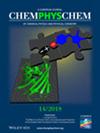
Hydrogen Bonding (H-bonds) between ions of like charge challenges the fundamental principle of electrostatics that opposite charges attract and like charges repel. This study provides direct structural and spectroscopic evidence of H-bonded anionic wires in protic ionic liquids (PILs), which consist of triethylammonium cations and hydrogen dicarboxylate anions. The anionic wires were identified by X-ray crystallography in the solid state, wherein the anions are linked by −OH···O− type H-bonds. The H-bonds within the anionic wire are significantly stronger than those between cation and anion despite repulsive Coulomb interaction in the first and attractive ones in the latter case. Analysis by nuclear magnetic resonance (NMR) and infrared (IR) spectroscopy suggests that the binding motifs of the solid structure are mainly preserved in the liquid state of the supercooled PILs. This conclusion is drawn from density functional theory (DFT) calculations of the same structural motifs as observed in the solid state. The calculated 1H NMR chemical shifts and IR C═O frequencies for these H-bond structures correspond well with the measured spectroscopic signatures. The anionic chains remain intact even when gradually removing the counterions. Our findings highlight the fundamental role of hydrogen bonding for the unusual attractive interaction between ions of like charge.
期刊介绍:
ChemPhysChem is one of the leading chemistry/physics interdisciplinary journals (ISI Impact Factor 2018: 3.077) for physical chemistry and chemical physics. It is published on behalf of Chemistry Europe, an association of 16 European chemical societies.
ChemPhysChem is an international source for important primary and critical secondary information across the whole field of physical chemistry and chemical physics. It integrates this wide and flourishing field ranging from Solid State and Soft-Matter Research, Electro- and Photochemistry, Femtochemistry and Nanotechnology, Complex Systems, Single-Molecule Research, Clusters and Colloids, Catalysis and Surface Science, Biophysics and Physical Biochemistry, Atmospheric and Environmental Chemistry, and many more topics. ChemPhysChem is peer-reviewed.

 求助内容:
 应助结果提醒方式:


 京公网安备 11010802042870号


