Yuyang Qian, Bo Wang, Guangsong Su, Peng Li, Zhenhao Zhao, Yuan Jiang, Lei Zhang, Zhongfang Zhao, Mulin Jun Li, Jiandang Shi, Dandan Huang, Wange Lu
{"title":"<i>HOTAIR</i> Promotes Prostate Cancer Progression by facilitating CDK9-Pol II Association and Transcriptional Elongation.","authors":"Yuyang Qian, Bo Wang, Guangsong Su, Peng Li, Zhenhao Zhao, Yuan Jiang, Lei Zhang, Zhongfang Zhao, Mulin Jun Li, Jiandang Shi, Dandan Huang, Wange Lu","doi":"10.7150/ijbs.134766","DOIUrl":null,"url":null,"abstract":"<p><p>Previous research has predominantly focused on the regulatory role of lncRNA <i>HOTAIR</i> in gene silencing by interacting with the Polycomb repressive complex 2 (PRC2), but its direct role as a transcriptional activator remains less well characterized. Here, our study reveals a novel regulatory mechanism of <i>HOTAIR</i>, which facilitates prostate cancer (PCa) progression by enhancing transcription elongation. Integrating ChIRP-seq, RNA-seq, and ChIP-seq, we found that HOTAIR co-localizes with AR and facilitates the interaction between CDK9 and Pol II. This function requires the 1-442 nt region and intact RNA, as deletion or RNase treatment disrupts the interaction. Re-expression of full-length HOTAIR, but not the deletion mutant, restores nascent transcription of target genes; conversely, CDK9 inhibition suppresses this elongation effect. We identified <i>MMP14</i> and <i>TNFAIP2</i> as functional downstream targets; ectopic expression of either rescues colony formation and invasive migration upon <i>HOTAIR</i> depletion. <i>HOTAIR</i> knockdown reduced Ser2P and Ser5P signals at target loci, yet RNA pull-down showed no direct binding to Pol II Ser5P, implying that any effect on initiation is indirect. This elongation activity operates in both AR-positive and AR-negative cells, with AR acting as a context-specific recruiter. Collectively, these findings support a model in which <i>HOTAIR</i> functions as an elongation activator and suggest potential therapeutic targets in prostate cancer.</p>","PeriodicalId":13762,"journal":{"name":"International Journal of Biological Sciences","volume":"22 14","pages":"8054-8073"},"PeriodicalIF":11.7000,"publicationDate":"2026-09-10","publicationTypes":"Journal Article","fieldsOfStudy":null,"isOpenAccess":false,"openAccessPdf":"https://www.ncbi.nlm.nih.gov/pmc/articles/PMC13618222/pdf/","citationCount":"0","resultStr":null,"platform":"Semanticscholar","paperid":null,"PeriodicalName":"International Journal of Biological Sciences","FirstCategoryId":"99","ListUrlMain":"https://doi.org/10.7150/ijbs.134766","RegionNum":2,"RegionCategory":"生物学","ArticlePicture":[],"TitleCN":null,"AbstractTextCN":null,"PMCID":null,"EPubDate":"2026/1/1 0:00:00","PubModel":"eCollection","JCR":"Q1","JCRName":"BIOCHEMISTRY & MOLECULAR BIOLOGY","Score":null,"Total":0}
引用次数: 0
Abstract
Previous research has predominantly focused on the regulatory role of lncRNA HOTAIR in gene silencing by interacting with the Polycomb repressive complex 2 (PRC2), but its direct role as a transcriptional activator remains less well characterized. Here, our study reveals a novel regulatory mechanism of HOTAIR, which facilitates prostate cancer (PCa) progression by enhancing transcription elongation. Integrating ChIRP-seq, RNA-seq, and ChIP-seq, we found that HOTAIR co-localizes with AR and facilitates the interaction between CDK9 and Pol II. This function requires the 1-442 nt region and intact RNA, as deletion or RNase treatment disrupts the interaction. Re-expression of full-length HOTAIR, but not the deletion mutant, restores nascent transcription of target genes; conversely, CDK9 inhibition suppresses this elongation effect. We identified MMP14 and TNFAIP2 as functional downstream targets; ectopic expression of either rescues colony formation and invasive migration upon HOTAIR depletion. HOTAIR knockdown reduced Ser2P and Ser5P signals at target loci, yet RNA pull-down showed no direct binding to Pol II Ser5P, implying that any effect on initiation is indirect. This elongation activity operates in both AR-positive and AR-negative cells, with AR acting as a context-specific recruiter. Collectively, these findings support a model in which HOTAIR functions as an elongation activator and suggest potential therapeutic targets in prostate cancer.
期刊介绍:
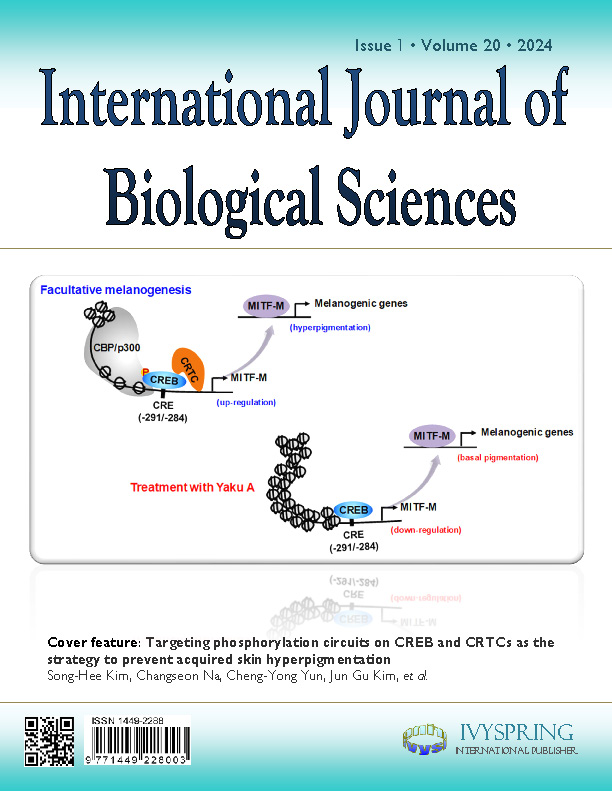
The International Journal of Biological Sciences is a peer-reviewed, open-access scientific journal published by Ivyspring International Publisher. It dedicates itself to publishing original articles, reviews, and short research communications across all domains of biological sciences.

 求助内容:
 应助结果提醒方式:


 京公网安备 11010802042870号


