
A Dynamic Event-Triggered Fuzzy $H_{i}/H_{\infty}$ Optimization Approach to Fault Detection for T-S Fuzzy Systems
IF 18.3
1区 计算机科学
Q1 AUTOMATION & CONTROL SYSTEMS
Ieee-Caa Journal of Automatica Sinica
Pub Date : 2026-09-01
Epub Date: 2026-09-29
DOI:10.1109/JAS.2026.125891
引用次数: 0
Abstract
This paper investigates the problem of dynamic event-triggered optimal fault detection (FD) for Takagi-Sugeno (T-S) fuzzy systems. Aiming at conserving limited communication resources, a dynamic event-triggering mechanism is implemented to transmit the system measurement to the remote fault detector. Based on it, a dynamic event-triggered T-S fuzzy fault detection filter (FDF) is constructed so that the generated residual is completely decoupled from the event-triggered transmission error. Subsequently, the design of T-S fuzzy FDF is formulated as an一种动态事件触发模糊$H_{i}/H_{\infty}$优化方法用于T-S模糊系统故障检测
研究了Takagi-Sugeno (T-S)模糊系统的动态事件触发最优故障检测问题。为了节约有限的通信资源,实现了动态事件触发机制,将系统测量值传递给远程故障检测器。在此基础上,构造了一个动态事件触发T-S模糊故障检测滤波器,使产生的残差与事件触发的传输误差完全解耦。随后,将T-S模糊FDF的设计制定为$H_{i}/H_{\infty}$优化问题,以便在对未知输入的鲁棒性和对故障的灵敏度之间实现最优权衡。与现有基于线性矩阵不等式的T-S模糊系统事件触发FD方法不同,该方法通过递归计算Riccati方程获得最优解,允许事件生成器和$H_{i}/H_{\infty}$ -FDF独立实现。以一个三相感应电机系统为例,说明了该方法的有效性。
本文章由计算机程序翻译,如有差异,请以英文原文为准。
求助全文
约1分钟内获得全文
求助全文
来源期刊
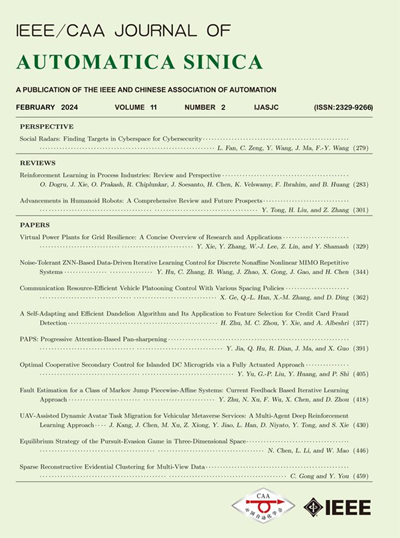
Ieee-Caa Journal of Automatica Sinica
Engineering-Control and Systems Engineering
CiteScore
23.50
自引率
11.00%
发文量
880
期刊介绍:
The IEEE/CAA Journal of Automatica Sinica is a reputable journal that publishes high-quality papers in English on original theoretical/experimental research and development in the field of automation. The journal covers a wide range of topics including automatic control, artificial intelligence and intelligent control, systems theory and engineering, pattern recognition and intelligent systems, automation engineering and applications, information processing and information systems, network-based automation, robotics, sensing and measurement, and navigation, guidance, and control.
Additionally, the journal is abstracted/indexed in several prominent databases including SCIE (Science Citation Index Expanded), EI (Engineering Index), Inspec, Scopus, SCImago, DBLP, CNKI (China National Knowledge Infrastructure), CSCD (Chinese Science Citation Database), and IEEE Xplore.
 求助内容:
 应助结果提醒方式:


 京公网安备 11010802042870号


