
Effects of ultrasound‐guided ipsilateral internal jugular vein compression on catheter malposition during ultrasound‐guided right infraclavicular subclavian venous catheterisation: a randomised controlled trial

IF 7.4 1区 医学 Q1 ANESTHESIOLOGY
Anaesthesia Pub Date : 2026-09-25 DOI:10.1111/anae.70419
Seoyoung Ma, Jangwu Kim, Kyung Won Shin, Woo‐Young Jo, Hee‐Pyoung Park, Hyongmin Oh
{"title":"Effects of ultrasound‐guided ipsilateral internal jugular vein compression on catheter malposition during ultrasound‐guided right infraclavicular subclavian venous catheterisation: a randomised controlled trial","authors":"Seoyoung Ma, Jangwu Kim, Kyung Won Shin, Woo‐Young Jo, Hee‐Pyoung Park, Hyongmin Oh","doi":"10.1111/anae.70419","DOIUrl":null,"url":null,"abstract":"Summary Introduction Central venous catheter malposition into the ipsilateral internal jugular vein (IJV) is an unresolved concern in ultrasound‐guided right infraclavicular subclavian venous catheterisation. We sought to investigate whether ultrasound‐guided ipsilateral IJV compression during guidewire advancement reduces catheter malposition during this procedure. Methods Adult patients undergoing elective neurosurgical procedures requiring an ultrasound‐guided right infraclavicular subclavian venous catheterisation were included in this study. Patients were assigned randomly to the IJV compression group or control group. In patients assigned to the IJV compression group, external compression was applied with an ultrasound probe to physically collapse the ipsilateral proximal IJV during guidewire advancement. The primary outcome was the incidence of overall catheter malposition. Secondary outcomes included the incidence of other catheterisation‐related complications (e.g. catheter malposition into the ipsilateral internal jugular or contralateral brachiocephalic veins) and catheterisation performance indices (e.g. catheterisation time). Results A total of 157 and 158 patients were assigned randomly to the IJV compression and control groups, respectively. Overall, we found that catheter malposition occurred less frequently in the IJV compression group (9/157 (6%) vs. 20/158 (13%); difference in proportions ‐6.9%, 95%CI ‐13.3% to ‐0.6%; OR 0.42, 95%CI 0.18–0.95; p = 0.034). Except for longer median (IQR [range]) catheterisation times in the IJV compression group (139 (114–172 [48–298]) s vs. 114 (90–150 [50–274]) s; p < 0.001), other between‐group differences in the secondary outcomes were not significant. All instances of catheter malposition into the ipsilateral IJV were corrected successfully by guidewire reinsertion under ultrasound‐guided ipsilateral IJV compression with maximal force. Discussion Ultrasound‐guided ipsilateral IJV compression during guidewire advancement can be an effective intervention to prevent catheter malposition during ultrasound‐guided right infraclavicular subclavian venous catheterisation.","PeriodicalId":7742,"journal":{"name":"Anaesthesia","volume":"32 1","pages":""},"PeriodicalIF":7.4000,"publicationDate":"2026-09-25","publicationTypes":"Journal Article","fieldsOfStudy":null,"isOpenAccess":false,"openAccessPdf":"","citationCount":"0","resultStr":null,"platform":"Semanticscholar","paperid":null,"PeriodicalName":"Anaesthesia","FirstCategoryId":"3","ListUrlMain":"https://doi.org/10.1111/anae.70419","RegionNum":1,"RegionCategory":"医学","ArticlePicture":[],"TitleCN":null,"AbstractTextCN":null,"PMCID":null,"EPubDate":"","PubModel":"","JCR":"Q1","JCRName":"ANESTHESIOLOGY","Score":null,"Total":0}
引用次数: 0

Abstract

Summary Introduction Central venous catheter malposition into the ipsilateral internal jugular vein (IJV) is an unresolved concern in ultrasound‐guided right infraclavicular subclavian venous catheterisation. We sought to investigate whether ultrasound‐guided ipsilateral IJV compression during guidewire advancement reduces catheter malposition during this procedure. Methods Adult patients undergoing elective neurosurgical procedures requiring an ultrasound‐guided right infraclavicular subclavian venous catheterisation were included in this study. Patients were assigned randomly to the IJV compression group or control group. In patients assigned to the IJV compression group, external compression was applied with an ultrasound probe to physically collapse the ipsilateral proximal IJV during guidewire advancement. The primary outcome was the incidence of overall catheter malposition. Secondary outcomes included the incidence of other catheterisation‐related complications (e.g. catheter malposition into the ipsilateral internal jugular or contralateral brachiocephalic veins) and catheterisation performance indices (e.g. catheterisation time). Results A total of 157 and 158 patients were assigned randomly to the IJV compression and control groups, respectively. Overall, we found that catheter malposition occurred less frequently in the IJV compression group (9/157 (6%) vs. 20/158 (13%); difference in proportions ‐6.9%, 95%CI ‐13.3% to ‐0.6%; OR 0.42, 95%CI 0.18–0.95; p = 0.034). Except for longer median (IQR [range]) catheterisation times in the IJV compression group (139 (114–172 [48–298]) s vs. 114 (90–150 [50–274]) s; p < 0.001), other between‐group differences in the secondary outcomes were not significant. All instances of catheter malposition into the ipsilateral IJV were corrected successfully by guidewire reinsertion under ultrasound‐guided ipsilateral IJV compression with maximal force. Discussion Ultrasound‐guided ipsilateral IJV compression during guidewire advancement can be an effective intervention to prevent catheter malposition during ultrasound‐guided right infraclavicular subclavian venous catheterisation.
超声引导下同侧颈内静脉压迫对右侧锁骨下静脉置管过程中导管错位的影响:一项随机对照试验
中心静脉导管错置至同侧颈内静脉(IJV)是超声引导下右侧锁骨下静脉置管术中尚未解决的问题。我们试图研究超声引导下在导丝推进过程中同侧IJV压迫是否能减少手术过程中导管错位。方法接受选择性神经外科手术、需要超声引导的右侧锁骨下静脉置管的成年患者纳入本研究。患者随机分为IJV压迫组和对照组。在被分配到IJV压迫组的患者中,在导丝推进过程中,使用超声探头进行外压迫,物理塌陷同侧IJV近端。主要观察指标是总体导管错位的发生率。次要结果包括其他导管相关并发症的发生率(例如导管错位进入同侧颈内静脉或对侧头臂静脉)和导管性能指标(例如导管时间)。结果157例和158例患者随机分为IJV压迫组和对照组。总的来说,我们发现IJV压迫组的导管错位发生率较低(9/157 (6%)vs. 20/158 (13%);比例差异- 6.9%,95%CI - 13.3%至- 0.6%;Or 0.42, 95%ci 0.18-0.95;P = 0.034)。除了IJV压迫组的中位(IQR[范围])置管时间更长(139 (114 - 172 [48-298])s vs. 114 (90-150 [50-274]) s;P < 0.001),其他次要结局组间差异无统计学意义。所有导管错位进入同侧IJV的病例均在超声引导下用最大的力将导丝重新插入同侧IJV,并成功矫正。超声引导下在导丝推进过程中对同侧IJV进行压迫是一种有效的干预措施,可防止超声引导下右侧锁骨下静脉置管过程中导管错位。
本文章由计算机程序翻译,如有差异,请以英文原文为准。
求助全文
约1分钟内获得全文 求助全文
来源期刊
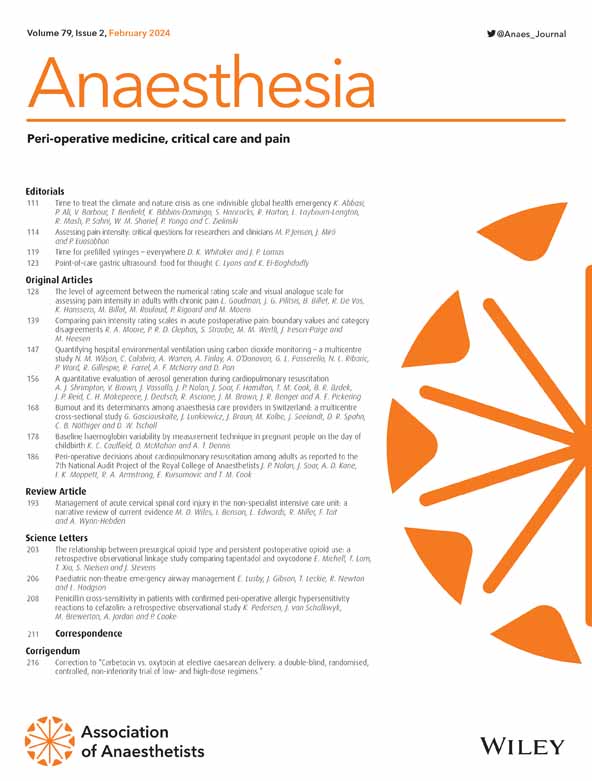
Anaesthesia
Anaesthesia 医学-麻醉学
CiteScore
21.20
自引率
9.30%
发文量
300
审稿时长
6 months
期刊介绍: The official journal of the Association of Anaesthetists is Anaesthesia. It is a comprehensive international publication that covers a wide range of topics. The journal focuses on general and regional anaesthesia, as well as intensive care and pain therapy. It includes original articles that have undergone peer review, covering all aspects of these fields, including research on equipment.

×
引用
GB/T 7714-2015
复制
MLA
复制
APA
复制
导出至
BibTeX EndNote RefMan NoteFirst NoteExpress
×
提示
您的信息不完整,为了账户安全,请先补充。
现在去补充
×
提示
您因"违规操作"
具体请查看互助需知
我知道了
×
提示
确定
请完成安全验证×
copy
已复制链接
快去分享给好友吧!
我知道了
右上角分享
点击右上角分享
0
联系我们:info@booksci.cn Book学术提供免费学术资源搜索服务,方便国内外学者检索中英文文献。致力于提供最便捷和优质的服务体验。 Copyright © 2023 布克学术 All rights reserved.
京ICP备2023020795号-1
ghs 京公网安备 11010802042870号
Book学术文献互助
Book学术文献互助群
群 号:604180095
Book学术官方微信
小红书


