
SETDB1 cooperates with the CRL4B complex to promote colorectal cancer tumorigenesis by disrupting circadian rhythm
IF 9.1
1区 医学
Q1 BIOCHEMISTRY & MOLECULAR BIOLOGY
引用次数: 0
Abstract
The circadian rhythm is an intrinsic, self-regulatory physiological system in organisms that is hierarchically governed by core clock genes. Dysregulation of this rhythm is closely associated with tumor progression. However, the specific molecular mechanisms underlying circadian rhythm disruption–mediated colorectal cancer (CRC) remain largely elusive. The histone methyltransferase SET domain bifurcated 1 (SETDB1) exerts oncogenic functions in multiple solid tumors, prompting this study to investigate the molecular mechanisms through which SETDB1 regulates CRC progression. Our results demonstrate that SETDB1 acts as an oncogene in CRC by interacting with the Cullin 4B-RING E3 ligase (CRL4B) complex to enhance cancer cell proliferation, invasion, and stemness maintenance. Specifically, SETDB1 and the CRL4B complex assemble into a transcriptional repressor complex that binds to the promoters of core clock genes, such as PER3 and CRY1, to repress their transcription, thereby disrupting cellular circadian rhythms and ultimately accelerating CRC cell proliferation and metastasis. Collectively, our findings elucidate the pivotal role of the SETDB1/CRL4B complex in CRC pathogenesis and provide a potential therapeutic strategy targeting SETDB1 for patients with CRC with high CUL4B expression.SETDB1与CRL4B复合体通过破坏昼夜节律促进结直肠癌肿瘤发生。
昼夜节律是生物体内在的、自我调节的生理系统,在层次上由核心时钟基因控制。这种节律失调与肿瘤进展密切相关。然而,昼夜节律紊乱介导的结直肠癌(CRC)的具体分子机制在很大程度上仍然难以捉摸。组蛋白甲基转移酶SET结构域分叉1 (SETDB1)在多种实体肿瘤中发挥致癌功能,促使本研究探讨SETDB1调节CRC进展的分子机制。我们的研究结果表明,SETDB1通过与Cullin 4B-RING E3连接酶(CRL4B)复合物相互作用,在结直肠癌中作为癌基因,增强癌细胞的增殖、侵袭和干细胞维持。具体来说,SETDB1和CRL4B复合体组装成一个转录抑制复合体,结合核心时钟基因的启动子,如PER3和CRY1,抑制其转录,从而破坏细胞昼夜节律,最终加速CRC细胞增殖和转移。总之,我们的研究结果阐明了SETDB1/CRL4B复合物在结直肠癌发病机制中的关键作用,并为高CUL4B表达的结直肠癌患者提供了一种针对SETDB1的潜在治疗策略。
本文章由计算机程序翻译,如有差异,请以英文原文为准。
求助全文
约1分钟内获得全文
求助全文
来源期刊
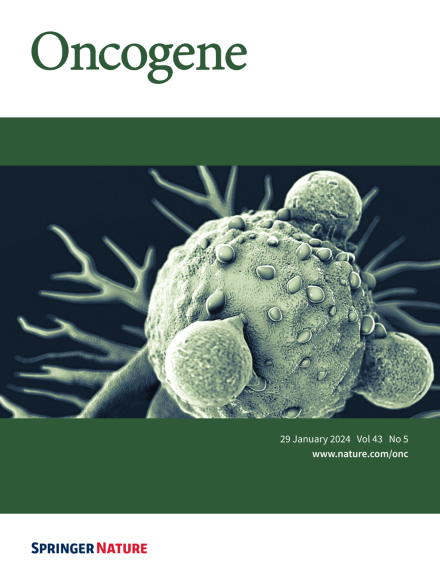
Oncogene
医学-生化与分子生物学
CiteScore
15.30
自引率
1.20%
发文量
404
审稿时长
1 months
期刊介绍:
Oncogene is dedicated to advancing our understanding of cancer processes through the publication of exceptional research. The journal seeks to disseminate work that challenges conventional theories and contributes to establishing new paradigms in the etio-pathogenesis, diagnosis, treatment, or prevention of cancers. Emphasis is placed on research shedding light on processes driving metastatic spread and providing crucial insights into cancer biology beyond existing knowledge.
Areas covered include the cellular and molecular biology of cancer, resistance to cancer therapies, and the development of improved approaches to enhance survival. Oncogene spans the spectrum of cancer biology, from fundamental and theoretical work to translational, applied, and clinical research, including early and late Phase clinical trials, particularly those with biologic and translational endpoints.
 求助内容:
 应助结果提醒方式:


 京公网安备 11010802042870号


