{"title":"[A brief discussion on the progress and development directions of clinical research in vascular surgery].","authors":"S M Wang, S W Wang","doi":"10.3760/cma.j.cn112139-20260803-00335","DOIUrl":null,"url":null,"abstract":"<p><p>Vascular surgery has experienced rapid development over the past three decades. With the application of minimally invasive and interventional techniques in the diagnosis and treatment of vascular diseases, clinical research and technological innovation in vascular surgery have expanded significantly. As populations aging accelerates globally-including in China-and the number of patients with cardiovascular and cerebrovascular disease within the existing healthcare system becomes increasingly evident. The future of vascular surgery will center on three core principles: minimization, precision, and intelligence. By integrating breakthroughs in basic science, engineering, and artificial intelligence, clinical translation will be accelerated. The discipline will shift from \"disease treatment\" to \"health management\", and from a \"surgery-centered\" single model to a \"patient-centered\" integrated approach model. Future developments will further incorporate artificial intelligence, big data models, precision medicine, more advanced and comprehensive minimally invasive technologies, enhancing multidisciplinary collaboration and preventive care. These advancements are expected to significantly improve diagnostic accuracy, treatment outcomes, and quality of life for patients with vascular diseases.</p>","PeriodicalId":60685,"journal":{"name":"中华外科杂志","volume":"64 11","pages":"1129-1132"},"PeriodicalIF":0.0000,"publicationDate":"2026-09-21","publicationTypes":"Journal Article","fieldsOfStudy":null,"isOpenAccess":false,"openAccessPdf":"","citationCount":"0","resultStr":null,"platform":"Semanticscholar","paperid":null,"PeriodicalName":"中华外科杂志","FirstCategoryId":"3","ListUrlMain":"https://doi.org/10.3760/cma.j.cn112139-20260803-00335","RegionNum":0,"RegionCategory":null,"ArticlePicture":[],"TitleCN":null,"AbstractTextCN":null,"PMCID":null,"EPubDate":"","PubModel":"","JCR":"","JCRName":"","Score":null,"Total":0}
引用次数: 0
Abstract
Vascular surgery has experienced rapid development over the past three decades. With the application of minimally invasive and interventional techniques in the diagnosis and treatment of vascular diseases, clinical research and technological innovation in vascular surgery have expanded significantly. As populations aging accelerates globally-including in China-and the number of patients with cardiovascular and cerebrovascular disease within the existing healthcare system becomes increasingly evident. The future of vascular surgery will center on three core principles: minimization, precision, and intelligence. By integrating breakthroughs in basic science, engineering, and artificial intelligence, clinical translation will be accelerated. The discipline will shift from "disease treatment" to "health management", and from a "surgery-centered" single model to a "patient-centered" integrated approach model. Future developments will further incorporate artificial intelligence, big data models, precision medicine, more advanced and comprehensive minimally invasive technologies, enhancing multidisciplinary collaboration and preventive care. These advancements are expected to significantly improve diagnostic accuracy, treatment outcomes, and quality of life for patients with vascular diseases.
期刊介绍:
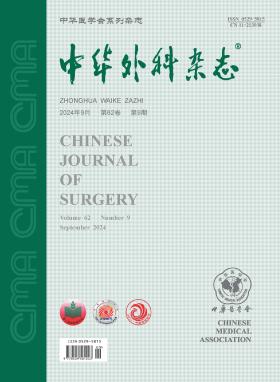
Chinese Journal of Surgery|Chin J Surg (monthly) is a high-level medical science and technology journal approved by the General Administration of Press and Publication of the People's Republic of China, under the supervision of the China Association for Science and Technology, and organised by the Chinese Medical Association for domestic and international public circulation. It was founded in January 1951, and is published on the basis of the Journal of Chinese Surgery. The Journal is aimed at senior and intermediate surgeons and related researchers, mainly reporting the leading scientific research results and clinical experience in the field of surgery, as well as the basic theoretical research that has a guiding effect on the clinical work of surgery.
Chinese Journal of Surgery|Chin J Surg is committed to reflecting the major research progress in the field of surgery in China and promoting academic exchanges at home and abroad. The main columns include thesis, meta-analysis, review, expert forum, synthesis, case report, diagnosis and treatment experience, technical exchange, clinical case discussion, academic controversy, and special lectures, etc. The journal has been accepted by the National Academy of Medicine of the United States. The journal has been included in many famous databases at home and abroad, such as the Biomedical Analysis and Online Retrieval System (MEDLINE) of the U.S. National Library of Medicine.

 求助内容:
 应助结果提醒方式:


 京公网安备 11010802042870号


