Dan Peng, Sijia Cheng, Guifu Si, Menghe Xu, Min Chen
{"title":"Photoresponsive Diarylethene-Based Polyolefins","authors":"Dan Peng, Sijia Cheng, Guifu Si, Menghe Xu, Min Chen","doi":"10.1021/acs.macromol.6c02256","DOIUrl":null,"url":null,"abstract":"<p>Stimuli-responsive polymers are a class of functional materials that can undergo reversible physical or chemical changes in their structure, properties, or functions in response to external stimuli. In this work, we proposed a novel photoresponsive closed-loop polymer design strategy that integrates responsive molecular properties with the closed-loop concept, aiming to effectively address the long-standing challenges associated with the poor responsiveness and inadequate recyclability of traditional polymer materials. By combining the efficiency of ring-opening metathesis polymerization (ROMP) with the intrinsic thermal stability of photoresponsive molecular switches, we reported the (co)polymerization of photoresponsive diarylethene-based (DTE) cyclic monomers. This approach enables the rational design and preparation of photoresponsive polyolefins with tunable structures and properties, including mechanical performance, thermodynamic characteristics, and reversible color variation. We further explored equilibrium-controlled transformations to establish reversible closed-loop pathways for monomer–polymer interconversion. Notably, for the DTE-based homopolymer, a dual closed-loop platform was established via photoinduced transformation and Ru-catalyzed metathesis (de)polymerization. This work provides an efficient platform to advance the sustainable development and practical application of advanced responsive polymers.</p>","PeriodicalId":51,"journal":{"name":"Macromolecules","volume":"59 19","pages":"10833–10842"},"PeriodicalIF":5.7000,"publicationDate":"2026-10-13","publicationTypes":"Journal Article","fieldsOfStudy":null,"isOpenAccess":false,"openAccessPdf":"","citationCount":"0","resultStr":null,"platform":"Semanticscholar","paperid":null,"PeriodicalName":"Macromolecules","FirstCategoryId":"92","ListUrlMain":"https://pubs.acs.org/doi/10.1021/acs.macromol.6c02256","RegionNum":1,"RegionCategory":"化学","ArticlePicture":[],"TitleCN":null,"AbstractTextCN":null,"PMCID":null,"EPubDate":"2026/9/21 0:00:00","PubModel":"Epub","JCR":"Q1","JCRName":"POLYMER SCIENCE","Score":null,"Total":0}
引用次数: 0
Abstract
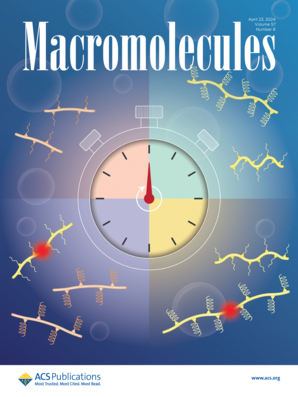
Stimuli-responsive polymers are a class of functional materials that can undergo reversible physical or chemical changes in their structure, properties, or functions in response to external stimuli. In this work, we proposed a novel photoresponsive closed-loop polymer design strategy that integrates responsive molecular properties with the closed-loop concept, aiming to effectively address the long-standing challenges associated with the poor responsiveness and inadequate recyclability of traditional polymer materials. By combining the efficiency of ring-opening metathesis polymerization (ROMP) with the intrinsic thermal stability of photoresponsive molecular switches, we reported the (co)polymerization of photoresponsive diarylethene-based (DTE) cyclic monomers. This approach enables the rational design and preparation of photoresponsive polyolefins with tunable structures and properties, including mechanical performance, thermodynamic characteristics, and reversible color variation. We further explored equilibrium-controlled transformations to establish reversible closed-loop pathways for monomer–polymer interconversion. Notably, for the DTE-based homopolymer, a dual closed-loop platform was established via photoinduced transformation and Ru-catalyzed metathesis (de)polymerization. This work provides an efficient platform to advance the sustainable development and practical application of advanced responsive polymers.
期刊介绍:
Macromolecules publishes original, fundamental, and impactful research on all aspects of polymer science. Topics of interest include synthesis (e.g., controlled polymerizations, polymerization catalysis, post polymerization modification, new monomer structures and polymer architectures, and polymerization mechanisms/kinetics analysis); phase behavior, thermodynamics, dynamic, and ordering/disordering phenomena (e.g., self-assembly, gelation, crystallization, solution/melt/solid-state characteristics); structure and properties (e.g., mechanical and rheological properties, surface/interfacial characteristics, electronic and transport properties); new state of the art characterization (e.g., spectroscopy, scattering, microscopy, rheology), simulation (e.g., Monte Carlo, molecular dynamics, multi-scale/coarse-grained modeling), and theoretical methods. Renewable/sustainable polymers, polymer networks, responsive polymers, electro-, magneto- and opto-active macromolecules, inorganic polymers, charge-transporting polymers (ion-containing, semiconducting, and conducting), nanostructured polymers, and polymer composites are also of interest. Typical papers published in Macromolecules showcase important and innovative concepts, experimental methods/observations, and theoretical/computational approaches that demonstrate a fundamental advance in the understanding of polymers.


 求助内容:
 应助结果提醒方式:


 京公网安备 11010802042870号


