
Interface-Constrained PINNs for Chloride Transport Inversion and Corrosion-Initiation Prediction of Marine PHC Pipe Piles
IF 9.2
1区 工程技术
Q1 COMPUTER SCIENCE, INTERDISCIPLINARY APPLICATIONS
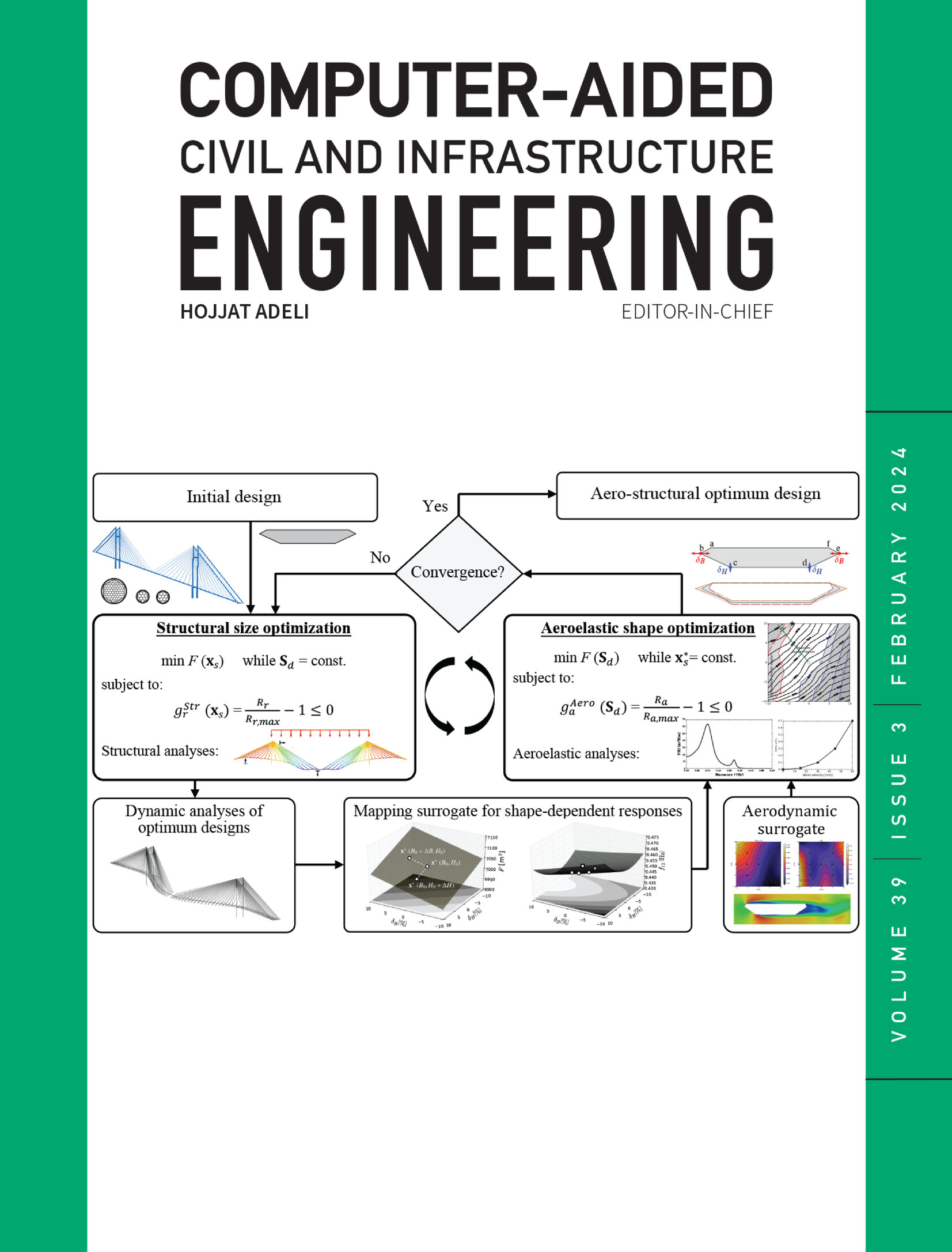
Computer-Aided Civil and Infrastructure Engineering
Pub Date : 2026-09-14
DOI:10.1016/j.cacaie.2026.100228
引用次数: 0
Abstract
Reliable durability assessment of prestressed high-strength concrete (PHC) pipe piles in marine environments requires accurate characterization of chloride transport parameters. However, these parameters are inherently layer-dependent because of centrifugal forming, and they are difficult to identify from limited field or experimental observations. This study proposes an inverse-to-forward spatiotemporal interface-constrained physics-informed neural network (IF-STIC-PINN) for identifying layer-dependent chloride diffusion coefficients from sparse short-term observations and subsequently predicting long-term chloride ingress and corrosion initiation. Chloride transport in PHC pipe piles is formulated as a radial convection-diffusion process in a centrifugally stratified annular domain. The governing equations, initial and boundary conditions, and interface continuity conditions are embedded into the neural-network training through physics-informed residuals and automatic differentiation. To represent material heterogeneity, separate subnetworks are constructed for the inner and outer layers of the PHC pipe pile, while interface constraints enforce the continuity of chloride concentration and total flux across the centrifugal-layer boundary. Temporal segmentation is further introduced to enhance the stability of long-term prediction. The effects of monitoring duration, sensor placement, spatial and temporal decomposition, and observation noise are systematically investigated. The results show that monitoring near the inner and outer exposure boundaries for approximately two to three years enables stable identification of layer-dependent diffusion coefficients. The proposed IF-STIC-PINN reconstructs the 100-year chloride concentration field with an基于界面约束的PHC管桩氯离子输运反演及腐蚀起爆预测
海洋环境下预应力高强混凝土(PHC)管桩耐久性评估需要准确表征氯离子输运参数。然而,由于离心形成,这些参数本质上依赖于层,并且很难从有限的现场或实验观察中识别出来。本研究提出了一种时空界面约束物理信息神经网络(if - stick - pinn),用于从稀疏的短期观测中识别依赖于层的氯化物扩散系数,并随后预测长期氯化物进入和腐蚀起始。氯化物在PHC管桩中的输运被描述为离心分层环形区域内的径向对流-扩散过程。控制方程、初始和边界条件以及界面连续性条件通过物理残差和自动微分嵌入到神经网络训练中。为了表现材料的非均质性,在PHC管桩的内层和外层构建了单独的子网络,而界面约束使氯离子浓度和总通量在离心层边界上保持连续性。为了提高长期预测的稳定性,进一步引入了时间分割。系统地研究了监测时间、传感器放置、时空分解和观测噪声等因素的影响。结果表明,在内外暴露边界附近监测大约两到三年,可以稳定地识别层相关扩散系数。提出的if - sticc - pinn重建了100年氯化物浓度场,L2相对误差约为0.72%,预测腐蚀起始时间为26.79年,而COMSOL模拟的结果为26.72年。对4个已公布的氯化物入水案例进行验证,得出浓度误差在1.60%-2.36%之间,腐蚀引发时间误差在1.05%以下。这些结果表明,IF-STIC-PINN提供了一个物理一致、数据高效且强大的计算框架,可将稀疏的短期氯化物观测结果转化为海洋PHC管桩的长期腐蚀起始评估。
本文章由计算机程序翻译,如有差异,请以英文原文为准。
求助全文
约1分钟内获得全文
求助全文
来源期刊
CiteScore
17.60
自引率
19.80%
发文量
146
审稿时长
1 months
期刊介绍:
Computer-Aided Civil and Infrastructure Engineering stands as a scholarly, peer-reviewed archival journal, serving as a vital link between advancements in computer technology and civil and infrastructure engineering. The journal serves as a distinctive platform for the publication of original articles, spotlighting novel computational techniques and inventive applications of computers. Specifically, it concentrates on recent progress in computer and information technologies, fostering the development and application of emerging computing paradigms.
Encompassing a broad scope, the journal addresses bridge, construction, environmental, highway, geotechnical, structural, transportation, and water resources engineering. It extends its reach to the management of infrastructure systems, covering domains such as highways, bridges, pavements, airports, and utilities. The journal delves into areas like artificial intelligence, cognitive modeling, concurrent engineering, database management, distributed computing, evolutionary computing, fuzzy logic, genetic algorithms, geometric modeling, internet-based technologies, knowledge discovery and engineering, machine learning, mobile computing, multimedia technologies, networking, neural network computing, optimization and search, parallel processing, robotics, smart structures, software engineering, virtual reality, and visualization techniques.
 求助内容:
 应助结果提醒方式:


 京公网安备 11010802042870号


