
Tumor-derived CTHRC1 mediates ITGB3-dependent osteoclast differentiation to promote prostate cancer bone metastasis
IF 9.1
1区 医学
Q1 BIOCHEMISTRY & MOLECULAR BIOLOGY
引用次数: 0
Abstract
Bone metastasis is a leading cause of mortality in advanced prostate cancer (PCa), with limited therapeutic options. This study investigates the molecular mechanisms underlying PCa bone metastasis and identifies potential therapeutic targets. Using in vitro co-culture systems and in vivo mouse models, we demonstrated that tumor-derived Collagen Triple Helix Repeat Containing 1 (CTHRC1) promotes osteoclast differentiation, thereby contributing to the development of osteolytic lesions in PCa bone metastasis. Mechanistically, CTHRC1 cooperates with receptor activator of nuclear factor-κB ligand (RANKL) signaling to promote osteoblast-derived RANKL-mediated osteoclastogenesis by disrupting the RANKL/osteoprotegerin (OPG) system. Furthermore, CTHRC1 directly binds to integrin beta 3 (ITGB3) on osteoclasts to activate the FAK/MEK/ERK1/2 pathway and dissociate SRC signaling, jointly mediating osteoclast differentiation. Blocking the CTHRC1-ITGB3 axis significantly weakened CTHRC1-induced osteoclast differentiation and bone resorption. Collectively, our findings identify CTHRC1 as a novel mediator in the bone microenvironment, providing a potential therapeutic target for inhibiting the occurrence and progression of PCa bone metastasis.肿瘤源性CTHRC1介导itgb3依赖性破骨细胞分化促进前列腺癌骨转移。
骨转移是晚期前列腺癌(PCa)死亡的主要原因,治疗选择有限。本研究探讨前列腺癌骨转移的分子机制,并确定潜在的治疗靶点。通过体外共培养系统和体内小鼠模型,我们证明肿瘤来源的胶原三螺旋重复序列含有1 (CTHRC1)促进破骨细胞分化,从而促进前列腺癌骨转移中溶骨病变的发展。机制上,CTHRC1通过破坏RANKL/osteoprotegerin (OPG)系统,与核因子-κB配体受体激活因子(RANKL)信号传导合作,促进成骨细胞来源的RANKL介导的破骨细胞生成。此外,CTHRC1直接与破骨细胞上的整合素β 3 (ITGB3)结合,激活FAK/MEK/ERK1/2通路,解离SRC信号,共同介导破骨细胞分化。阻断CTHRC1-ITGB3轴可显著削弱cthrc1诱导的破骨细胞分化和骨吸收。总之,我们的研究结果确定CTHRC1是骨微环境中的一种新的介质,为抑制PCa骨转移的发生和进展提供了潜在的治疗靶点。
本文章由计算机程序翻译,如有差异,请以英文原文为准。
求助全文
约1分钟内获得全文
求助全文
来源期刊
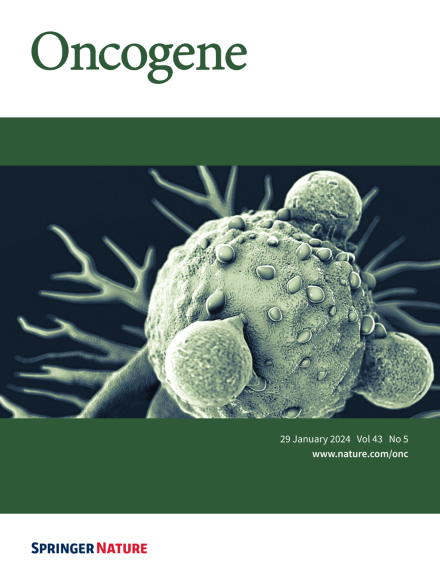
Oncogene
医学-生化与分子生物学
CiteScore
15.30
自引率
1.20%
发文量
404
审稿时长
1 months
期刊介绍:
Oncogene is dedicated to advancing our understanding of cancer processes through the publication of exceptional research. The journal seeks to disseminate work that challenges conventional theories and contributes to establishing new paradigms in the etio-pathogenesis, diagnosis, treatment, or prevention of cancers. Emphasis is placed on research shedding light on processes driving metastatic spread and providing crucial insights into cancer biology beyond existing knowledge.
Areas covered include the cellular and molecular biology of cancer, resistance to cancer therapies, and the development of improved approaches to enhance survival. Oncogene spans the spectrum of cancer biology, from fundamental and theoretical work to translational, applied, and clinical research, including early and late Phase clinical trials, particularly those with biologic and translational endpoints.
 求助内容:
 应助结果提醒方式:


 京公网安备 11010802042870号


