
Spatial Programming of Redox Pathways for Z-Scheme Photocatalytic Water Splitting
IF 16.6
1区 化学
Q1 CHEMISTRY, MULTIDISCIPLINARY
引用次数: 0
Abstract
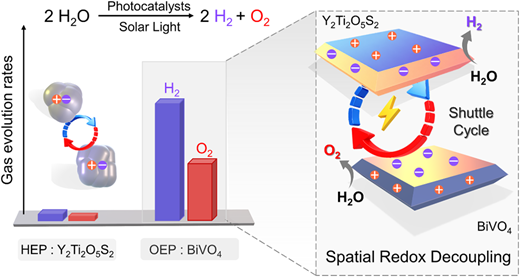
Particulate Z-scheme overall water splitting holds considerable promise for solar hydrogen production, yet its potential is persistently constrained by mediator-involved reverse reactions and related interfacial charge loss. Here we show that water-splitting reactions and parasitic mediator redox can be spatially decoupled across microscale surface domains, thereby suppressing reverse chemistry at its origin. Using facet-engineered Y2Ti2O5S2 and BiVO4 microcrystals as H2-evolving and O2-evolving photocatalysts, respectively, anisotropic charge separation together with facet-selective mediator adsorption directs mediator redox to specific facets, while H2 and O2 evolution proceed on the lateral facets of both photocatalysts. This spatially organized interfacial architecture separates forward and parasitic pathways within individual particles, suppressing mediator self-cycling and H2/O2 recombination without hindering productive interparticle charge transfer. Consequently, visible-light-driven overall water splitting activity is enhanced by over 60-fold relative to the nonfaceted counterpart, delivering an apparent quantum yield of 17.1% at 420 nm, a solar-to-hydrogen efficiency exceeding 1.0%, and sustained activity near atmospheric pressure. These findings establish spatial decoupling of interfacial redox sites as a general design principle for mitigating reverse reactions in Z-scheme artificial photosynthesis for solar hydrogen production.
z - scheme光催化水分解氧化还原途径的空间规划
粒子z方案整体水分解在太阳能制氢方面具有相当大的前景,但其潜力一直受到涉及介质的逆反应和相关界面电荷损失的限制。在这里,我们发现水分解反应和寄生介质氧化还原可以在微尺度表面域的空间上解耦,从而抑制其起源的逆向化学。采用表面工程的Y2Ti2O5S2微晶和BiVO4微晶分别作为H2-析出光催化剂和O2-析出光催化剂,各向异性电荷分离和表面选择性介质吸附将介质氧化还原到特定的表面,而H2和O2的析出则在两种光催化剂的侧面进行。这种空间组织的界面结构分离了单个粒子内的正向和寄生途径,抑制了介质的自循环和H2/O2重组,而不妨碍粒子间的电荷转移。因此,可见光驱动的整体水分解活性相对于非面相体提高了60倍以上,在420纳米处提供17.1%的表观量子产率,太阳能到氢的效率超过1.0%,并且在大气压附近保持活性。这些发现确立了界面氧化还原位点的空间解耦是减轻z方案太阳能制氢人工光合作用中逆向反应的一般设计原则。
本文章由计算机程序翻译,如有差异,请以英文原文为准。
求助全文
约1分钟内获得全文
求助全文
来源期刊
CiteScore
24.40
自引率
6.00%
发文量
2398
审稿时长
1.6 months
期刊介绍:
The flagship journal of the American Chemical Society, known as the Journal of the American Chemical Society (JACS), has been a prestigious publication since its establishment in 1879. It holds a preeminent position in the field of chemistry and related interdisciplinary sciences. JACS is committed to disseminating cutting-edge research papers, covering a wide range of topics, and encompasses approximately 19,000 pages of Articles, Communications, and Perspectives annually. With a weekly publication frequency, JACS plays a vital role in advancing the field of chemistry by providing essential research.
 求助内容:
求助内容: 应助结果提醒方式:

 京公网安备 11010802042870号


