
Instructing the Learning of Language Model with the Token Interpretation to Improve Language Understanding
IF 18.3
1区 计算机科学
Q1 AUTOMATION & CONTROL SYSTEMS
Ieee-Caa Journal of Automatica Sinica
Pub Date : 2026-08-01
Epub Date: 2026-08-28
DOI:10.1109/JAS.2026.125900
引用次数: 0
Abstract
Pretrained language models (PLMs) have established state-of-the-art performance across diverse natural language understanding (NLU) tasks. This study reveals that seman-tic-rich explanations of lexical units can effectively guide PLM learning processes. We propose a novel language understanding enhancement method with token interpretation (LUETI) that addresses two critical limitations in conventional PLMs: Incomplete token semantics caused by isolated contextual learning and insufficient semantic encoding in embedding matrices. LUETI operates through dual mechanisms, augmenting token represen-tations by integrating hidden states with corresponding token interpretations and refining embedding spaces using interpretation-derived semantic vectors for token prediction. LUETI, which is implemented as a plug-in module for standard architectures, demonstrates significant improvements on BERT and GLM, achieving average performance gains of 3.36% and 4.87% respectively on the SuperGLUE benchmark with equivalent parameters and training data. Note that LUETI-equipped models attain comparable performance to baseline PLMs using only 60% of pretraining data. Findings establish token interpretation as a computationally efficient but semantically powerful enhancement strategy for language model pretraining.用符号解释指导语言模型学习提高语言理解能力
预训练语言模型(PLMs)已经在各种自然语言理解(NLU)任务中建立了最先进的性能。本研究揭示了丰富语义的词汇单位解释可以有效地指导PLM学习过程。我们提出了一种新的语言理解增强方法,即标记解释(LUETI),该方法解决了传统plm中的两个关键限制:孤立的上下文学习导致的标记语义不完整以及嵌入矩阵中语义编码不足。LUETI通过双重机制进行操作,通过将隐藏状态与相应的令牌解释集成来增加令牌表示,并使用解释派生的语义向量来优化嵌入空间以进行令牌预测。LUETI作为标准架构的插件模块实现,在BERT和GLM上表现出显著的改进,在具有等效参数和训练数据的SuperGLUE基准测试上分别实现了3.36%和4.87%的平均性能提升。请注意,配备luetii的模型仅使用60%的预训练数据就可以获得与基线plm相当的性能。研究结果表明,符号解释是一种计算效率高但语义功能强大的语言模型预训练增强策略。
本文章由计算机程序翻译,如有差异,请以英文原文为准。
求助全文
约1分钟内获得全文
求助全文
来源期刊
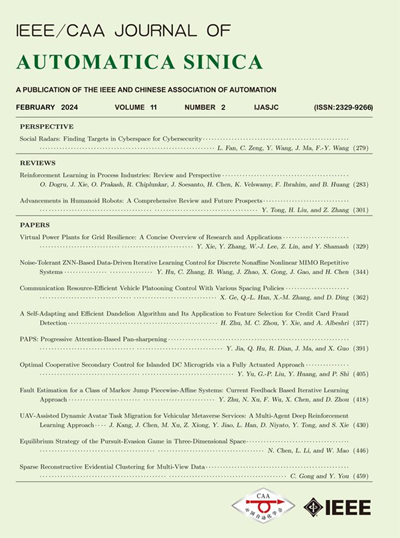
Ieee-Caa Journal of Automatica Sinica
Engineering-Control and Systems Engineering
CiteScore
23.50
自引率
11.00%
发文量
880
期刊介绍:
The IEEE/CAA Journal of Automatica Sinica is a reputable journal that publishes high-quality papers in English on original theoretical/experimental research and development in the field of automation. The journal covers a wide range of topics including automatic control, artificial intelligence and intelligent control, systems theory and engineering, pattern recognition and intelligent systems, automation engineering and applications, information processing and information systems, network-based automation, robotics, sensing and measurement, and navigation, guidance, and control.
Additionally, the journal is abstracted/indexed in several prominent databases including SCIE (Science Citation Index Expanded), EI (Engineering Index), Inspec, Scopus, SCImago, DBLP, CNKI (China National Knowledge Infrastructure), CSCD (Chinese Science Citation Database), and IEEE Xplore.
 求助内容:
 应助结果提醒方式:


 京公网安备 11010802042870号


