{"title":"PDE4D-CXCL13 axis in gland epithelial cells promotes B cell infiltration in primary Sjögren's syndrome.","authors":"Ru-Hong Fang, Mei-Yue Lu, Han-Shuang Liang, Xue-Jie Hu, Liu-Wei Chu, Chang Shu, Lan-Qi Du, Yu-Lin Jiang, Yan Cheng, De-Yun Liu, Xue-Lan-Ting Li, Lin-Li Yao, Xiang Lin, Xu Li, Pai-Pai Guo, Qing-Tong Wang","doi":"10.1038/s41401-026-01894-7","DOIUrl":null,"url":null,"abstract":"<p><p>Primary Sjögren's syndrome (pSS) is a prevalent autoimmune disorder characterized by immune cell, particularly B cell, infiltration into exocrine glands, where autoantibody production disrupts glandular architecture and secretory function. Unraveling the mechanisms that drive this B cell trafficking could unveil innovative therapeutic avenues for pSS. We report that phosphodiesterase 4D (PDE4D) is markedly up-regulated in glandular epithelial cells from both pSS patients and murine models, correlating tightly with diminished saliva output and heightened B cell infiltration. Mechanistically, lipopolysaccharide (LPS) engages Toll-like receptor 2/4 signaling in human salivary gland epithelial cells to induce PDE4D expression. Then, PDE4D reduces the phosphorylation of FOXO1 and enhances its nuclear translocation and stability; in turn, FOXO1 amplifies C-X-C motif chemokine ligand 13 (CXCL13) secretion that promotes B cell chemotaxis. To interrogate the functional relevance of PDE4D, we generated pSS models in PDE4D-knockout and wild-type (WT) mice, and additionally treated WT-pSS mice with a selective PDE4D inhibitor. Genetic deletion or pharmacologic inhibition of PDE4D augmented PKA-mediated FOXO1 phosphorylation, suppressed CXCL13 expression in glandular epithelial cells, and significantly attenuated disease manifestations. Collectively, our findings position PDE4D as a promising therapeutic target for pSS.</p>","PeriodicalId":6942,"journal":{"name":"Acta Pharmacologica Sinica","volume":" ","pages":""},"PeriodicalIF":10.4000,"publicationDate":"2026-08-17","publicationTypes":"Journal Article","fieldsOfStudy":null,"isOpenAccess":false,"openAccessPdf":"","citationCount":"0","resultStr":null,"platform":"Semanticscholar","paperid":null,"PeriodicalName":"Acta Pharmacologica Sinica","FirstCategoryId":"3","ListUrlMain":"https://doi.org/10.1038/s41401-026-01894-7","RegionNum":1,"RegionCategory":"医学","ArticlePicture":[],"TitleCN":null,"AbstractTextCN":null,"PMCID":null,"EPubDate":"","PubModel":"","JCR":"Q1","JCRName":"CHEMISTRY, MULTIDISCIPLINARY","Score":null,"Total":0}
引用次数: 0
Abstract
Primary Sjögren's syndrome (pSS) is a prevalent autoimmune disorder characterized by immune cell, particularly B cell, infiltration into exocrine glands, where autoantibody production disrupts glandular architecture and secretory function. Unraveling the mechanisms that drive this B cell trafficking could unveil innovative therapeutic avenues for pSS. We report that phosphodiesterase 4D (PDE4D) is markedly up-regulated in glandular epithelial cells from both pSS patients and murine models, correlating tightly with diminished saliva output and heightened B cell infiltration. Mechanistically, lipopolysaccharide (LPS) engages Toll-like receptor 2/4 signaling in human salivary gland epithelial cells to induce PDE4D expression. Then, PDE4D reduces the phosphorylation of FOXO1 and enhances its nuclear translocation and stability; in turn, FOXO1 amplifies C-X-C motif chemokine ligand 13 (CXCL13) secretion that promotes B cell chemotaxis. To interrogate the functional relevance of PDE4D, we generated pSS models in PDE4D-knockout and wild-type (WT) mice, and additionally treated WT-pSS mice with a selective PDE4D inhibitor. Genetic deletion or pharmacologic inhibition of PDE4D augmented PKA-mediated FOXO1 phosphorylation, suppressed CXCL13 expression in glandular epithelial cells, and significantly attenuated disease manifestations. Collectively, our findings position PDE4D as a promising therapeutic target for pSS.
期刊介绍:
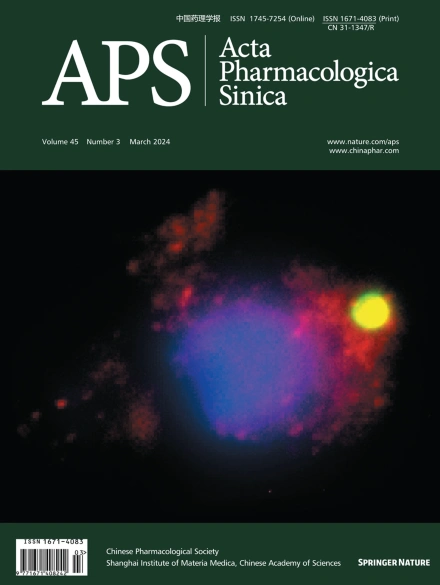
APS (Acta Pharmacologica Sinica) welcomes submissions from diverse areas of pharmacology and the life sciences. While we encourage contributions across a broad spectrum, topics of particular interest include, but are not limited to: anticancer pharmacology, cardiovascular and pulmonary pharmacology, clinical pharmacology, drug discovery, gastrointestinal and hepatic pharmacology, genitourinary, renal, and endocrine pharmacology, immunopharmacology and inflammation, molecular and cellular pharmacology, neuropharmacology, pharmaceutics, and pharmacokinetics. Join us in sharing your research and insights in pharmacology and the life sciences.

 求助内容:
 应助结果提醒方式:


 京公网安备 11010802042870号


