
Enhanced antitumor immunity of mRNA vaccines by bioorthogonal-like delayed activation of exogeneous STING
IF 44.5
1区 生物学
Q1 BIOTECHNOLOGY & APPLIED MICROBIOLOGY
引用次数: 0
Abstract
The development of cGAS–STING (stimulator of interferon genes) agonists as mRNA vaccine adjuvants has been hampered by widespread STING expression and by the observation that codelivered STING agonists suppress antigen mRNA translation. Here, to address these challenges, we engineer synchronized STING (Syn-STING): a lipid nanoparticle (LNP) codelivering antigen mRNA, mRNA encoding full-length STING transmembrane protein and a bioorthogonal-like delayed-release STING activator, DMXAA. DMXAA release is controlled by a biodegradable linker, enabling localized mouse STING activation while avoiding systemic endogeneous human STING recognition. In humanized STING mouse models, we test human papillomavirus E7 and ovalbumin antigens with mouse STING or a human STING mutant engineered for DMXAA specificity. Intratumoral or subcutaneous LNPs are preferentially internalized by myeloid cells, preserving antigen expression fidelity, achieving localized STING activation in antigen-presenting cells and preventing systemic regulatory B cell differentiation and immunocyte apoptosis. The Syn-STING vaccine elicits robust adaptive responses and Th1-biased T cell immunity. It suppresses tumor growth and prolongs survival while exhibiting negligible anti-STING immunity.

外源性STING生物正交样延迟激活增强mRNA疫苗抗肿瘤免疫
cGAS-STING(干扰素基因刺激剂)激动剂作为mRNA疫苗佐剂的发展一直受到STING广泛表达和共递送STING激动剂抑制抗原mRNA翻译的观察的阻碍。在这里,为了解决这些挑战,我们设计了同步STING (Syn-STING):脂质纳米颗粒(LNP)共递送抗原mRNA, mRNA编码全长STING跨膜蛋白和生物正交样延迟释放STING激活剂DMXAA。DMXAA的释放由可生物降解的连接物控制,可使局部小鼠STING激活,同时避免系统内源性人类STING识别。在人源化STING小鼠模型中,我们用小鼠STING或人源化STING基因突变体检测人乳头瘤病毒E7和卵清蛋白抗原。瘤内或皮下LNPs优先被骨髓细胞内化,保持抗原表达保真度,在抗原呈递细胞中实现局部STING激活,防止系统性调节性B细胞分化和免疫细胞凋亡。Syn-STING疫苗可引起强大的适应性反应和th1偏向性T细胞免疫。它抑制肿瘤生长并延长生存期,同时表现出微不足道的抗sting免疫。
本文章由计算机程序翻译,如有差异,请以英文原文为准。
求助全文
约1分钟内获得全文
求助全文
来源期刊
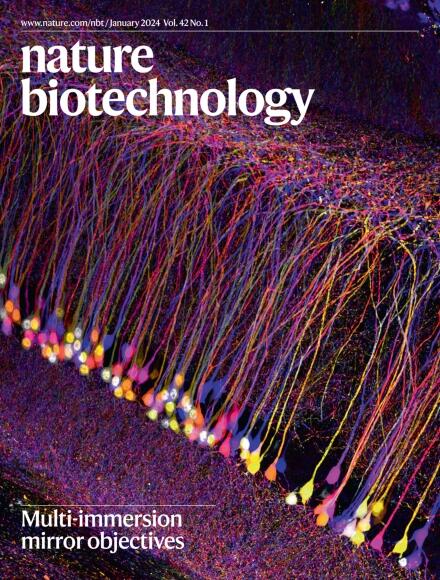
Nature biotechnology
工程技术-生物工程与应用微生物
CiteScore
63.00
自引率
1.70%
发文量
382
审稿时长
3 months
期刊介绍:
Nature Biotechnology is a monthly journal that focuses on the science and business of biotechnology. It covers a wide range of topics including technology/methodology advancements in the biological, biomedical, agricultural, and environmental sciences. The journal also explores the commercial, political, ethical, legal, and societal aspects of this research.
The journal serves researchers by providing peer-reviewed research papers in the field of biotechnology. It also serves the business community by delivering news about research developments. This approach ensures that both the scientific and business communities are well-informed and able to stay up-to-date on the latest advancements and opportunities in the field.
Some key areas of interest in which the journal actively seeks research papers include molecular engineering of nucleic acids and proteins, molecular therapy, large-scale biology, computational biology, regenerative medicine, imaging technology, analytical biotechnology, applied immunology, food and agricultural biotechnology, and environmental biotechnology.
In summary, Nature Biotechnology is a comprehensive journal that covers both the scientific and business aspects of biotechnology. It strives to provide researchers with valuable research papers and news while also delivering important scientific advancements to the business community.
文献相关原料
原料信息
原料厂家

 求助内容:
 应助结果提醒方式:


 京公网安备 11010802042870号


