{"title":"Drug Discovery's Blind Spot: Why Organoid-Artificial Intelligence Convergence Demands Integrated Governance.","authors":"Johnny Sakr","doi":"10.1080/15265161.2026.2710282","DOIUrl":null,"url":null,"abstract":"<p><p>Organoid-artificial intelligence (AI) platforms are increasingly central to drug discovery, yet they sit between two governance regimes. AI frameworks presume stable, well-characterized inputs, while organoid ethics focuses on donor consent, moral status, and tissue use, leaving downstream computational uses of organoid-derived data underregulated. This article argues that the convergence of living biological variability with algorithmic decision-making creates a governance vacuum in high-stakes preclinical contexts. The organoid-AI case is distinctive because two mature governance traditions, built on incompatible assumptions, intersect at a decision-critical point, and because organoid-derived biological states are transient and often irrecoverable. The article maps the structural causes of this gap, illustrates its practical consequences through three failure scenarios assessing likely probability and impact, and proposes an integrated two-pillar framework: graduated AI validation indexed to organoid functional complexity and tamper-resistant audit trails linking biological and algorithmic metadata. It concludes that proactive governance is morally preferable to delayed, crisis-driven regulation.</p>","PeriodicalId":50962,"journal":{"name":"American Journal of Bioethics","volume":" ","pages":"1-16"},"PeriodicalIF":17.6000,"publicationDate":"2026-08-11","publicationTypes":"Journal Article","fieldsOfStudy":null,"isOpenAccess":false,"openAccessPdf":"","citationCount":"0","resultStr":null,"platform":"Semanticscholar","paperid":null,"PeriodicalName":"American Journal of Bioethics","FirstCategoryId":"98","ListUrlMain":"https://doi.org/10.1080/15265161.2026.2710282","RegionNum":1,"RegionCategory":"哲学","ArticlePicture":[],"TitleCN":null,"AbstractTextCN":null,"PMCID":null,"EPubDate":"","PubModel":"","JCR":"Q1","JCRName":"ETHICS","Score":null,"Total":0}
引用次数: 0
Abstract
Organoid-artificial intelligence (AI) platforms are increasingly central to drug discovery, yet they sit between two governance regimes. AI frameworks presume stable, well-characterized inputs, while organoid ethics focuses on donor consent, moral status, and tissue use, leaving downstream computational uses of organoid-derived data underregulated. This article argues that the convergence of living biological variability with algorithmic decision-making creates a governance vacuum in high-stakes preclinical contexts. The organoid-AI case is distinctive because two mature governance traditions, built on incompatible assumptions, intersect at a decision-critical point, and because organoid-derived biological states are transient and often irrecoverable. The article maps the structural causes of this gap, illustrates its practical consequences through three failure scenarios assessing likely probability and impact, and proposes an integrated two-pillar framework: graduated AI validation indexed to organoid functional complexity and tamper-resistant audit trails linking biological and algorithmic metadata. It concludes that proactive governance is morally preferable to delayed, crisis-driven regulation.
期刊介绍:
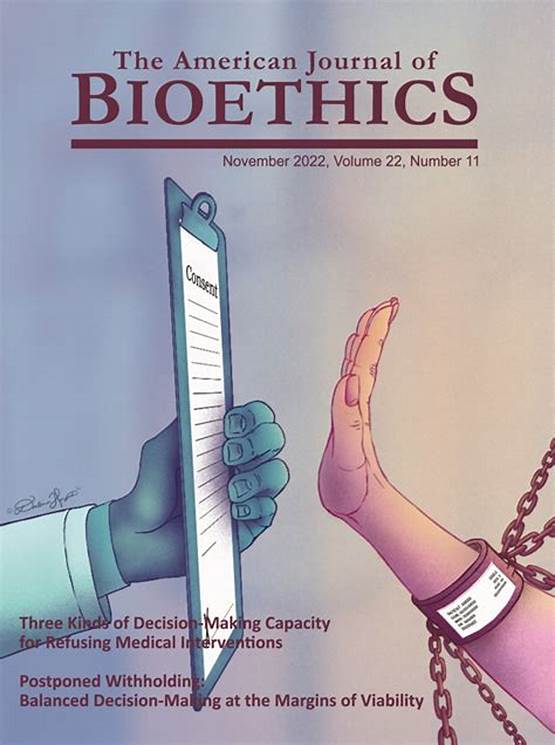
The American Journal of Bioethics (AJOB) is a renowned global publication focused on bioethics. It tackles pressing ethical challenges in the realm of health sciences.
With a commitment to the original vision of bioethics, AJOB explores the social consequences of advancements in biomedicine. It sparks meaningful discussions that have proved invaluable to a wide range of professionals, including judges, senators, journalists, scholars, and educators.
AJOB covers various areas of interest, such as the ethical implications of clinical research, ensuring access to healthcare services, and the responsible handling of medical records and data.
The journal welcomes contributions in the form of target articles presenting original research, open peer commentaries facilitating a dialogue, book reviews, and responses to open peer commentaries.
By presenting insightful and authoritative content, AJOB continues to shape the field of bioethics and engage diverse stakeholders in crucial conversations about the intersection of medicine, ethics, and society.

 求助内容:
 应助结果提醒方式:


 京公网安备 11010802042870号


