
Assessment of planning organ at risk volume margins in non-adaptive pancreatic stereotactic body radiotherapy
IF 3.2
Q2 ONCOLOGY
Physics and Imaging in Radiation Oncology
Pub Date : 2026-07-01
Epub Date: 2026-07-15
DOI:10.1016/j.phro.2026.101043
引用次数: 0
Abstract
Background and Purpose
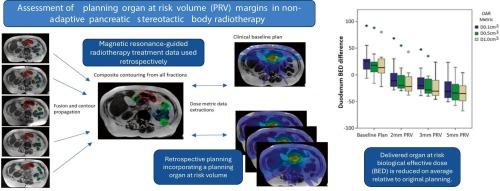
Organ at risk (OAR) motion results in increased risk of radiotherapy treatment side effects due to the potential for greater dose than intended being delivered. This is of particular concern in stereotactic ablative body radiotherapy (SABR). The study aim was to assess the role of planning organ at risk volume (PRV) margins applied to OARs of the gastrointestinal (GI) tract over five fraction non-adaptive SABR for pancreatic cancer.
Materials and Methods
The clinical adaptive magnetic resonance-guided radiotherapy baseline planning for 10 patients was combined with retrospective replanning respecting constraints to OAR plus a margin of 2–5 mm. Baseline planning/replanning was applied to OAR contouring at treatment fractions without plan adaptation. The impact of PRV margin was assessed in terms of the encompassing of OAR motion, effect on delivered dose, and degree of associated compromise in planned treatment volume (PTV) dose coverage.
Results
Whilst variable across individual OARs, a 2–5 mm margin poorly encompassed motion in 40–70% of fractions. However, a 2–5 mm margin did effectively limit dose increases in most cases such that delivered biological effective dose (BED) did not exceed, on average, the baseline value. A margin of 2–3 mm resulted in minor PTV compromise (D70% median PTV BED decrease <10 Gy), whereas a 5 mm margin resulted in moderate compromise (D70% median PTV BED decrease ∼20 Gy).
Conclusions
A PRV margin of 2–5 mm for OARs limits the increase in delivered dose. Consideration of such a margin is relevant in optimizing non-adaptive treatment practice.
非适应性胰腺立体定向放射治疗中规划危险器官体积边界的评估
背景和目的危险器官(OAR)运动导致放射治疗副作用的风险增加,因为放射治疗的剂量可能大于预期的剂量。这在立体定向消融体放疗(SABR)中尤其值得关注。该研究的目的是评估计划器官的危险体积(PRV)边缘应用于胃肠道OARs的作用,而不是五分之一的非适应性SABR用于胰腺癌。材料与方法对10例患者进行临床适应性磁共振引导放射治疗基线规划,并结合OAR约束和2-5 mm余量的回顾性重新规划。基线计划/重新计划应用于无计划适应的治疗分数的桨形轮廓。PRV边界的影响是根据OAR运动的包罗性、对递送剂量的影响以及计划治疗量(PTV)剂量覆盖的相关损害程度来评估的。结果虽然不同的桨,2-5毫米的边缘差包含40-70%的分数运动。然而,在大多数情况下,2-5毫米的间隙确实有效地限制了剂量的增加,使得传递的生物有效剂量(BED)平均不超过基线值。2-3 mm的间隙导致轻微的PTV损害(D70%中位PTV BED减少约10 Gy),而5 mm的间隙导致中度损害(D70%中位PTV BED减少约20 Gy)。结论OARs的PRV切缘为2 ~ 5 mm,限制了给药剂量的增加。在优化非适应性治疗实践时,考虑这样的边际是相关的。
本文章由计算机程序翻译,如有差异,请以英文原文为准。
求助全文
约1分钟内获得全文
求助全文
来源期刊
Physics and Imaging in Radiation Oncology
Physics and Astronomy-Radiation
CiteScore
5.30
自引率
18.90%
发文量
93
审稿时长
6 weeks
 求助内容:
求助内容: 应助结果提醒方式:

 京公网安备 11010802042870号


