
Development of an artificial intelligence driven dose prediction pipeline for online adaptive magnetic resonance-guided radiotherapy

IF 3.2 Q2 ONCOLOGY
Benjamin Tengler, Moritz Schneider, Marcel Nachbar, Simon Boeke, Cihan Gani, Maximilian Niyazi, Paul Fischer, Christian F. Baumgartner, Daniela Thorwarth
{"title":"Development of an artificial intelligence driven dose prediction pipeline for online adaptive magnetic resonance-guided radiotherapy","authors":"Benjamin Tengler,&nbsp;Moritz Schneider,&nbsp;Marcel Nachbar,&nbsp;Simon Boeke,&nbsp;Cihan Gani,&nbsp;Maximilian Niyazi,&nbsp;Paul Fischer,&nbsp;Christian F. Baumgartner,&nbsp;Daniela Thorwarth","doi":"10.1016/j.phro.2026.101048","DOIUrl":null,"url":null,"abstract":"<div><h3>Background and Purpose</h3><div>The closed-off nature of most treatment planning systems (TPS) limits the potential for using artificial intelligence (AI) tools during online adaptive treatments. The aim of this study was to develop an AI-driven pipeline (AutoAdapt) for online planning of adaptive radiotherapy usable in a closed-off setting, providing optimal plan constraints derived from a population-based dose prediction model.</div></div><div><h3>Material and methods</h3><div>The AutoAdapt pipeline consists of a physics-aware Swin UNet transformer network for dose prediction trained on 266 magnetic resonance images from 25 prostate cancer patients treated with 60 Gy on a 1.5 T magnetic resonance linear accelerator. The predicted dose was used to calculate plan constraints that were subsequently fed into a commercial TPS. AutoAdapt was tested using ten unseen cases and compared to manual plans based on clinical objectives, time, and complexity.</div></div><div><h3>Results</h3><div>While all plans were approved by a radiation oncologist, AutoAdapt met all clinical objectives in seven patients compared to ten when manually planned. AutoAdapt yielded a significantly lower D<sub>0.035cm<sup>3</sup></sub> to the rectum (<em>p</em> = 0.01). Manual plans achieved a median rectum V<sub>20Gy</sub> of 44% compared to 51% in AutoAdapt plans (<em>p</em> = 0.02). The pipeline only required a median of 29 s (7.5%) longer than the manual planners.</div></div><div><h3>Conclusions</h3><div>The developed pipeline resulted in high-quality plans, ready for clinical use without further adjustments. AutoAdapt prioritized maximum rectum dose over D<sub>20%</sub> compared to manual planning, while requiring less manual work. In the future, AutoAdapt may be used to assist human planners and improve adaptive radiotherapy workflows.</div></div>","PeriodicalId":36850,"journal":{"name":"Physics and Imaging in Radiation Oncology","volume":"40 ","pages":"Article 101048"},"PeriodicalIF":3.2000,"publicationDate":"2026-07-01","publicationTypes":"Journal Article","fieldsOfStudy":null,"isOpenAccess":false,"openAccessPdf":"","citationCount":"0","resultStr":null,"platform":"Semanticscholar","paperid":null,"PeriodicalName":"Physics and Imaging in Radiation Oncology","FirstCategoryId":"1085","ListUrlMain":"https://www.sciencedirect.com/science/article/pii/S240563162600148X","RegionNum":0,"RegionCategory":null,"ArticlePicture":[],"TitleCN":null,"AbstractTextCN":null,"PMCID":null,"EPubDate":"2026/7/23 0:00:00","PubModel":"Epub","JCR":"Q2","JCRName":"ONCOLOGY","Score":null,"Total":0}
引用次数: 0

Abstract

Background and Purpose

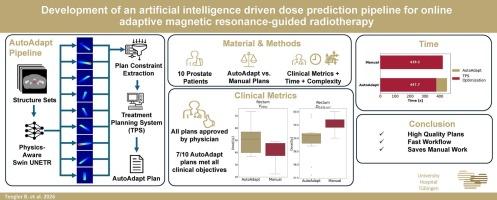
The closed-off nature of most treatment planning systems (TPS) limits the potential for using artificial intelligence (AI) tools during online adaptive treatments. The aim of this study was to develop an AI-driven pipeline (AutoAdapt) for online planning of adaptive radiotherapy usable in a closed-off setting, providing optimal plan constraints derived from a population-based dose prediction model.

Material and methods

The AutoAdapt pipeline consists of a physics-aware Swin UNet transformer network for dose prediction trained on 266 magnetic resonance images from 25 prostate cancer patients treated with 60 Gy on a 1.5 T magnetic resonance linear accelerator. The predicted dose was used to calculate plan constraints that were subsequently fed into a commercial TPS. AutoAdapt was tested using ten unseen cases and compared to manual plans based on clinical objectives, time, and complexity.

Results

While all plans were approved by a radiation oncologist, AutoAdapt met all clinical objectives in seven patients compared to ten when manually planned. AutoAdapt yielded a significantly lower D0.035cm3 to the rectum (p = 0.01). Manual plans achieved a median rectum V20Gy of 44% compared to 51% in AutoAdapt plans (p = 0.02). The pipeline only required a median of 29 s (7.5%) longer than the manual planners.

Conclusions

The developed pipeline resulted in high-quality plans, ready for clinical use without further adjustments. AutoAdapt prioritized maximum rectum dose over D20% compared to manual planning, while requiring less manual work. In the future, AutoAdapt may be used to assist human planners and improve adaptive radiotherapy workflows.
Abstract Image

人工智能驱动的自适应磁共振引导放射治疗剂量预测管道的开发
背景与目的大多数治疗计划系统(TPS)的封闭性限制了在在线自适应治疗中使用人工智能(AI)工具的潜力。本研究的目的是开发一个人工智能驱动的管道(AutoAdapt),用于在封闭环境中在线规划适应性放疗,提供基于人群剂量预测模型的最佳计划约束。材料和方法AutoAdapt管道包括一个物理感知的Swin UNet变压器网络,用于剂量预测,该网络对25名前列腺癌患者在1.5 T磁共振线性加速器上接受60 Gy治疗的266幅磁共振图像进行训练。预测剂量被用来计算计划约束,这些计划约束随后被输入到商业TPS中。AutoAdapt使用10个未见过的病例进行测试,并根据临床目标、时间和复杂性与手动计划进行比较。结果:虽然所有计划都得到了放射肿瘤学家的批准,但AutoAdapt在7名患者中达到了所有临床目标,而手动计划的患者为10名。AutoAdapt对直肠的D0.035cm3显著降低(p = 0.01)。手动计划实现的中位直肠V20Gy为44%,而自动适应计划为51% (p = 0.02)。该管道只需要比人工规划长29秒(7.5%)。结论开发的管道方案高质量,可用于临床,无需进一步调整。与手动规划相比,AutoAdapt优先考虑直肠最大剂量超过D20%,同时需要更少的手动工作。在未来,AutoAdapt可用于协助人类计划者和改善自适应放疗工作流程。
本文章由计算机程序翻译,如有差异,请以英文原文为准。
求助全文
约1分钟内获得全文 求助全文
来源期刊
Physics and Imaging in Radiation Oncology
Physics and Imaging in Radiation Oncology Physics and Astronomy-Radiation
CiteScore
5.30
自引率
18.90%
发文量
93
审稿时长
6 weeks

×
引用
GB/T 7714-2015
复制
MLA
复制
APA
复制
导出至
BibTeX EndNote RefMan NoteFirst NoteExpress
×
提示
您的信息不完整,为了账户安全,请先补充。
现在去补充
×
提示
您因"违规操作"
具体请查看互助需知
我知道了
×
提示
确定
请完成安全验证×
copy
已复制链接
快去分享给好友吧!
我知道了
右上角分享
点击右上角分享
0
联系我们:info@booksci.cn Book学术提供免费学术资源搜索服务,方便国内外学者检索中英文文献。致力于提供最便捷和优质的服务体验。 Copyright © 2023 布克学术 All rights reserved.
京ICP备2023020795号-1
ghs 京公网安备 11010802042870号
Book学术文献互助
Book学术文献互助群
群 号:604180095
Book学术官方微信
小红书


