
Impact of dose reporting modes on dosimetric accuracy in a national end-to-end stereotactic spine radiotherapy audit
IF 3.2
Q2 ONCOLOGY
Physics and Imaging in Radiation Oncology
Pub Date : 2026-07-01
Epub Date: 2026-07-14
DOI:10.1016/j.phro.2026.101041
引用次数: 0
Abstract
Background and purpose
Spinal Stereotactic Body Radiotherapy (SBRT) is among the most complex treatments currently delivered. A multi-centre dosimetry audit evaluated the accuracy of spinal SBRT treatment delivery and the impact of different dose reporting modes (DRM).
Methods and materials
The audit used anthropomorphic phantoms containing alanine in the Planning Target Volume (PTV) and Gafchromic™ EBT3 film in the axial plane, with a combination of onsite and remote audits due to Covid travel restrictions. Centres used their local planning protocol and technique to create a clinically acceptable treatment plan, following national guidance.
Results
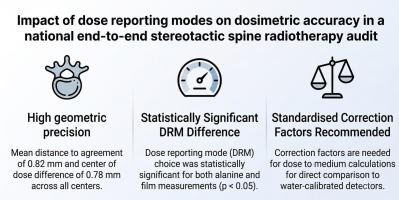
Fifty-nine plans from 44 treatment planning systems at 41 centres were analysed. The mean PTV dose difference was 1.2% [−6.5–8.5%] with alanine and 1.0% [−7.0–8.5%] within the 100% isodose for film. Alanine measurements were, on average, higher than the calculated dose for all plans, but lower for the Dw,m specifically. For alanine and film, the choice of DRM was statistically significant.
The mean distance to agreement and average Centre of Dose difference for films was 0.82 mm [0.35–1.7 mm] and 0.78 mm [0.1–1.7 mm] respectively. The choice of DRM was not significant for either metric.
Conclusions
This audit demonstrated that the majority of centres are delivering spinal SBRT consistently, with acceptable dosimetric and geometric accuracy. However, it also highlighted the challenges of verifying doses reported in Dm,m and Dw,m, as there was a statistically significant difference with the measured dose when stratified by DRM.
国家端到端立体定向脊柱放射治疗审计中剂量报告模式对剂量测定准确性的影响
背景和目的椎体立体定向放射治疗(SBRT)是目前最复杂的治疗方法之一。一项多中心剂量学审计评估了脊髓SBRT治疗递送的准确性和不同剂量报告模式(DRM)的影响。方法和材料:由于新冠肺炎的旅行限制,审计在规划目标体(PTV)中使用含有丙氨酸的拟人模型,在轴向面使用Gafchromic™EBT3薄膜,并结合现场和远程审计。在国家指导下,各中心利用当地的规划方案和技术制定临床可接受的治疗方案。结果对41个中心44个治疗计划系统的59个方案进行了分析。在100%等剂量范围内,丙氨酸的平均PTV剂量差为1.2%[−6.5-8.5%],薄膜的平均PTV剂量差为1.0%[−7.0-8.5%]。平均而言,丙氨酸测量值高于所有计划的计算剂量,但低于Dw,特别是m。对于丙氨酸和膜,DRM的选择有统计学意义。平均一致距离为0.82 mm [0.35-1.7 mm],平均剂量差中心为0.78 mm [0.1-1.7 mm]。DRM的选择对任何一个指标都不重要。结论:本次审核表明,大多数中心持续提供脊髓SBRT,具有可接受的剂量学和几何精度。然而,它也强调了验证Dm,m和Dw,m中报告的剂量的挑战,因为当按DRM分层时,与测量剂量存在统计学上的显着差异。
本文章由计算机程序翻译,如有差异,请以英文原文为准。
求助全文
约1分钟内获得全文
求助全文
来源期刊
Physics and Imaging in Radiation Oncology
Physics and Astronomy-Radiation
CiteScore
5.30
自引率
18.90%
发文量
93
审稿时长
6 weeks
 求助内容:
求助内容: 应助结果提醒方式:

 京公网安备 11010802042870号


