
Improved synthetic CT generation using surface scan information integrated into a deformable registration algorithm for limited Field of View data

IF 3.2 Q2 ONCOLOGY
Joachim Marichal, Stina Svensson, Geert De Kerf, Ola Weistrand, Mattias Nilsing, Michaël Claessens, Pelle Jansson, Dirk Verellen
{"title":"Improved synthetic CT generation using surface scan information integrated into a deformable registration algorithm for limited Field of View data","authors":"Joachim Marichal,&nbsp;Stina Svensson,&nbsp;Geert De Kerf,&nbsp;Ola Weistrand,&nbsp;Mattias Nilsing,&nbsp;Michaël Claessens,&nbsp;Pelle Jansson,&nbsp;Dirk Verellen","doi":"10.1016/j.phro.2026.101050","DOIUrl":null,"url":null,"abstract":"<div><h3>Background and purpose</h3><div>Cone-Beam Computed Tomography (CBCT) based synthetic CT is being increasingly used for post-delivery dose computation or adaptive workflows in radiotherapy. However, the limited Field-of-View of the CBCT can cause inaccuracies when tissues fall outside the Field of View. This study evaluates the integration of surface-guided radiotherapy information to enhance synthetic CT generation for breast cases with missing tissues on CBCT.</div></div><div><h3>Materials and Methods</h3><div>A retrospective analysis was performed on 20 breast patients. CBCT volumes were acquired on a linac, with simultaneous surface scans from three cameras. A full Field of View CBCT was used to generate a reference synthetic CT. A smaller Field of View CBCT was reconstructed from the same raw data to create two synthetic CTs: a standard synthetic CT and a surface-guided synthetic CT, for which surface scan information was incorporated into the algorithm to guide reconstruction outside the Field of View. We compared the image similarity, external contour geometry, and dose distribution.</div></div><div><h3>Results</h3><div>The surface-guided synthetic CT showed superior agreement with the reference for nine tested metrics. Specifically, it showed an average Mean Squared Error reduction of 1963 HU<span><math><msup><mrow></mrow><mrow><mn>2</mn></mrow></msup></math></span> (<span><math><mrow><mi>p</mi><mo>=</mo><mn>0.002</mn></mrow></math></span>), revealing hot spots in some cases.</div></div><div><h3>Conclusion</h3><div>Integrating surface scan information into deformable registration improves synthetic CT generation for CBCT with limited Field of View, yielding more accurate images and enhanced dose distribution precision for breast cases. Future work will explore other sites, and potential applications for adaptive radiotherapy.</div></div>","PeriodicalId":36850,"journal":{"name":"Physics and Imaging in Radiation Oncology","volume":"40 ","pages":"Article 101050"},"PeriodicalIF":3.2000,"publicationDate":"2026-07-01","publicationTypes":"Journal Article","fieldsOfStudy":null,"isOpenAccess":false,"openAccessPdf":"","citationCount":"0","resultStr":null,"platform":"Semanticscholar","paperid":null,"PeriodicalName":"Physics and Imaging in Radiation Oncology","FirstCategoryId":"1085","ListUrlMain":"https://www.sciencedirect.com/science/article/pii/S2405631626001508","RegionNum":0,"RegionCategory":null,"ArticlePicture":[],"TitleCN":null,"AbstractTextCN":null,"PMCID":null,"EPubDate":"2026/7/29 0:00:00","PubModel":"Epub","JCR":"Q2","JCRName":"ONCOLOGY","Score":null,"Total":0}
引用次数: 0

Abstract

Background and purpose

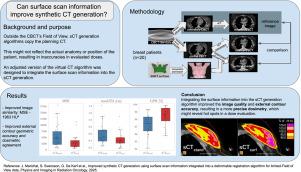
Cone-Beam Computed Tomography (CBCT) based synthetic CT is being increasingly used for post-delivery dose computation or adaptive workflows in radiotherapy. However, the limited Field-of-View of the CBCT can cause inaccuracies when tissues fall outside the Field of View. This study evaluates the integration of surface-guided radiotherapy information to enhance synthetic CT generation for breast cases with missing tissues on CBCT.

Materials and Methods

A retrospective analysis was performed on 20 breast patients. CBCT volumes were acquired on a linac, with simultaneous surface scans from three cameras. A full Field of View CBCT was used to generate a reference synthetic CT. A smaller Field of View CBCT was reconstructed from the same raw data to create two synthetic CTs: a standard synthetic CT and a surface-guided synthetic CT, for which surface scan information was incorporated into the algorithm to guide reconstruction outside the Field of View. We compared the image similarity, external contour geometry, and dose distribution.

Results

The surface-guided synthetic CT showed superior agreement with the reference for nine tested metrics. Specifically, it showed an average Mean Squared Error reduction of 1963 HU2 (p=0.002), revealing hot spots in some cases.

Conclusion

Integrating surface scan information into deformable registration improves synthetic CT generation for CBCT with limited Field of View, yielding more accurate images and enhanced dose distribution precision for breast cases. Future work will explore other sites, and potential applications for adaptive radiotherapy.
Abstract Image

改进合成CT生成方法,将表面扫描信息集成到有限视场数据的可变形配准算法中
背景和目的基于二束计算机断层扫描(CBCT)的合成CT越来越多地用于分娩后剂量计算或放射治疗的自适应工作流程。然而,当组织落在视野之外时,CBCT的有限视野会导致不准确。本研究评估了表面引导放疗信息的整合,以增强乳腺CBCT上组织缺失病例的合成CT生成。材料与方法对20例乳腺癌患者的临床资料进行回顾性分析。CBCT体积是在直线机上获得的,同时由三个相机进行表面扫描。采用全视场CBCT生成参考合成CT。从相同的原始数据重构较小的视场CBCT,创建两个合成CT:标准合成CT和表面引导合成CT,其中表面扫描信息被纳入算法以指导视场外的重建。我们比较了图像相似度、外轮廓几何形状和剂量分布。结果表面引导合成CT在9项指标上与参考文献具有较好的一致性。具体来说,它显示了1963 HU2的平均均方误差降低(p=0.002),揭示了某些情况下的热点。结论将表面扫描信息整合到变形配准中,可提高有限视场CBCT合成CT生成的准确性,提高乳腺病例的剂量分布精度。未来的工作将探索适应性放射治疗的其他地点和潜在应用。
本文章由计算机程序翻译,如有差异,请以英文原文为准。
求助全文
约1分钟内获得全文 求助全文
来源期刊
Physics and Imaging in Radiation Oncology
Physics and Imaging in Radiation Oncology Physics and Astronomy-Radiation
CiteScore
5.30
自引率
18.90%
发文量
93
审稿时长
6 weeks

×
引用
GB/T 7714-2015
复制
MLA
复制
APA
复制
导出至
BibTeX EndNote RefMan NoteFirst NoteExpress
×
提示
您的信息不完整,为了账户安全,请先补充。
现在去补充
×
提示
您因"违规操作"
具体请查看互助需知
我知道了
×
提示
确定
请完成安全验证×
copy
已复制链接
快去分享给好友吧!
我知道了
右上角分享
点击右上角分享
0
联系我们:info@booksci.cn Book学术提供免费学术资源搜索服务,方便国内外学者检索中英文文献。致力于提供最便捷和优质的服务体验。 Copyright © 2023 布克学术 All rights reserved.
京ICP备2023020795号-1
ghs 京公网安备 11010802042870号
Book学术文献互助
Book学术文献互助群
群 号:604180095
Book学术官方微信
小红书


