Intira Sriprasert, Yongmei Huang, Donna Shoupe, Megan L Evans, Xiao Xu, Jason D Wright
{"title":"Initiation and Duration of Systemic Hormone Therapy for Menopausal Symptoms.","authors":"Intira Sriprasert, Yongmei Huang, Donna Shoupe, Megan L Evans, Xiao Xu, Jason D Wright","doi":"10.1097/AOG.0000000000006386","DOIUrl":null,"url":null,"abstract":"<p><strong>Objective: </strong>To examine real-world patterns of systemic hormone therapy (HT) initiation and continuation among women with a diagnosis of menopause.</p><p><strong>Methods: </strong>Using the Merative™ MarketScan® Research Databases (2009-2022), we identified women aged 45-60 years with menopause-related claims and at least 12 months of continuous enrollment. Patients with bilateral oophorectomy, breast or gynecologic cancers, or HT contraindications were excluded. Multivariable regression analyzed factors associated with HT initiation, formulation, and duration.</p><p><strong>Results: </strong>Of 318,621 eligible women, 21.7% initiated systemic HT within 1 year. Predictors of HT initiation included younger age (adjusted odds ratio [aOR] 2.17; 95% CI, 2.12-2.23), prior hysterectomy (aOR 1.98; 95% CI, 1.77-2.21), and local hormone use (aOR 3.25; 95% CI, 3.05-3.47). Initiation was significantly lower among women with obesity (aOR 0.78; 95% CI, 0.75-0.81), diabetes (aOR 0.69; 95% CI, 0.66-0.72), and Black racial identification (aOR 0.78; 95% CI, 0.68-0.89). Initial formulations were estrogen plus progestogen (52.5%), estrogen-alone (32.4%), and progestogen-alone (15.1%). The median first-episode duration was 6.6 months; 38.8% of patients continued at 12 months. Black racial (adjusted hazard ratio [aHR] 1.52; 95% CI, 1.34-1.73) and Hispanic ethnic (aHR 1.43; 95% CI, 1.14-1.80) identities predicted faster discontinuation. Conversely, prior hysterectomy (aHR 0.75; 95% CI, 0.68-0.83) and concurrent local hormone use (aHR 0.84; 95% CI, 0.80-0.89) reduced discontinuation risk.</p><p><strong>Conclusion: </strong>Although one-fifth of women initiated systemic HT shortly after their diagnosis, low persistence and racial disparities among those who initiated reveal critical gaps in long-term menopause management. Furthermore, true real-world utilization is likely even lower due to underdocumentation in clinical coding. These findings underscore an urgent need for targeted, equitable interventions to improve treatment adherence and ensure consistent, comprehensive care for menopausal women.</p>","PeriodicalId":19483,"journal":{"name":"Obstetrics and gynecology","volume":" ","pages":"e318-e328"},"PeriodicalIF":5.1000,"publicationDate":"2026-11-01","publicationTypes":"Journal Article","fieldsOfStudy":null,"isOpenAccess":false,"openAccessPdf":"","citationCount":"0","resultStr":null,"platform":"Semanticscholar","paperid":null,"PeriodicalName":"Obstetrics and gynecology","FirstCategoryId":"3","ListUrlMain":"https://doi.org/10.1097/AOG.0000000000006386","RegionNum":2,"RegionCategory":"医学","ArticlePicture":[],"TitleCN":null,"AbstractTextCN":null,"PMCID":null,"EPubDate":"2026/7/27 0:00:00","PubModel":"Epub","JCR":"Q1","JCRName":"OBSTETRICS & GYNECOLOGY","Score":null,"Total":0}
引用次数: 0
Abstract
Objective: To examine real-world patterns of systemic hormone therapy (HT) initiation and continuation among women with a diagnosis of menopause.
Methods: Using the Merative™ MarketScan® Research Databases (2009-2022), we identified women aged 45-60 years with menopause-related claims and at least 12 months of continuous enrollment. Patients with bilateral oophorectomy, breast or gynecologic cancers, or HT contraindications were excluded. Multivariable regression analyzed factors associated with HT initiation, formulation, and duration.
Results: Of 318,621 eligible women, 21.7% initiated systemic HT within 1 year. Predictors of HT initiation included younger age (adjusted odds ratio [aOR] 2.17; 95% CI, 2.12-2.23), prior hysterectomy (aOR 1.98; 95% CI, 1.77-2.21), and local hormone use (aOR 3.25; 95% CI, 3.05-3.47). Initiation was significantly lower among women with obesity (aOR 0.78; 95% CI, 0.75-0.81), diabetes (aOR 0.69; 95% CI, 0.66-0.72), and Black racial identification (aOR 0.78; 95% CI, 0.68-0.89). Initial formulations were estrogen plus progestogen (52.5%), estrogen-alone (32.4%), and progestogen-alone (15.1%). The median first-episode duration was 6.6 months; 38.8% of patients continued at 12 months. Black racial (adjusted hazard ratio [aHR] 1.52; 95% CI, 1.34-1.73) and Hispanic ethnic (aHR 1.43; 95% CI, 1.14-1.80) identities predicted faster discontinuation. Conversely, prior hysterectomy (aHR 0.75; 95% CI, 0.68-0.83) and concurrent local hormone use (aHR 0.84; 95% CI, 0.80-0.89) reduced discontinuation risk.
Conclusion: Although one-fifth of women initiated systemic HT shortly after their diagnosis, low persistence and racial disparities among those who initiated reveal critical gaps in long-term menopause management. Furthermore, true real-world utilization is likely even lower due to underdocumentation in clinical coding. These findings underscore an urgent need for targeted, equitable interventions to improve treatment adherence and ensure consistent, comprehensive care for menopausal women.
期刊介绍:
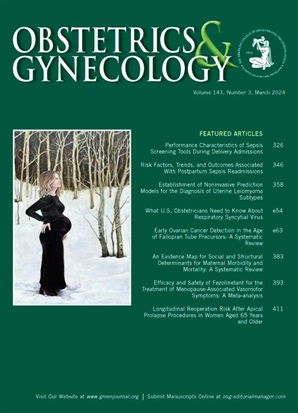
"Obstetrics & Gynecology," affectionately known as "The Green Journal," is the official publication of the American College of Obstetricians and Gynecologists (ACOG). Since its inception in 1953, the journal has been dedicated to advancing the clinical practice of obstetrics and gynecology, as well as related fields. The journal's mission is to promote excellence in these areas by publishing a diverse range of articles that cover translational and clinical topics.
"Obstetrics & Gynecology" provides a platform for the dissemination of evidence-based research, clinical guidelines, and expert opinions that are essential for the continuous improvement of women's health care. The journal's content is designed to inform and educate obstetricians, gynecologists, and other healthcare professionals, ensuring that they stay abreast of the latest developments and best practices in their field.

 求助内容:
 应助结果提醒方式:


 京公网安备 11010802042870号


