
Hybrid Tri-Level Optimal Sizing of Hydrogen Storage for Addressing Long-Term Seasonal Fluctuation of RES

IF 10.3 1区 工程技术 Q1 ENERGY & FUELS
IEEE Transactions on Sustainable Energy Pub Date : 2026-04-01 Epub Date: 2025-08-19 DOI:10.1109/TSTE.2025.3600298
Qianwen Hu;Gengfeng Li;Bingkai Huang;Qiming Yang;Siyuan Sun;Zhaohong Bie;Jianzhong Wu;Yue Zhou;Yiheng Bian
{"title":"Hybrid Tri-Level Optimal Sizing of Hydrogen Storage for Addressing Long-Term Seasonal Fluctuation of RES","authors":"Qianwen Hu;Gengfeng Li;Bingkai Huang;Qiming Yang;Siyuan Sun;Zhaohong Bie;Jianzhong Wu;Yue Zhou;Yiheng Bian","doi":"10.1109/TSTE.2025.3600298","DOIUrl":null,"url":null,"abstract":"Time-varying renewable energy sources (RES), influenced by climate conditions, create seasonal power mismatches. Allocation of hydrogen energy storage (HES) can mitigate long-duration seasonal power mismatch caused by load variation, climate variability and seasonal meteorological conditions. However, one single uncertainty set cannot well consider the characteristics of RES uncertainty in different seasons impacted by long-term climate conditions. To address the above challenges and optimally size and allocate HES in power systems, this paper proposes a hybrid tri-level planning framework that integrates RES interannual long-term and seasonal fluctuation, using a combination of distributionally robust optimization (DRO) and adaptive robust optimization (ARO). Specifically, a RES probability distribution ambiguity set under typical climate conditions is constructed using norm constraints, and data-driven DRO is introduced to address RES long-term uncertainty. RES seasonal uncertainty is then adaptively modelled using multiple uncertainty sets based on the seasonal meteorological characteristics of RES, and ARO is proposed to reformulate the lower-level problem for the worst-case scenarios. The proposed framework is solved using the improved column and constraint generation algorithm (C&CG) with duality-free decomposition. Simulations on IEEE 39-bus system and IEEE 118-bus system confirm the effectiveness of the proposed planning framework and solution algorithm.","PeriodicalId":452,"journal":{"name":"IEEE Transactions on Sustainable Energy","volume":"17 2","pages":"883-896"},"PeriodicalIF":10.3000,"publicationDate":"2026-04-01","publicationTypes":"Journal Article","fieldsOfStudy":null,"isOpenAccess":false,"openAccessPdf":"","citationCount":"0","resultStr":null,"platform":"Semanticscholar","paperid":null,"PeriodicalName":"IEEE Transactions on Sustainable Energy","FirstCategoryId":"5","ListUrlMain":"https://ieeexplore.ieee.org/document/11130456/","RegionNum":1,"RegionCategory":"工程技术","ArticlePicture":[],"TitleCN":null,"AbstractTextCN":null,"PMCID":null,"EPubDate":"2025/8/19 0:00:00","PubModel":"Epub","JCR":"Q1","JCRName":"ENERGY & FUELS","Score":null,"Total":0}
引用次数: 0

Abstract

Time-varying renewable energy sources (RES), influenced by climate conditions, create seasonal power mismatches. Allocation of hydrogen energy storage (HES) can mitigate long-duration seasonal power mismatch caused by load variation, climate variability and seasonal meteorological conditions. However, one single uncertainty set cannot well consider the characteristics of RES uncertainty in different seasons impacted by long-term climate conditions. To address the above challenges and optimally size and allocate HES in power systems, this paper proposes a hybrid tri-level planning framework that integrates RES interannual long-term and seasonal fluctuation, using a combination of distributionally robust optimization (DRO) and adaptive robust optimization (ARO). Specifically, a RES probability distribution ambiguity set under typical climate conditions is constructed using norm constraints, and data-driven DRO is introduced to address RES long-term uncertainty. RES seasonal uncertainty is then adaptively modelled using multiple uncertainty sets based on the seasonal meteorological characteristics of RES, and ARO is proposed to reformulate the lower-level problem for the worst-case scenarios. The proposed framework is solved using the improved column and constraint generation algorithm (C&CG) with duality-free decomposition. Simulations on IEEE 39-bus system and IEEE 118-bus system confirm the effectiveness of the proposed planning framework and solution algorithm.
解决可再生能源长期季节性波动的混合三能级最优储氢规模
时变可再生能源(RES)受气候条件的影响,造成季节性电力失配。氢储能系统的配置可以缓解负荷变化、气候变化和季节性气象条件造成的长时间季节性电力失配。然而,单一不确定性集不能很好地考虑受长期气候条件影响的不同季节RES不确定性特征。为了解决上述挑战并优化电力系统中可再生能源的规模和分配,本文提出了一种混合三层规划框架,该框架结合了分布鲁棒优化(DRO)和自适应鲁棒优化(ARO),集成了可再生能源年际长期波动和季节波动。具体而言,利用范数约束构造典型气候条件下RES概率分布模糊集,并引入数据驱动DRO来解决RES的长期不确定性。基于RES的季节气象特征,利用多个不确定性集自适应建模RES的季节不确定性,并提出ARO来重新表述最坏情况下的低层问题。该框架采用改进的无对偶分解列约束生成算法(C&CG)求解。在IEEE 39总线系统和IEEE 118总线系统上的仿真验证了所提出的规划框架和求解算法的有效性。
本文章由计算机程序翻译,如有差异,请以英文原文为准。
求助全文
约1分钟内获得全文 求助全文
来源期刊
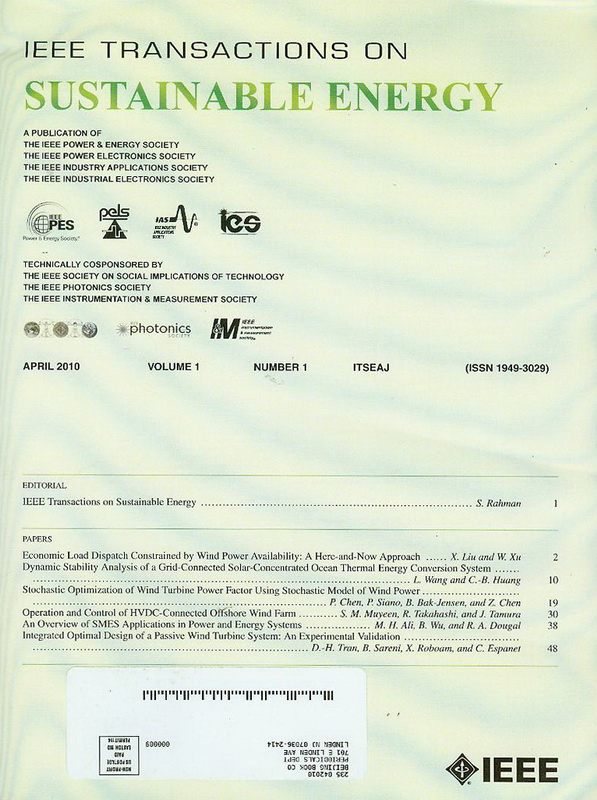
IEEE Transactions on Sustainable Energy
IEEE Transactions on Sustainable Energy ENERGY & FUELS-ENGINEERING, ELECTRICAL & ELECTRONIC
CiteScore
21.40
自引率
5.70%
发文量
215
审稿时长
5 months
期刊介绍: The IEEE Transactions on Sustainable Energy serves as a pivotal platform for sharing groundbreaking research findings on sustainable energy systems, with a focus on their seamless integration into power transmission and/or distribution grids. The journal showcases original research spanning the design, implementation, grid-integration, and control of sustainable energy technologies and systems. Additionally, the Transactions warmly welcomes manuscripts addressing the design, implementation, and evaluation of power systems influenced by sustainable energy systems and devices.

×
引用
GB/T 7714-2015
复制
MLA
复制
APA
复制
导出至
BibTeX EndNote RefMan NoteFirst NoteExpress
×
提示
您的信息不完整,为了账户安全,请先补充。
现在去补充
×
提示
您因"违规操作"
具体请查看互助需知
我知道了
×
提示
确定
请完成安全验证×
copy
已复制链接
快去分享给好友吧!
我知道了
右上角分享
点击右上角分享
0
联系我们:info@booksci.cn Book学术提供免费学术资源搜索服务,方便国内外学者检索中英文文献。致力于提供最便捷和优质的服务体验。 Copyright © 2023 布克学术 All rights reserved.
京ICP备2023020795号-1
ghs 京公网安备 11010802042870号
Book学术文献互助
Book学术文献互助群
群 号:604180095
Book学术官方微信
小红书


