
Charlotte Hadley, Xiubin Zhang, Hilary Stewart, Sophie Stanley, Ces Kulikowski, Andrea Partridge, Laura Wareing, Lisa Ashmore, Christopher Gaffney, Jo Rycroft Malone, Andrew Smith, Cliff Shelton
{"title":"Addressing inequities in the design and delivery of prehabilitation in the UK: case studies of challenges, complexities and good practice*","authors":"Charlotte Hadley, Xiubin Zhang, Hilary Stewart, Sophie Stanley, Ces Kulikowski, Andrea Partridge, Laura Wareing, Lisa Ashmore, Christopher Gaffney, Jo Rycroft Malone, Andrew Smith, Cliff Shelton","doi":"10.1111/anae.70286","DOIUrl":null,"url":null,"abstract":"<div>\n \n \n <section>\n \n <h3> Introduction</h3>\n \n <p>Prehabilitation has become increasingly prominent in the context of cancer surgery. While prehabilitation offers significant benefits, it can also inadvertently broaden inequalities because it is often more accessible to some than others. To explore the connection between health inequalities and prehabilitation before cancer surgery, we designed a qualitative study based on case study methodology.</p>\n </section>\n \n <section>\n \n <h3> Methods</h3>\n \n <p>Diverse prehabilitation services were purposively sampled. We conducted orientation interviews with service leads; semi-structured interviews with professionals, patients and carers; and observations of prehabilitation practice. These were conducted following topic guides informed by implementation science theory. We employed an inductive thematic approach to allow themes to emerge, highlighting connections between prehabilitation and health inequalities.</p>\n </section>\n \n <section>\n \n <h3> Results</h3>\n \n <p>Six prehabilitation services across England and Wales were included, comprising a combination of established and new services, urban and semi-rural settings and varied healthcare delivery models. We conducted 47 interviews with professionals, 47 interviews with patients (including eight with carers) and 28 observations of practice. We developed six themes, which illuminated how: patients' circumstances influence their ability to engage; the value of prehabilitation to patients depends on how it is introduced and understood; services can address, but also exacerbate, health inequalities; services may offer more and/or less than the prototypical prehabilitation model; services use and develop an incomplete evidence base; and services work with limited resources to provide the most benefit.</p>\n </section>\n \n <section>\n \n <h3> Discussion</h3>\n \n <p>Our findings highlight that while prehabilitation is often presented as a simple concept in the literature, in practice it is a complex intervention that must integrate with other ongoing treatments (e.g. surgery, chemotherapy, radiotherapy) during an already challenging period in patients' lives. Our qualitative findings from real-world settings illustrate how and why disparities arise in practice and offer insights for more equitable prehabilitation.</p>\n </section>\n </div>","PeriodicalId":7742,"journal":{"name":"Anaesthesia","volume":"81 11","pages":"1510-1525"},"PeriodicalIF":7.4000,"publicationDate":"2026-10-13","publicationTypes":"Journal Article","fieldsOfStudy":null,"isOpenAccess":false,"openAccessPdf":"https://onlinelibrary.wiley.com/doi/epdf/10.1111/anae.70286","citationCount":"0","resultStr":null,"platform":"Semanticscholar","paperid":null,"PeriodicalName":"Anaesthesia","FirstCategoryId":"3","ListUrlMain":"https://onlinelibrary.wiley.com/doi/10.1111/anae.70286","RegionNum":1,"RegionCategory":"医学","ArticlePicture":[],"TitleCN":null,"AbstractTextCN":null,"PMCID":null,"EPubDate":"2026/7/20 0:00:00","PubModel":"Epub","JCR":"Q1","JCRName":"ANESTHESIOLOGY","Score":null,"Total":0}
引用次数: 0
Abstract
Introduction
Prehabilitation has become increasingly prominent in the context of cancer surgery. While prehabilitation offers significant benefits, it can also inadvertently broaden inequalities because it is often more accessible to some than others. To explore the connection between health inequalities and prehabilitation before cancer surgery, we designed a qualitative study based on case study methodology.
Methods
Diverse prehabilitation services were purposively sampled. We conducted orientation interviews with service leads; semi-structured interviews with professionals, patients and carers; and observations of prehabilitation practice. These were conducted following topic guides informed by implementation science theory. We employed an inductive thematic approach to allow themes to emerge, highlighting connections between prehabilitation and health inequalities.
Results
Six prehabilitation services across England and Wales were included, comprising a combination of established and new services, urban and semi-rural settings and varied healthcare delivery models. We conducted 47 interviews with professionals, 47 interviews with patients (including eight with carers) and 28 observations of practice. We developed six themes, which illuminated how: patients' circumstances influence their ability to engage; the value of prehabilitation to patients depends on how it is introduced and understood; services can address, but also exacerbate, health inequalities; services may offer more and/or less than the prototypical prehabilitation model; services use and develop an incomplete evidence base; and services work with limited resources to provide the most benefit.
Discussion
Our findings highlight that while prehabilitation is often presented as a simple concept in the literature, in practice it is a complex intervention that must integrate with other ongoing treatments (e.g. surgery, chemotherapy, radiotherapy) during an already challenging period in patients' lives. Our qualitative findings from real-world settings illustrate how and why disparities arise in practice and offer insights for more equitable prehabilitation.
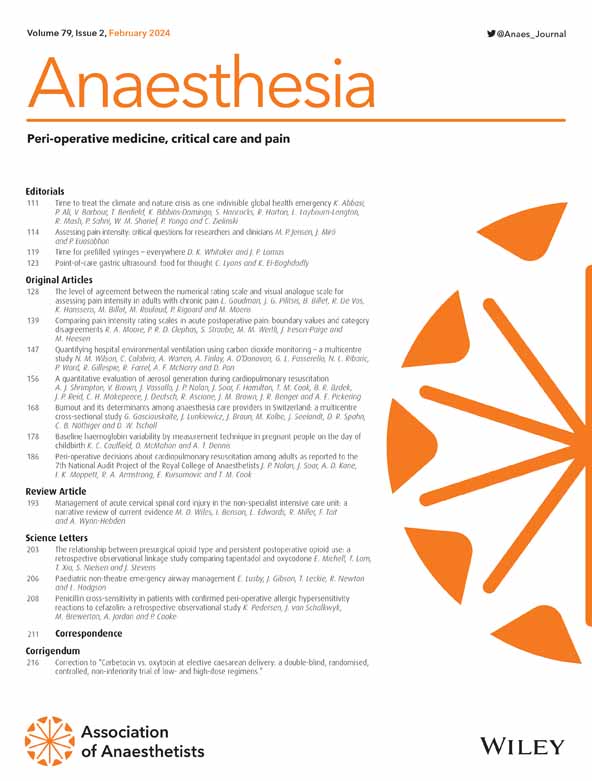
期刊介绍:
The official journal of the Association of Anaesthetists is Anaesthesia. It is a comprehensive international publication that covers a wide range of topics. The journal focuses on general and regional anaesthesia, as well as intensive care and pain therapy. It includes original articles that have undergone peer review, covering all aspects of these fields, including research on equipment.



