
Development of a cost-effective end-to-end commissioning test for simulation-omitted direct-to-unit adaptive radiotherapy
IF 3.2
Q2 ONCOLOGY
Physics and Imaging in Radiation Oncology
Pub Date : 2026-07-01
Epub Date: 2026-06-26
DOI:10.1016/j.phro.2026.101028
引用次数: 0
Abstract
Background and Purpose
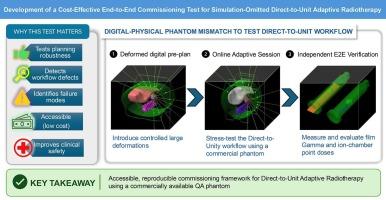
Direct-to-Unit (simulation-omitted) adaptive radiotherapy (ART) enables same-day treatment by generating treatment plans from diagnostic images, eliminating the need for computed tomography (CT) simulation. These workflows rely on online plan re-optimization to account for anatomical, CT-number, and setup variations. However, no standardized end-to-end (E2E) credentialing protocol currently exists to validate the accuracy of Direct-to-Unit ART. Although customized ART phantoms are available, they are often costly, and impractical for one-time commissioning. To address this gap, we developed a low-cost E2E commissioning framework using a commercially available CIRS ZEUS phantom to verify workflow accuracy while minimizing financial burden.
Materials and Methods
E2E commissioning tests were performed on Varian Ethos and Elekta Unity systems using a CIRS ZEUS phantom (Model 008Z) equipped with inserts for ionization chamber point-dose and planar film measurements. The ionization chamber and Gafchromic EBT4 films were independently cross-calibrated on an Elekta Versa linear accelerator. Pseudo–diagnostic CT datasets were generated and deformed to simulate anatomical variation. Pre-plans (2 Gy × 30 fractions) were created and delivered across three ART fractionation schemes. Point-dose measurements were compared with system-reported values, and planar dose distributions were evaluated using global gamma analysis.
Results
All point-dose differences were within 3% (for high-dose regions) or 3 cGy (for low-dose regions) of the system-reported values. All planar film measurements achieved gamma pass rates exceeding 90% using 3%/3 mm criterion.
Conclusion
This cost-effective E2E approach provides a practical commissioning solution for Direct-to-Unit ART, supporting safe clinical implementation and facilitating cross-institutional standardization.
开发一种具有成本效益的端到端调试测试,用于模拟省略的直接对单元自适应放疗
背景和目的直接对单元(模拟省略)适应性放射治疗(ART)通过从诊断图像生成治疗计划实现当日治疗,消除了计算机断层扫描(CT)模拟的需要。这些工作流程依赖于在线计划重新优化,以解释解剖结构、ct编号和设置变化。然而,目前还没有标准化的端到端(E2E)认证协议来验证直接到单位抗逆转录病毒治疗的准确性。虽然定制的ART幻影是可用的,但它们通常是昂贵的,并且不适合一次性调试。为了解决这一差距,我们开发了一个低成本的端到端调试框架,使用市售的CIRS ZEUS模型来验证工作流程的准确性,同时最大限度地减少经济负担。材料和方法在Varian Ethos和Elekta Unity系统上进行了se2e调试测试,使用了配备电离室点剂量和平面膜测量插件的CIRS ZEUS幻影(型号008Z)。在Elekta Versa直线加速器上对电离室和Gafchromic EBT4薄膜进行了独立的交叉校准。生成并变形伪诊断CT数据集以模拟解剖变化。预先计划(2 Gy × 30馏分)被创建并通过三个ART分馏方案交付。将点剂量测量值与系统报告值进行比较,并使用全局伽玛分析评估平面剂量分布。结果所有点剂量差异均在系统报告值的3%(高剂量区)或3cgy(低剂量区)以内。使用3%/ 3mm标准,所有平面薄膜测量的伽马通过率均超过90%。结论该方法为直接到单位的ART提供了实用的调试解决方案,支持临床安全实施,促进跨机构标准化。
本文章由计算机程序翻译,如有差异,请以英文原文为准。
求助全文
约1分钟内获得全文
求助全文
来源期刊
Physics and Imaging in Radiation Oncology
Physics and Astronomy-Radiation
CiteScore
5.30
自引率
18.90%
发文量
93
审稿时长
6 weeks
 求助内容:
求助内容: 应助结果提醒方式:

 京公网安备 11010802042870号


