
BMI Normalization Is Associated With Lower Risk of Progression to Type 1 Diabetes, Primarily in Youth
IF 22.6
1区 医学
Q1 ENDOCRINOLOGY & METABOLISM
引用次数: 0
Abstract
OBJECTIVE Elevated BMI is associated with increased risk of progression to stage 3 type 1 diabetes (T1D). We tested whether normalization of BMI is associated with lower stage 3 risk among autoantibody-positive individuals with overweight or obesity. RESEARCH DESIGN AND METHODS We studied 833 autoantibody-positive participants in the TrialNet Pathway to Prevention study with overweight or obesity at baseline. Cumulative incidence of stage 3 T1D was evaluated using Cox proportional hazards models. Reported P values were adjusted for baseline age, BMI z score, and T1D stage, unless otherwise noted. RESULTS During follow-up, BMI normalized in 26.8% of participants and was associated with a lower risk of progression to stage 3 T1D (hazard ratio 0.516, P < 0.001) over a median follow-up time of 4.1 years. This association was primarily observed in youth (n = 421, hazard ratio 0.497, P = 0.001), including boys <12 years old (n = 140, P < 0.001) and girls ≥12 years old (n = 73, P = 0.043), but not in adults (n = 412, P = 0.130). BMI normalization was also associated with a lower risk of transition from stage 1 to stage 2 and from stage 2 to stage 3, but not clearly from stage 0 to stage 1 (P = 0.010, P = 0.003, and P = 0.051, respectively, adjusted for baseline age and BMI z score). In exploratory models, adjustment for insulin sensitivity/resistance indices or oral disposition index weakened the association between BMI normalization and lower progression risk, whereas adjustment for insulin secretion, glycemia-adjusted C-peptide, or progression-risk indices generally strengthened it. CONCLUSIONS Among autoantibody-positive individuals with overweight or obesity, BMI normalization was associated with a 48.4% lower risk of clinical T1D, primarily in youth.BMI正常化与1型糖尿病进展风险降低相关,主要发生在年轻人身上
BMI升高与进展为3期1型糖尿病(T1D)的风险增加相关。我们测试了自身抗体阳性的超重或肥胖个体中BMI的正常化是否与较低的3期风险相关。研究设计和方法我们在TrialNet预防途径研究中研究了833名自身抗体阳性的参与者,他们在基线时超重或肥胖。采用Cox比例风险模型评估3期T1D的累积发病率。报告的P值根据基线年龄、BMI z评分和T1D分期进行调整,除非另有说明。结果在随访期间,26.8%的参与者BMI恢复正常,并且在4.1年的中位随访时间内,与进展为3期T1D的风险降低相关(风险比0.516,P < 0.001)。这种关联主要在年轻人中观察到(n = 421,风险比0.497,P = 0.001),包括男孩&;12岁(n = 140, P < 0.001)和≥12岁的女孩(n = 73, P = 0.043),但成人中没有(n = 412, P = 0.130)。BMI正常化也与从1期到2期和从2期到3期的较低风险相关,但从0期到1期的风险不明显(P = 0.010, P = 0.003和P = 0.051,分别根据基线年龄和BMI z评分进行调整)。在探索性模型中,调整胰岛素敏感性/抵抗指数或口腔倾向指数削弱了BMI正常化与较低进展风险之间的关联,而调整胰岛素分泌、血糖调节c肽或进展风险指数通常加强了这种关联。结论:在自身抗体阳性的超重或肥胖个体中,BMI正常化与临床T1D风险降低48.4%相关,主要发生在年轻人中。
本文章由计算机程序翻译,如有差异,请以英文原文为准。
求助全文
约1分钟内获得全文
求助全文
来源期刊
Diabetes Care
医学-内分泌学与代谢
CiteScore
27.80
自引率
4.90%
发文量
449
审稿时长
1 months
期刊介绍:
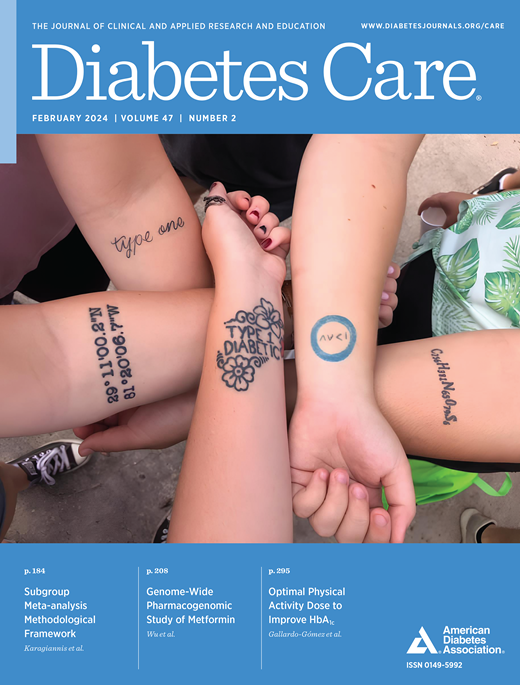
The journal's overarching mission can be captured by the simple word "Care," reflecting its commitment to enhancing patient well-being. Diabetes Care aims to support better patient care by addressing the comprehensive needs of healthcare professionals dedicated to managing diabetes.
Diabetes Care serves as a valuable resource for healthcare practitioners, aiming to advance knowledge, foster research, and improve diabetes management. The journal publishes original research across various categories, including Clinical Care, Education, Nutrition, Psychosocial Research, Epidemiology, Health Services Research, Emerging Treatments and Technologies, Pathophysiology, Complications, and Cardiovascular and Metabolic Risk. Additionally, Diabetes Care features ADA statements, consensus reports, review articles, letters to the editor, and health/medical news, appealing to a diverse audience of physicians, researchers, psychologists, educators, and other healthcare professionals.
 求助内容:
 应助结果提醒方式:


 京公网安备 11010802042870号


