I. A. Panteleev, A. A. Baryakh, D. V. Lozhkin, A. S. Sokolov
{"title":"Influence of Fracturing on the Elastic Properties of Sylvinite: Comparison of Effective Media Theory Methods Based on X-ray Computed Microtomography","authors":"I. A. Panteleev, A. A. Baryakh, D. V. Lozhkin, A. S. Sokolov","doi":"10.1134/S1069351326700485","DOIUrl":null,"url":null,"abstract":"<p>Comparison of several effective medium theory methods was performed to describe the degradation of the elastic moduli of red sylvinite samples subjected to cyclic uniaxial compression with an increase in maximum load after each cycle. The predicted values of the Young’s modulus of red sylvinite after each loading cycle were determined using X-ray computed microtomography (CT data). The dependence of the deformation characteristics of red sylvinite on the maximum load in a cycle was experimentally determined. At loads up to 10 MPa, the tangent modulus of deformation changes insignificantly (≤10%); after a cycle with a load of 20 MPa, its significant degradation is observed, on average, by 32%. Analysis of CT data for sylvinite samples showed that microcrack formation begins in sylvinite conglomerates and at the boundaries with halite, and with increasing load, it spreads to halite conglomerates. It was found that the change in the tangent modulus of deformation of sylvinite linearly correlates with the volume fraction of microcracks. Two methods are proposed for estimating microcrack density from CT data: based on their maximum size and based on the radius of penny-shaped cracks of equivalent volume and lateral surface area. To describe the dependence of the effective Young’s modulus on the maximum load in a cycle, the following methods of effective medium theory were tested: the Mori–Tanaka method, the differential effective medium method, and the self-consistency method. It was established that the differential effective medium method and the self-consistency method with the crack density assessment by the first method give underestimated values of the average effective normalized Young’s modulus, starting from moderate loads, while the Mori–Tanaka method gives overestimated values. It is shown that the self-consistent method using the equivalent penny-shaped crack model to estimate the crack density gives acceptable results for predicting the effective Young’s modulus at a microcrack density of up to 0.5.</p>","PeriodicalId":602,"journal":{"name":"Izvestiya, Physics of the Solid Earth","volume":"62 3","pages":"603 - 613"},"PeriodicalIF":0.7000,"publicationDate":"2026-07-17","publicationTypes":"Journal Article","fieldsOfStudy":null,"isOpenAccess":false,"openAccessPdf":"","citationCount":"0","resultStr":null,"platform":"Semanticscholar","paperid":null,"PeriodicalName":"Izvestiya, Physics of the Solid Earth","FirstCategoryId":"89","ListUrlMain":"https://link.springer.com/article/10.1134/S1069351326700485","RegionNum":4,"RegionCategory":"地球科学","ArticlePicture":[],"TitleCN":null,"AbstractTextCN":null,"PMCID":null,"EPubDate":"","PubModel":"","JCR":"Q4","JCRName":"GEOCHEMISTRY & GEOPHYSICS","Score":null,"Total":0}
引用次数: 0
Abstract
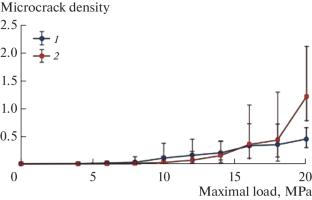
Comparison of several effective medium theory methods was performed to describe the degradation of the elastic moduli of red sylvinite samples subjected to cyclic uniaxial compression with an increase in maximum load after each cycle. The predicted values of the Young’s modulus of red sylvinite after each loading cycle were determined using X-ray computed microtomography (CT data). The dependence of the deformation characteristics of red sylvinite on the maximum load in a cycle was experimentally determined. At loads up to 10 MPa, the tangent modulus of deformation changes insignificantly (≤10%); after a cycle with a load of 20 MPa, its significant degradation is observed, on average, by 32%. Analysis of CT data for sylvinite samples showed that microcrack formation begins in sylvinite conglomerates and at the boundaries with halite, and with increasing load, it spreads to halite conglomerates. It was found that the change in the tangent modulus of deformation of sylvinite linearly correlates with the volume fraction of microcracks. Two methods are proposed for estimating microcrack density from CT data: based on their maximum size and based on the radius of penny-shaped cracks of equivalent volume and lateral surface area. To describe the dependence of the effective Young’s modulus on the maximum load in a cycle, the following methods of effective medium theory were tested: the Mori–Tanaka method, the differential effective medium method, and the self-consistency method. It was established that the differential effective medium method and the self-consistency method with the crack density assessment by the first method give underestimated values of the average effective normalized Young’s modulus, starting from moderate loads, while the Mori–Tanaka method gives overestimated values. It is shown that the self-consistent method using the equivalent penny-shaped crack model to estimate the crack density gives acceptable results for predicting the effective Young’s modulus at a microcrack density of up to 0.5.
期刊介绍:
Izvestiya, Physics of the Solid Earth is an international peer reviewed journal that publishes results of original theoretical and experimental research in relevant areas of the physics of the Earth''s interior and applied geophysics. The journal welcomes manuscripts from all countries in the English or Russian language.

 求助内容:
求助内容: 应助结果提醒方式:

 京公网安备 11010802042870号


