D. A. Alekseev, E. I. Balikhin, A. A. Goncharov, A. Yu. Gunar, N. I. Ignatyev, A. V. Koshurnikov, P. Yu. Pushkarev
{"title":"Time-Domain Electromagnetic Sounding in Arctic Water Areas","authors":"D. A. Alekseev, E. I. Balikhin, A. A. Goncharov, A. Yu. Gunar, N. I. Ignatyev, A. V. Koshurnikov, P. Yu. Pushkarev","doi":"10.1134/S1069351326700461","DOIUrl":null,"url":null,"abstract":"<p>The time-domain electromagnetic (TDEM) sounding method is effectively used in shallow marine waters all over the world, including the Arctic shelf, where the main object of study is the permafrost layer. A generalized geoelectric model of the Arctic shelf section is presented, which is based on the results of studies conducted by the authors, using archival information from available sources, and contains three main layers: unfrozen bottom sedimentary layer, permafrost layer and subpermafrost layer. Algorithms for solving direct and inverse problems of TDEM are briefly described, including those using the polarization properties of the layers. Typical curves of apparent electrical resistance of TDEM (TDEM curves) are constructed, corresponding to geoelectric models of Arctic waters for three zones: the open sea, the transition zone, and the river mouth. The curves qualitatively reflect the dependence of resistance on depth, except for the case of the most highly resistive section containing a polarizing layer, when the curve is strongly distorted. A series of model experiments were carried out to solve the inverse problem within the framework of a five-layer model. It was shown that when obtaining possible equivalent models that differ from the true one (created by the authors using known parameters), their number can be reduced by fixing the parameters of the water layer, thereby improving the modeling results. The effects associated with the polarizability of the subpermafrost layer, which significantly complicate interpretation, but quickly fade with an increase in the thickness of the seawater layer, were analyzed.</p>","PeriodicalId":602,"journal":{"name":"Izvestiya, Physics of the Solid Earth","volume":"62 3","pages":"580 - 588"},"PeriodicalIF":0.7000,"publicationDate":"2026-07-17","publicationTypes":"Journal Article","fieldsOfStudy":null,"isOpenAccess":false,"openAccessPdf":"","citationCount":"0","resultStr":null,"platform":"Semanticscholar","paperid":null,"PeriodicalName":"Izvestiya, Physics of the Solid Earth","FirstCategoryId":"89","ListUrlMain":"https://link.springer.com/article/10.1134/S1069351326700461","RegionNum":4,"RegionCategory":"地球科学","ArticlePicture":[],"TitleCN":null,"AbstractTextCN":null,"PMCID":null,"EPubDate":"","PubModel":"","JCR":"Q4","JCRName":"GEOCHEMISTRY & GEOPHYSICS","Score":null,"Total":0}
引用次数: 0
Abstract
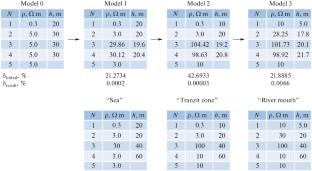
The time-domain electromagnetic (TDEM) sounding method is effectively used in shallow marine waters all over the world, including the Arctic shelf, where the main object of study is the permafrost layer. A generalized geoelectric model of the Arctic shelf section is presented, which is based on the results of studies conducted by the authors, using archival information from available sources, and contains three main layers: unfrozen bottom sedimentary layer, permafrost layer and subpermafrost layer. Algorithms for solving direct and inverse problems of TDEM are briefly described, including those using the polarization properties of the layers. Typical curves of apparent electrical resistance of TDEM (TDEM curves) are constructed, corresponding to geoelectric models of Arctic waters for three zones: the open sea, the transition zone, and the river mouth. The curves qualitatively reflect the dependence of resistance on depth, except for the case of the most highly resistive section containing a polarizing layer, when the curve is strongly distorted. A series of model experiments were carried out to solve the inverse problem within the framework of a five-layer model. It was shown that when obtaining possible equivalent models that differ from the true one (created by the authors using known parameters), their number can be reduced by fixing the parameters of the water layer, thereby improving the modeling results. The effects associated with the polarizability of the subpermafrost layer, which significantly complicate interpretation, but quickly fade with an increase in the thickness of the seawater layer, were analyzed.
期刊介绍:
Izvestiya, Physics of the Solid Earth is an international peer reviewed journal that publishes results of original theoretical and experimental research in relevant areas of the physics of the Earth''s interior and applied geophysics. The journal welcomes manuscripts from all countries in the English or Russian language.

 求助内容:
求助内容: 应助结果提醒方式:

 京公网安备 11010802042870号


