A. A. Ostapchuk, I. I. Nugmanov, K. G. Morozova, O. V. Bergal-Kuvikas
{"title":"Seismogenic Spots in the Kamchatka Subduction Zone: Geological and Geophysical Perspective","authors":"A. A. Ostapchuk, I. I. Nugmanov, K. G. Morozova, O. V. Bergal-Kuvikas","doi":"10.1134/S1069351326700394","DOIUrl":null,"url":null,"abstract":"<p>The evolution of tectonic faults and localization of strong earthquake sources are controlled by the configuration and rheological properties of tectonic asperities. Seismogenic spots are a seismic manifestation of tectonic asperities and can be identified on the basis of spatiotemporal analysis of seismicity, namely, they represent topologically dense spatial groups of background seismicity. This study investigates the seismicity patterns of the Kamchatka Subduction Zone (KSZ), where the oceanic Pacific Plate subducts beneath the continental Okhotsk Plate along the Kamchatka Peninsula. We used the regional seismic catalog from the Kamchatka Branch, Geophysical Survey, Russian Academy of Sciences, which includes 38 886 events recorded from January 1, 1990, to September 14, 2025. The magnitude of completeness (<i>M</i><sub>c</sub>) for the catalog is 3.0. Seven seismogenic spots, with characteristic sizes ranging from 150 to 250 km, are identified within the KSZ. The structuring of these spots is shown to persist throughout the entire 35-year observation period. The boundaries of the seismogenic spots are consistent with the structural features of the subducting Pacific plate. Within these seismogenic spots, 18 out of 23 epicenters of earthquakes with magnitudes greater than 7 that have occurred in the region since 1900 are localized. The source structure of the strongest Kamchatka megaearthquake <i>M</i><sub>w</sub> 8.8 on July 29, 2025, which reflects the configuration of tectonic asperities, is in full agreement with the configuration of the KSZ seismogenic spots.</p>","PeriodicalId":602,"journal":{"name":"Izvestiya, Physics of the Solid Earth","volume":"62 3","pages":"399 - 413"},"PeriodicalIF":0.7000,"publicationDate":"2026-07-17","publicationTypes":"Journal Article","fieldsOfStudy":null,"isOpenAccess":false,"openAccessPdf":"","citationCount":"0","resultStr":null,"platform":"Semanticscholar","paperid":null,"PeriodicalName":"Izvestiya, Physics of the Solid Earth","FirstCategoryId":"89","ListUrlMain":"https://link.springer.com/article/10.1134/S1069351326700394","RegionNum":4,"RegionCategory":"地球科学","ArticlePicture":[],"TitleCN":null,"AbstractTextCN":null,"PMCID":null,"EPubDate":"","PubModel":"","JCR":"Q4","JCRName":"GEOCHEMISTRY & GEOPHYSICS","Score":null,"Total":0}
引用次数: 0
Abstract
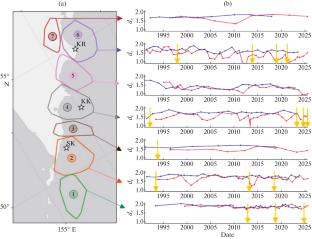
The evolution of tectonic faults and localization of strong earthquake sources are controlled by the configuration and rheological properties of tectonic asperities. Seismogenic spots are a seismic manifestation of tectonic asperities and can be identified on the basis of spatiotemporal analysis of seismicity, namely, they represent topologically dense spatial groups of background seismicity. This study investigates the seismicity patterns of the Kamchatka Subduction Zone (KSZ), where the oceanic Pacific Plate subducts beneath the continental Okhotsk Plate along the Kamchatka Peninsula. We used the regional seismic catalog from the Kamchatka Branch, Geophysical Survey, Russian Academy of Sciences, which includes 38 886 events recorded from January 1, 1990, to September 14, 2025. The magnitude of completeness (Mc) for the catalog is 3.0. Seven seismogenic spots, with characteristic sizes ranging from 150 to 250 km, are identified within the KSZ. The structuring of these spots is shown to persist throughout the entire 35-year observation period. The boundaries of the seismogenic spots are consistent with the structural features of the subducting Pacific plate. Within these seismogenic spots, 18 out of 23 epicenters of earthquakes with magnitudes greater than 7 that have occurred in the region since 1900 are localized. The source structure of the strongest Kamchatka megaearthquake Mw 8.8 on July 29, 2025, which reflects the configuration of tectonic asperities, is in full agreement with the configuration of the KSZ seismogenic spots.
期刊介绍:
Izvestiya, Physics of the Solid Earth is an international peer reviewed journal that publishes results of original theoretical and experimental research in relevant areas of the physics of the Earth''s interior and applied geophysics. The journal welcomes manuscripts from all countries in the English or Russian language.

 求助内容:
求助内容: 应助结果提醒方式:

 京公网安备 11010802042870号


