{"title":"DNA Sequencing by the Ionic Blockade Currents Method","authors":"F. V. Gasparyan, L. F. Gasparyan, V. V. Simonyan","doi":"10.1134/S1068337226700350","DOIUrl":null,"url":null,"abstract":"<p>The solid-state nanopore probing technology can be useful for identifying the sequence of biological polymers. In nanopore experiments, the useful signal measured is the ionic current that passes through a nanopore while it is blocked nucleotides of a DNA molecule. The correlation between ionic blockade current passing through the nanopore, the geometric configuration of the pore, and the DNA sequence is the challenge addressed in this publication. The ionic blockade current was calculated and its histogram was constructed. An analysis of the effect of the nanopore size on the ionic blockade current was carried out. A detailed analysis of the dynamics of a DNA molecule in aqueous solution under the action of gravity, electrophoretic force and drag force is carried out. Analytical dependencies of the translocation rate of a DNA molecule through a nanopore on molecule’s approach time to the nanopore, and on the applied voltage are obtained and analyzed. Numerical calculations were performed for dsDNA. Cases of coincidence and vice versa of the direction of the applied electric field with gravity are considered. For the case where the electrophoretic force is directed opposite to gravity, DNA movement slows down and the translocation rate decreases. Recommendations are provided for increasing the accuracy of reading DNA molecules. Reducing the time it takes for DNA to approach the pore can reduce the translocation rate to hundreds and thousands of nm/s. When interpreting the dynamics of the DNA molecule in aqueous solution, a new effect is introduced, which we call the “proton seduction effect”.</p>","PeriodicalId":623,"journal":{"name":"Journal of Contemporary Physics (Armenian Academy of Sciences)","volume":"61 1","pages":"112 - 121"},"PeriodicalIF":0.5000,"publicationDate":"2026-07-08","publicationTypes":"Journal Article","fieldsOfStudy":null,"isOpenAccess":false,"openAccessPdf":"","citationCount":"0","resultStr":null,"platform":"Semanticscholar","paperid":null,"PeriodicalName":"Journal of Contemporary Physics (Armenian Academy of Sciences)","FirstCategoryId":"101","ListUrlMain":"https://link.springer.com/article/10.1134/S1068337226700350","RegionNum":4,"RegionCategory":"物理与天体物理","ArticlePicture":[],"TitleCN":null,"AbstractTextCN":null,"PMCID":null,"EPubDate":"","PubModel":"","JCR":"Q4","JCRName":"PHYSICS, MULTIDISCIPLINARY","Score":null,"Total":0}
引用次数: 0
Abstract
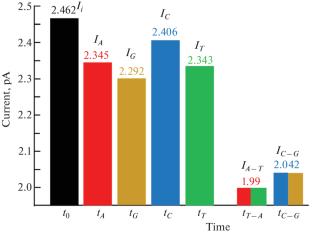
The solid-state nanopore probing technology can be useful for identifying the sequence of biological polymers. In nanopore experiments, the useful signal measured is the ionic current that passes through a nanopore while it is blocked nucleotides of a DNA molecule. The correlation between ionic blockade current passing through the nanopore, the geometric configuration of the pore, and the DNA sequence is the challenge addressed in this publication. The ionic blockade current was calculated and its histogram was constructed. An analysis of the effect of the nanopore size on the ionic blockade current was carried out. A detailed analysis of the dynamics of a DNA molecule in aqueous solution under the action of gravity, electrophoretic force and drag force is carried out. Analytical dependencies of the translocation rate of a DNA molecule through a nanopore on molecule’s approach time to the nanopore, and on the applied voltage are obtained and analyzed. Numerical calculations were performed for dsDNA. Cases of coincidence and vice versa of the direction of the applied electric field with gravity are considered. For the case where the electrophoretic force is directed opposite to gravity, DNA movement slows down and the translocation rate decreases. Recommendations are provided for increasing the accuracy of reading DNA molecules. Reducing the time it takes for DNA to approach the pore can reduce the translocation rate to hundreds and thousands of nm/s. When interpreting the dynamics of the DNA molecule in aqueous solution, a new effect is introduced, which we call the “proton seduction effect”.
期刊介绍:
Journal of Contemporary Physics (Armenian Academy of Sciences) is a journal that covers all fields of modern physics. It publishes significant contributions in such areas of theoretical and applied science as interaction of elementary particles at superhigh energies, elementary particle physics, charged particle interactions with matter, physics of semiconductors and semiconductor devices, physics of condensed matter, radiophysics and radioelectronics, optics and quantum electronics, quantum size effects, nanophysics, sensorics, and superconductivity.

 求助内容:
求助内容: 应助结果提醒方式:

 京公网安备 11010802042870号


